Showing posts with label 2D6 wargames. Show all posts

Sunday, 20 September 2020

Meanwhile back in the Dark Ages - Mercia 798AD

Its been a while since I last returned to the Dark Ages campaign. It's the downside of a solo campaign, my opponent tends not to pester me if I side-line things for a while!  In case you had forgotten the last post was >here<.  Wessex was feeling feisty and the Witan approved a plan to to test Mercian resolve by attacking Hwicce, a Mercian province across the Thames from Wilsaetan.  King Beorhtric considered that Mercia would be in flux following the death of Offa and that they would struggle to gather a large force to defend against his incursion.  He was wrong.  A few miles beyond the Thames he finds himself facing a significant Mercian army commanded by this years Mercian King Coenwulf (they tend to change quite rapidly post Offa, I blame the Danes).  This is a significant moment  as its the first time two Kings have faced each other across the battlefield in this campaign.  Both have brought a significant amount pf their manpower to bear and a serious defeat here will have a significant effect on troop numbers along the Thames Valley and for the Mercians the Welsh Borders for the next few years.

The forces are will be drawn up on the new "Acme Table Topper of Tactical Ineptitude" (TM pending) aka my new wargames table in 4 x 4 configuration.  The game is being played on a larger than normal area as the armies are BBDBA sized and "I have a table and I'm gonna use it" mode has been engaged.  The layout was experimental and didn't use the DBA terrain rules as I wanted the table’s first run out to look pretty!  The fields are just cosmetic and have no terrain effect the only 'true' terrain consists of a village, two hills (one gentle and one steep), the river, two woods and an area of boggy ground.  The village buildings are all from 2D6 miniatures and everything else is scratch built.

The Battlefield

Wessex has brought the men of Wilsaetan, Bearruc Scir, Hamptun Scir, Dorsaete and Sumersaetan almost their entire strength is here.  Facing them are men from Hwicce, Maegonsaetan, Tomsaetan, Wrocensaetan and Hendrica.  Which may make more sense if you check out the campaign master map at  https://elenderilsblog.blogspot.com/2020/05/the-dark-ages-campaign-some-background.html 

I will be using the Solo DBA amendments to run the Mercians, so tonight's job is to determine their deployment and tactical stance.  The West Saxons are already deployed in three bodies which is done before seeing the AI controlled force so as not to gain any unfair advantage.  I'm calling the other side the  AI but it is all done on dice and charts although it's not impossible that the dice may well be tactically smarter than I am.

More in a short while.

Monday, 8 June 2020

The Dark Ages Campaign 798 AD - Border disputes in Pictia

Fearing the growing  power of the Pictish Kingdom Riderch King of Strathclyde has determined on a show of force.  The target is the region of Menteith to the immediate North West of Strat Clut and an important link between Pict and Scot's-Irish lands.  Riderch gathers all his might at Cambuslang and heads North.  He is met close to Mucetauc (Modern Mugdock in Sterlingshire) by a force lead by the Mormaer of Menteith supported by the men of  Fib and Strath Erin.  This is close by the site of an actual real world battle between Strathclyde and the Picts a century earlier.

I diced for sides and the Picts fell to be managed by the solo rules.  These determined that they would be formed up in five groups (the DBA solo rules require groups of no more than four elements and cavalry to be in two groups which means that the first turn for the AI is usually sorting the groups out to a more sensible arrangement I think I want to change this).  The Pictish spearmen (3Pk) were two elements deep in two groups on a crestline in the centre.  Cavalry and Light Horse on their right and Light Infantry on the left.  The plan was for the spearmen to push forwards with the horse and light Infantry protecting the flanks of the spearmen.

The initial deployment.  Picts are furthest away 
On my side after the Pictish defenders had deployed I placed my Spearmen in two lines in the centre with a frontline wide enough to overlap the Pictish spearmen on both ends of their line and as far forwards as possible.  All my cavalry bar one element on my left facing the Pictish horsemen and all the Light Infantry along with the remaining cavalry element on my right.  My plan was to engage the two flank groups and hold them back while dealing with the main Pictish threat in the centre.

You know what they say about plans though!

The overall tactical stance of the Picts was aggressive which to be fair to the solo rules seemed right given the situation.  They started with a general advance and closed up the two groups of infantry in the centre into one body.  Their cavalry pushed ahead of the centre trying to engage the Welsh cavalry and prevent it getting around the back of the main body.  In response the Britons of Strathclyde push their own cavalry forward to clash with the Pictish light cavalry who form the front line opposite them.  In the combat they destroy one LH element and recoil the others, 0-1 to the Welsh.

The Pictish massed spears pour down from the distant ridge 
The Picts continue to plod forwards in the centre and a swirling cavalry melee erupts on their left wing as they feed the second line of cavalry into the fight.  They destroy a Welsh cavalry element 1-1.  In return the Welsh also feed their reserves into the cavalry fight but then seem to loose all of the fights with recoils along the line.  Those Pictish light cavalry are tougher than they look.  On the other wing the light infantry fight is inconclusive although the lone unit of welsh cavalry does get into a flank position.  Next turn the Picts get the dreaded single pip just when they don't want it.  They elect to continue to push the mass of spearmen forward but this means that there is no movement on the two flanks and the centre is starting to push too far ahead of it's flank guards.

So far so good the Pictish infantry have advanced beyond their supports
In response the Britons withdraw their centre and try to reform line with their horse.  Over on the right the light infantry fight is still see sawing.

The Strathclyde Welsh refuse their centre
The Pictish command still favours aggressive action but doesn't have the pip score to do all it would like.  They prioritise stabilising the cavalry wing and attacking with their light infantry while they still have it to attack with.  They manage to destroy one light infantry element making it 2-1 to the Picts.  The Welsh get a good pip score and take the opportunity to deploy their reserve of spearmen.  One unit moves into the front line and the remaining two head out over towards the right wing in case the light infantry fail to hold over there.  The cavalry regroup but loose another cavalry element in the melee. 3-1 to the Picts.  This was not how the plan was meant to unfold!

The Picts continue in their attempt to come to grips with the Welsh shield wall but are still a move away from contact.  To try to offset the overlap on their spearmen they add a light Infantry element to the end of the line.  On the left flank things are falling apart with another Welsh light infantry unit destroyed, 4-1 to the Picts and only two elements off the Strathclyde Welsh's breakpoint!  The Welsh can see the day slipping away from them and having a reasonable pip score they advance in the centre hoping it isn't too little too late.

The Welsh centre commits and starts to turn the left flank of the Picts
The dice Gods now turn their face away from the painted men of Pictia and narrow their options with a low pip score.  In a do or die move the surviving Pictish light infantry attempts to hold the Welsh cavalry in place for a turn to prevent a camp run.  They hold for a turn and then succumb to a flank attack from the Welsh spear reserves. In the centre the main infantry action starts.  Pictish 3Pk stacked up two deep for a cumulative opening factor of six against Welsh spear on a basic factor of four.  Again the dice Gods turn away and the Picts only kill one spear element in the first round of combats 5- 2 to the Picts.  In an equivalent to Wellington shouting 'Now Maitland. now's your time!' the Welsh close onto the flanks of the Pictish Infantry line and attack all along the line.  It will only take one Welsh loss and it is all over.  The first attack goes in with flank support and the Pict Light infantry recoil, except they can't,  5-3 Another kill in the centre of the line 5-4 and the flank attack on the other end of the line kills another element 5-5!  There are some Welsh cavalry on the field ...they think it's all over! and with the destruction of one more element it is, the Welsh have pulled it out of the bag.

There are some Picts left but they are all intent on going home, without further delay
Menteith has passed into Strathclyde Welsh control.  There were no command casualties, but there will be lamentations in Pictia and Strathclyde for the small folk who never came away from this field.

Strathclyde losses
Strat Clut 1 x Cv, 1 x Sp, 1 x Ps.
Rheghed  1 x Cv, 1 x Ps

Pictish losses
Menteith    1 x Ps (now SC Welsh)
Fib             1 x 3Pk, 1 x Ps
Strath Erin 1 x 3Pk, 1 x LH, 1 x Ps

These casualties will have an effect in later games in this five year turn as destroyed elements from this fight will not be available until the next full game turn and Strathclyde are to be attacked by Northumbria and the Picts are attacking the Dal Raitian Scots.

I learned that a solid wall of spears can hold off a pike armed body but only once they start to get overlaps can they do real damage to them.  Pike have to be used aggressively before their flanks can be turned.  Light Cavalry are stronger in these rules against cavalry than I expected and light infantry are a nuisance if allowed to do what they want so they have to be neutralised early. 

Strathclyde Welsh figures are from Baccus’ Goth range.  The Picts are from Irregular.  Buildings are Leven and 2D6 Miniatures.  The sharp eyed will have noticed that I had to proxy some figures as I need more Picts and Strathclyde Welsh.  I really wish someone did some Picts that were a better match for the Baccus figures. Plus I need to do something a bit more creative with the built up area than dumping buildings on a bit of felt!

Last but not least the chronicles have another entry.

798 AD In this year in spring, on the 25th day of May, there was a great battle at Mucetauc in Pictia and there the Peithwyr were put to flight by the Britons of Alt Clut and divers were slain of both peoples.  Such a slaughter has not been in these lands since the time of the Romans.


Friday, 1 May 2020

Progress in April - the leadpile diminishes

Lockdown has actually slowed down my painting output, odd isn't it.  I suspect it is because while still working, I'm now doing this from home every day and not just three days a week.  That means I have more freetime and things I would have been putting off are getting moved up the priority list which means that figure painting is being moved down!  The good news is that I haven't bought any more figures so the leadpile is still diminishing.

The photos are pretty poor I'm afraid its really sunny here today and my phone camera doesn't seem to cope well with contrast.

As well as the 6mm stuff, I also painted a couple of old castings in 25mm (or possibly 28mm) that have been sitting in the lead pile for a couple of decades or more.  I think they are Grenadier fantasy figures from the 1980's or 90's but I'm not sure.  They don't feature on the leadpile statistics as they aren't part of the 6mm pile.  I'm not sure how I am going to texture the bases yet.  I might try something different from my usual sand and flock approach.  These are big beasts at 30mm from the soles of their feet to their eyeline.  I have an idea in mind to use these to throw a spanner into the works for any French and Indian Wars skirmish games I might host in the future.

Not sure what these are but they will be fine as Sasquatch
During April I managed to complete 11 elements based for DBx or ADLG totalling 60 cavalry figures and 56 foot figures all in glorious 6mm-arama.  This is made up of two Late Roman Auxilia Palatina bases, 2 Sassanid LMI Javelinmen bases, 2 Gothic heavy cavalry (Roman Foederati), and 4 Late Roman Heavy Cavalry (Equites).  On top of which my resin pile is slightly smaller too.  I have completed 3 Dark Age buildings and a Roman villa.  The buildings are a mix of Levan and 2D6 and are as always lovely sculpts.

Auxilia Palatina with home made transfers on the shields
I have used Moorish Infantry for the Daylami LMI as they are Ax(Fast) in DBA and Light Medium Infantry in ADLG so a less well regimented look seemed right.  There are only 12 figures per base compared to 16 for DBA Solid Auxilia or the ADLG Medium Infantry Sword which also helps distinguish them.
Daylami Javelinmen for the Ssassanids.  
The Roman Equites are part of the revamp of my Late Imperial Romans they are Baccus late Imperial Roman Heavy cavalry.  To be honest apart from the lack of cloaks they seem almost identical to the Goth heavy Cavalry.  If need more I may try the earlier period Heavy Cavalry instead just for some variety.

Roman Equites
The Goth heavy cavalry are the first ones I have actually painted as Goths.  All the previous ones to cross the painting table have become Strathclyde Welsh noble cavalry.  I have some Goth medium cavalry in the queue and likewise those will be the first of those to be actual Goths too.  I really like the Gothic range from Baccus, nice sculpts and capable of being proxies for a huge range of other armies as they are generic Dark Age migration period barbarians.  My only historical quibble is that none of the foot have the strange, stepped shoulder, coffin shields, although that would stop them being such useful proxies.


Gothic Heavy Cavalry.  Lets claim it was at dawn and they riding out of the sunrise...or something!
The buildings are a Leven Roman Villa which has been sitting around for a year or more a small viking hut also from leven and two thatched 2D6 dark age buildings.  These work well with the leven anglo-saxon and viking range but seem a bit big compared to the leven Roman villa, still tey are never going to be side by side on the table so it's all fine, and both are simply lovely sculpts.

More Urban sprawl.  I remember when this was all rural drop terrain
The leadpile is still ahead by 265 6mm figures compared by the start of the year, but I have actually painted more cavalry than I bought so I'm ahead there by 19 figures.  Still not going to run out of figures anytime soon though, although I may need to give Irregular Miniatures some of my money for some castings that Baccus don't do, or at least don't sell in small enough numbers for what I need.It's not going to be much of an order mostly foot command figures, but you know how it is once I start to look at the online catalog almost anything could happen!


Thursday, 19 December 2019

Second sight - 2D6 Anglo-Saxon Buildings

Second sight posts will be where I give my thoughts on new products after I have painted, based or for rules after I have played a game with them.  In this case its a chance to provide some pictures of the painted Anglo-Saxon buildings from 2D6 which I gave an initial review of a few days ago.

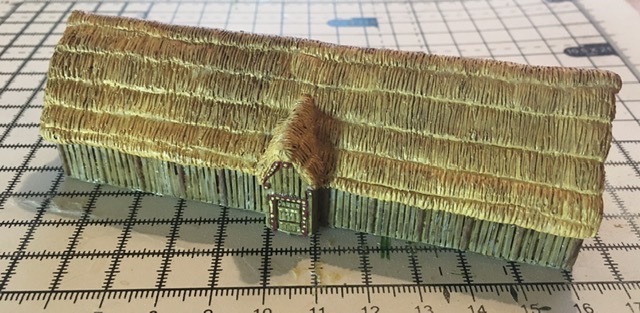
The evidence for the appearance of Anglo-Saxon housing isn't great as most buildings were of timber construction so little remains of their architecture other than archaeological evidence.  That gives us a good idea of the footprint of the buildings and evidence of the type of construction and the materials used but little or no idea of the look of the finished buildings.  For makers of model buildings that means that they have to look at the best reconstructions of these buildings.  In this case 2D6 based their models on the structures at West Stow Anglo-Saxon village near Bury St Edmunds.   From what I can see on the village's website they are a pretty good reproduction too.  Wattle and Daub is known to have been used and there is good evidence for timber planked structures and that latter style is what 2D6 have modelled.  There is less evidence (that is to say none that I am aware of) as to how they treated the exposed woodwork to preserve it from the elements.  It might have been lime washed or even painted if the building was the hall of a Thegn or an Alderman but for the less wealthy it was probably just as simple to replace planks as they rotted.  I have read that the Anglo-Saxons preferred to use logs split in half as planks rather than flat split logs and the models reflect that.

The Great Hall - Timber walls and a thatch roof

Painting is easy as there is good definition to work with.  The thatch is particularly well modeled which means a simple straw yellow block paint with a wash of Agrax earthshade is sufficient.  The newer the thatch the more yellow the block painting needs to be and the lighter the coat of Earthshade.  The downside to the design is that timber and thatch doesn't create a lot of colour contract for the finished paint schemes, which probably reflects the nature of the original structures really well.  Looking at examples of older thatched buildings in real life shows that the thatch quickly weathers to a dark grey-brown colour. As cut timber weathers to a grey almost silver shade I tried a couple of techniques to break things up a bit.  For the timber I started with a Vallejo Green Brown (70.879) washed with Earthshade and then dry brushed a really heavily thinned Vallejo Sky Grey (70,989) which creates a bit of contract.  I also tried block painting in the Sky Grey and then washing with Earthshade which was OK and had the benefit of being fast but wasn't as nice a finish as the grey dry brush.

The pit dwelling in the centre plus two huts the light thatch gives the best contrast
The photos are a bit lighter than reality as the lighting was a bit harsh.  I should really make a light box!

Cottage with wood shingle roof - the timber walls look lighter here than in reality

I'm reasonably happy with the results and will be buying more of the 2D6 buildings as they are released.  There are palisade sections due for release next which will allow me to create fenced enclosures around a Hall complex.  These were usually ovals so some curved sections would be nice. I should really like to see some wattle and daub versions of the existing cottages and Great Hall too to give a bit of variety.

Lastly if you want to order some for yourself the webshop for 2D6 can be found at https://www.2d6wargaming.com/