Showing posts with label ADLG. Show all posts

Monday, 30 December 2024

Giving ADLG a proper go

I only have the edition of ADLG prior to the current one and other than a couple of games against Paul Dawson I haven't really played many games with these, or the current version of the rules.  However, I got to thinking (dangerous as always) that building a couple or three 120pt armies from my existing troops wasn't too much of a stretch after building a standard DBA Army.  This is also known as rampant expansionism, mission creep or a simple 'ooh shiny complex'.  The only issue I can see is the almost automatic urge to just add a few more options to cover all the bases to build a standard 200pt ADLG army.  Before you know it I could be up to DBM/DBMM figure counts!

The difference between the figure counts is less pronounced with cavalry heavy armies as these use a single base in both ADLG and DBA.  Infantry heavy armies with two bases for heavy and medium infantry in ADLG are where things really show up.  Lets have a look at the difference using a Late Imperial Roman force as an example (because it is somewhere in the middle as a 'combined arms force).

There isn't a great deal in the way of alternatives in the DBA army list for the Western Late Imperials.  Two legionary elements, three auxilia, two light cavalry and two cavalry (which include the general) are mandatory which covers 75% of the army!  The remaining three elements provide options as follow.  Firstly two of Auxilia Palatina or Velites (can be one of each), then lastly one from Clibanarii (3Kn), Catafractarii/Alans (4Kn), legionaries, bolt shooters, Lanciarii (3Bd) or warband .  So optional choices are limited.  For my last three elements I went with options of 1 x Auxilia Palatina, 1 x Velites and 1 x Catafracts (4Kn).  Oh and for what it's worth the Eastern Empires options are even less flexible!

Late Imperial Romans as a 12 Element DBA 3.0 army plus camp

One thing I have noted is that the Late Imperial Roman army list defines Clibanarii as 4Kn and Catafracts as 3Kn, I think this is the wrong way around as most lists show cataphracts as 4Kn which is why I changed them in the last paragraph! 


Late Imperial Romans as a 200pt ADLG force with two commands
Next lets look at the ADLG version, I excluded Foederati (Huns, Goths etc) to make the comparison closer, My selection still only has 12 units. However, it looks bigger as it has separate bases for it's two generals and of course the heavy and medium infantry are double based. What is less obvious is that this army has two commands so it's more like Big Battle DBA, it also has a fortified camp which prevents Light Cavalry raids on it. On top of which it has paid points for special capabilities for some units.

The Final selections were; First command   a brilliant general, 1 x Elite Heavy cavalry (Impact), 1 x Equites Sagittarii Light cavalry, 1 x Elite Cataphracts, 1 x Equites Heavy Cavalry (Impact)1 x Elite Legionaries (Impact, Armour, Missile Support), 1 x Elite Auxilia Palatina (Impact, Missile Support).  Second command, an ordinary general,  2 x Legionaries (Armour, Impact, Missile Support),  2 x Auxilia Palatina (Impact, Missile support), 2 x  Light Infantry Archers.  Plus a Fortified Camp.


A better view of the ADLG army

ADLG differs from DBA in that it has a points based army creation system so it has those interesting moments of self doubt about making choices, just like the old WRG ancients army list quandaries.   You know, the should I make those Hun horse archers elite or take a unit of light infantry archers instead kind of thing, rather than the straight 12 element choice of DBA.   It also has special capabilities (as shown above) in some lists.  So the Legionaries above can have armour, missile support and elite status as options. Me being, well, me I have gone for armour and missile support for the Legionaries, impact is mandatory  For the auxilia again missile support and mandatory impact.  The mounted command also took the elite option for it's the infantry reserve.

ADLG has other things going for it too that I like, light infantry and cavalry archers actually shoot at stuff, and units degrade rather than die in an all or nothing way.  Why I haven't used the rules more I really don't know, as I do really like 'chrome' within the rules of a game and the extra figures gives the whole army a better appearance.  

Any way as a result of all of this thinking my painting table is now packed again, after I did really well in November in clearing stuff down.  The western gunfight figures are on the back burner (or is that the left side burner as per the picture), as masses of Baccus 6mm horsemen take centre stage. These are mostly Late Roman/Early Byzantine horse archers and Hunnic heavy cavalry who will be proxying as Byzantine Boukellarioi.  It's a good thing I like painting horses.

I haven't imposed the mess which is my painting table on you for a while!

As you can probably tell I'm having a bit of an upsurge with my painting mojo after a fairly slow year.  I cleared 128 infantry and 30 cavalry figures from the lead pile in November and at this rate will be ahead by a couple of hundred figures compared to January 1st.  Retirement eh, what is it good for?  Well painting teeny tiny soldiers apparently!

Tuesday, 3 December 2024

More Moors

The Moors are coming along nicely.  As usual I'm starting by building a DBA3 army but will probably extend to a small L'Arte De La Guerre (ADLG) army later.  In part this is because DBA and ADLG have different ways of depicting the different parts of the army.  

With DBA there is a standard army of 12 elements which depicts the General, and his bodyguard, as one of those 12 elements and defines him as being a standard DBA troop type (with a bonus in combat).  ADLG on the other hand has generals either as a separate base that can be attached and unattached from any unit of the army or as an attached general permanently linked to a single unit (pretty much as in DBA).  On top of which many ADLG infantry units consist of the equivalent of two DBA elements.  That makes it easier (and cheaper) to start with the DBA version of an army, which is why I started where I have.  Come on you all knew I was a cheapskate!  ADLG also uses an army selection points system with standard games having a 200 point budget. There is a version closer to DBA army size using 100 or 120 points.  That said even at the lower point values an ADLG army is likely to have between 30 to 40% more bases than the DBA equivalent because of the infantry basing system.

Anyway back to the moors (cries of Cathy...Heathcliff in a strange North African tongue should now be ringing in your ears, No? OK maybe that's just me then?).  The General's element is now completed along with the additional infantry.  After some thinking and a query to the hive mind on TMP I decided to use Late Roman Heavy Cavalry castings to differentiate the General from his underlings...er... I mean brave fighting men.  I removed the Draco standard from the command figure group and replaced it with one based upon the Infantry standard.  Which may be wrong but at least it's a standard.


All the army to date, but...wait for it...there is moor to come

When it comes to painting horses I rather like liver chestnut and bay horses as the mainstay of my cavalry. To my eye nothing says 'horse' as much as the black tail and manes of a bay. I do throw in some pure brown, black and greys for variety and the very occasional pure chestnut and roan. I rarely do units in 6mm with all the horses in the same coat colours as these are troops on campaign not the parade ground. If you do spot a unit all of one colour watch out, it will be something or someone a bit special and probably has more oomph than other cavalry formations.

The general's element for DBA

As a final thought I realise that I should have created a Moorish army years ago, honestly the scope for puns is huge!  For a start they are almost all bare headed, not a cap to be seen, although I doubt many have been to Ilkley Moor.  I will leave you to work that one out. 😉

Tuesday, 5 November 2024

Mixed emotions!

 A number of years ago I added a plea onto the Baccus forums for the esteemed Mr Berry to create a range of early Byzantines so I could replace my venerable Irregular Miniatures army.  At the time the response was that it may happen but not in the immediate future.  However, I wanted a Byzantine army, specifically one for the 5th - 6th centuries, so I decided to proxy other Baccus figures to that very end.    Sassanid regular infantry had a suitably large shield so I started there and though I say so myself they don't look too bad, yet they were not perfect.  In my mind's eye I had an image of the old Hinchcliffe 25mm figures but in glorious 6mm, but needs must and all that.  At 'The other Partisan' last month I bought some of Mr B's Hunnic Noble to serve as, well, Hunnic Nobles, but also to proxy for Boukellariioi for Belisarius or Narses.  This week in a fit of enthusiasm I started to work on a second unit of Skoutatoi.  No sooner had I started then 'bingly bong' goes my mobile phone to alert me to the fact that Baccus 6mm have launched a new range for a new period.  Yes you guessed it the period is 'Late Antiquity' and the range 'Early Byzantines'.

So this is the cause of my mixed emotions the infantry are exactly what I was dreaming of but I already have proxy troops for that role.  I almost wish that they were not what I wanted, but the entire range is perfect!  Damn you Mr Berry, now I think I may be falling prey to some form of compulsive behaviour disorder.  This is caused by knowing that the exact figures I want are out there so my lovingly proxied Sassanids are no longer ticking the right boxes.  I must have proper Byzantines, I need proper Byzantines!!!

Not 'proper Byzantines' but I was happy with them until.....

So in due course I will, of course, weaken and buy said 'proper Byzantines' the only question remaining is what to do with the demobilised Sassanid proxies, other than use them as Sassanid regular infantry (well that would be too easy wouldn't it).

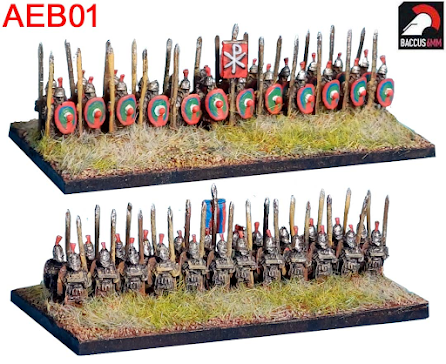
Proper Byzantines!  (image from the Baccus 6mm catalogue)

Other than the above mixed emotions the new range looks really useful.  It will cover Justinian Byzantines and Maurikian Byzantines, it has the Avar influenced half armoured cavalry (drool)) as well as lance and bow armed heavy cavalry.  At a push it would cover Byzantine armies through to the introduction of the kite shield in the late 10th Century.  The castings look excellent, you can see them here Baccus 6mm and the later Byzantines from the early Medieval range are here Baccus 6mm.  I now have a terrible stabbing pain in my wallet!

Friday, 10 July 2020

Project updates

I seem  to have been a bit scatter brained of late with new projects starting that were not on my radar at the start of the year..  Other things that I intended to do have stalled, so at the half way point of the year, it seems like a good time to take stock.

I was going to try out Seven Years War gaming and created some paper figures to do that.  So a win for creating the figures but after that I didn't actually play a test game!  I may come back to this I have the rules and the armies I just need the motivation to try a game.  Replacing the 7YW project on the front burner has been a later linear warfare period; the American Civil War.  I have the rules (Altar of Freedom) and perhaps more importantly an understanding of the tactics and grand tactics of the conflict.  As I have mentioned before it is also a period I have gamed in the past using a set of rules from the 1970s called 'Circa 1863' these were set at regimental level and required a lot of record keeping, I have hopes that the more abstract system in AoF will be more engaging.

On the figure painting front things are more positive.  I have finished converting my Late Imperial Roman DBA army to an all Baccus force.  The Picts and Scots-Irish DBA armies are completed and I have made a start on extending the Picts back to the earlier period army list by adding more chariots to the queue on the painting table.  Both of these are Irregular Miniature armies.  I do like the chariots and will probably order some more to flesh out the Scots-Irish to cover the early period for them too.  So that's three things off my to do list there.  There has been some scope drift though as I have started to increase the Late Imperials to create an ADLG baseline army at 200pts.  The Sassanids are already completed as a 200 point ADLG point force.

Early Sassanid Persians for ADLG completed 
Video Fly by of the Sassanids

The ACW Ironclads are finished too but I need to complete the Chilean and Peruvian Ironclads for the Great Pacific War.  The ACW ironclads might feature in Altar of Freedom games in due course.  So lets call that fifty percent success to date.

ACW Ironclads plus some tugs and a sloop in the rear
I'm calling the World War One dogfight rules done now, as I have finalised some spotting rules I can live with and have amended the rules for rear gunners to make them a less effective.
Oh and I got bored so I made a Barker Marker and recoil gauge for DBA

The list of unfinished projects isn't getting any shorter though as I keep getting tempted.  So there are still a number of World War One aircraft needing painting and there is a list of extra ones I need when Heroics and Ros reopen that list for new purchases.  I have read that this is likely to be early in July.  There are some building and modelling projects linked to the ACW that I need to get under way so I can try out AoF. Oh and that Dark Ages campaign isn't going to play itself.


Saturday, 13 June 2020

On The Painting Table


You might have thought that with the lockdown forcing us all to stay at home that I would have done a lot of figure painting, but in reality what has happened is that I have slowed down. I suspect that this is because I'm still working, albeit from home and I'm relatively busy with work.  I was already working that way for a part of each week so I have a desk in the box bedroom which I laughingly call my office This is the same room where I have my painting desk setup and after a day sat there working the idea of spinning the chair around 90 degrees to the painting table isn't as attractive as it was before lockdown.

Still despite all of that I have managed to  move on with some projects.  The Picts and Scots-Irish have full DBA armies now covering the early medieval parts of those lists.  There are reinforcements from Irregular Miniatures in the post for the Picts.  These will let me cover the earlier period of their list to provide an opponent for my Late Imperial Romans, by adding Attacotti and chariots to the mix along with more spears and cavalry.  I have also painted up some more of the 1/2400th Ironclads from Tumbling Dice.

The painting table itself currently has more Sassanids which when painted and based will complete the basic 200pt ADLG army.  There are more Late Roman horse and foot plus some Huns and Goths.  Lastly a few command figures for various of my Dark Age armies so I can morph them to ADLG from DBx.  Oh and some Sassanid armoured spearmen who are going to be the test for proxying as Maurikian Byzantine Skoutatoi.

More Horses to paint, that will keep me busy for a while.
So as the lockdown eases, as they used to say in Hill Street Blues, Lets all be careful out there.
  

Friday, 1 May 2020

Progress in April - the leadpile diminishes

Lockdown has actually slowed down my painting output, odd isn't it.  I suspect it is because while still working, I'm now doing this from home every day and not just three days a week.  That means I have more freetime and things I would have been putting off are getting moved up the priority list which means that figure painting is being moved down!  The good news is that I haven't bought any more figures so the leadpile is still diminishing.

The photos are pretty poor I'm afraid its really sunny here today and my phone camera doesn't seem to cope well with contrast.

As well as the 6mm stuff, I also painted a couple of old castings in 25mm (or possibly 28mm) that have been sitting in the lead pile for a couple of decades or more.  I think they are Grenadier fantasy figures from the 1980's or 90's but I'm not sure.  They don't feature on the leadpile statistics as they aren't part of the 6mm pile.  I'm not sure how I am going to texture the bases yet.  I might try something different from my usual sand and flock approach.  These are big beasts at 30mm from the soles of their feet to their eyeline.  I have an idea in mind to use these to throw a spanner into the works for any French and Indian Wars skirmish games I might host in the future.

Not sure what these are but they will be fine as Sasquatch
During April I managed to complete 11 elements based for DBx or ADLG totalling 60 cavalry figures and 56 foot figures all in glorious 6mm-arama.  This is made up of two Late Roman Auxilia Palatina bases, 2 Sassanid LMI Javelinmen bases, 2 Gothic heavy cavalry (Roman Foederati), and 4 Late Roman Heavy Cavalry (Equites).  On top of which my resin pile is slightly smaller too.  I have completed 3 Dark Age buildings and a Roman villa.  The buildings are a mix of Levan and 2D6 and are as always lovely sculpts.

Auxilia Palatina with home made transfers on the shields
I have used Moorish Infantry for the Daylami LMI as they are Ax(Fast) in DBA and Light Medium Infantry in ADLG so a less well regimented look seemed right.  There are only 12 figures per base compared to 16 for DBA Solid Auxilia or the ADLG Medium Infantry Sword which also helps distinguish them.
Daylami Javelinmen for the Ssassanids.  
The Roman Equites are part of the revamp of my Late Imperial Romans they are Baccus late Imperial Roman Heavy cavalry.  To be honest apart from the lack of cloaks they seem almost identical to the Goth heavy Cavalry.  If need more I may try the earlier period Heavy Cavalry instead just for some variety.

Roman Equites
The Goth heavy cavalry are the first ones I have actually painted as Goths.  All the previous ones to cross the painting table have become Strathclyde Welsh noble cavalry.  I have some Goth medium cavalry in the queue and likewise those will be the first of those to be actual Goths too.  I really like the Gothic range from Baccus, nice sculpts and capable of being proxies for a huge range of other armies as they are generic Dark Age migration period barbarians.  My only historical quibble is that none of the foot have the strange, stepped shoulder, coffin shields, although that would stop them being such useful proxies.


Gothic Heavy Cavalry.  Lets claim it was at dawn and they riding out of the sunrise...or something!
The buildings are a Leven Roman Villa which has been sitting around for a year or more a small viking hut also from leven and two thatched 2D6 dark age buildings.  These work well with the leven anglo-saxon and viking range but seem a bit big compared to the leven Roman villa, still tey are never going to be side by side on the table so it's all fine, and both are simply lovely sculpts.

More Urban sprawl.  I remember when this was all rural drop terrain
The leadpile is still ahead by 265 6mm figures compared by the start of the year, but I have actually painted more cavalry than I bought so I'm ahead there by 19 figures.  Still not going to run out of figures anytime soon though, although I may need to give Irregular Miniatures some of my money for some castings that Baccus don't do, or at least don't sell in small enough numbers for what I need.It's not going to be much of an order mostly foot command figures, but you know how it is once I start to look at the online catalog almost anything could happen!


Wednesday, 29 April 2020

More on Ancient gaming and lists

Blogging sometimes sends me off in unexpected directions.  I like to pretend that I have some sort of idea about what I intend to write about in my next couple of posts and then one thing leads to another (or to be more accurate its more a case of  one post leads to another) and I'm off down a different rabbit hole!  So it is with this post.  My last post on army lists and balance in DBA got me thinking about the development of the DBx family of rules and how they represent a complete change of direction from the older WRG Ancients rule sets.  So I dug out the copies of the WRG  rules I have (4th Edition through to 7th) to remind myself of how they worked.

Barney looking for me down that rabbit hole or possibly digging out the rules from my filing system!
I should say at this point that I have a soft spot for the WRG ancients rules.  Like many gamers of a 'certain' vintage they were the first proper rules I used.  Before WRG I had rules by Charles Grant and John Tunstall which were as much tutorials on how to write rules as they were a fully formed set of rules.  WRG were different, from the start they were written as a set to use in competitions so had to be full and complete, or at least complete enough to not need house rules for competition use.  Second they tried to cover everything needed for the period they covered, weather, time of day, troop definitions the whole nine yards as they say.  With WRG rules an opponent and I could buy a set of rules and use them exactly as written by and large, although there was always the small matter of Phil Barker's writing style to give rise to some points of debate on interpretation.

Those rules were pretty much the only game in town, as it was a couple of years before competing rule sets arose.   Those I tried were no improvement and were often worse than WRG.  At best some were Ok but for whatever reason they came and went while the WRG sets soldiered on year after year.  I started playing using 3rd edition and as each new edition appeared switched to the new set.  The core mechanisms stayed pretty much the same right through to 6th edition.  They were detailed and often slow to play and most games I played struggled to come to a natural conclusion in a single session.  Part of the after game ritual was the discussion which usually started with 'well if we had time to play another turn I would have....'

It was 7th edition that made dramatic changes to core mechanisms.  Basing as elements and no figure removal (as with DBx) came in with that set, although the weapon and troop classes remained the same.  The command rules became more detailed and there was less scope for changing things on the fly.  One of the issues that confused me was that although units were based as elements some formations required troops to be based in part elements (such as wedge or rhomboid) which partially defeated the element concept.  For a lot of gamers the 7th was too different to earlier editions and it simply wasn't WRG ancients anymore.

Phil Barker's original concepts had stayed unchanged from 1st through to 6th edition ancients and similar concepts were used by scores of other sets as well.  Combat focussed on the armour type of the target unit and the weapon system used by the attacker.  Units lost figures once the casualty calculation reached multiples of 20 casualties (as each figure represented 20 actual men).  This had drawbacks as units tended to contract along their frontage which isn't how things worked in reality as casualties would be replaced from the rear ranks to try to maintain a units frontage.  In 7th the actual number of casualties was determined but was then used to determine if the unit became fatigued and influenced immediate reaction to the combat.  Then the casualty slate was wiped clean. Instead fatigue carried forward and impacted on the unit's performance in future turns.  No figures were (or could be) removed so frontages stayed intact.

WRG didn't develop their ancients set any further then 7th edition although others did (Warrior were, I think, developed from WRG 7th edition).  Instead Phil Barker wrote DBA.  Then he bolted on additional chrome to DBA to create firstly DBM and then DBMM, in effect he started to move back to something like a simplified 7th edition but from the other direction.

About the time 7th edition were published I drifted out of figure gaming for a while due to the usual reasons, young family, change of job and my gaming group breaking up to take new jobs in different places.  I bought a copy of 7th, read it and made notes on the mechanisms, but never played it.  To be honest I couldn't get my head around the newfangled idea of basing as elements and the lack of figure removal as that had been at the mainstay of every other set of rules I had ever used until that point.  My 25mm collection stayed based for 6th edition and didn't morph into DBx armies.

My 25mm Late Imperial Romans based for 6th Edition.  These are a mix of Hinchcliffe, Prince August hand casts, Irregular miniatures plus a few Essex
My 25mm 6th edition armies went to a good home when I downsized. The video shows them as they were when I was checking them before they went to their new home.  They hadn't been out of storage for a decade at that point which explains the loose spears and shields. The unpainted stuff had been that way for about 20 years at that point!

Having looked back over the old rule sets I can see what the design objective with 7th edition was.  I even wish I had had the chance to play them as there is a lot of good in them.  Strangely when I came to write my homebrew ECW rules many of the concepts from 7th solved design issues I had and addressed some of the playing decisions I wanted to focus on.  Looking back I can see the first glimpse of DBM, DBMM and related games like ADLG in those rules.   Personally I think that Phil Barker recognised that there was tension between detail and playability and wanted to address it with 7th.  I don't know that he achieved that  to the satisfaction of players.  The fact that he turned to DBA as a new starting point and them developed rules more akin to 7th with DBM and DBMM suggests that he was close to what he wanted but couldn't quite get there with the mechanisms of the previous sets.  None of which really matters when looking at whether DBA and it's further developments deliver a good game or not, but it is interesting to see how we got to the place we currently occupy with WRG rules.  I suspect DBA 3.0 is the last hurrah for WRG ancient and medieval rule sets but 1969 to date is a damn good run by anybodies standards and many of the current rule sets for the period owe a lot to the work done by WRG.
Over 20 years gaming right here in one place - WRG 4th - 7th editions

Sunday, 26 April 2020

Comparison of army lists

Following on from my Roman v Persia DBA game over Easter I got to thinking about the balance of the standard 12 element games of DBA.  So as an exercise I converted the two armies to DBM, DBMM and ADLG equivalents using the closest matches to the DBA element choices I could find.  The results confirmed one of my views about DBA's 12 element selections which is that the armies don't give balanced match ups, even between historical enemies. DBA doesn't distinguish between Inferior, Ordinary or Superior troop categories  as DBM or DBMM do (shown by the initial after the type in brackets so (O) is an ordinary example of the type).  It doesn't have points values either as selections are made assuming all troop types are of equal value.  What the comparison did was show that this simply isn't true.

The closest match is DBM as there is almost a 1:1 equivalency in the element types if we assume all DBA troop categories are equivalent to Regular  and Ordinary troop classes in DBM.  The Army lists for my game were: 

Early Sassanid 
General (Cv), 5 Asaravan (Cv), 1 horse archer (LH), 1 elephant, 1 Daylami (4Ax) and 2 Levies (7Hd).

Western Late Imperial Roman
General (Cv), 1 Equites (Cv), 1 Cataphract (4Kn), 2 Equites Illyricani (LH), 2 legionaries (4Bd), 3 Auxilia Palatina (4Ax), 2 Light Infantry (Ps).

DBM equivalents
The DBM armies are (based on my admittedly elderly copy of DBM (1994) and equally old army lists (1993)) as follow.  All troops are solid unless noted as (F) for fast or (X) for exception.

Early Sassanid (all irregular troops)
General (Cv (S)), 5 Asaravan (Cv (O)), 1 horse archer (LH (F)), 1 elephant (El (O)), 1 Daylami (Ax (O)) and 2 Levies (Hd(O)).

Western Late Imperial Roman (all regular troops)
General (Cv(O)), 1 Equites (Cv (O)), 1 Cataphract (Kn (X)), 2 Equites Illyricani (LH(O)), 2 Legionaries (Bd(O)), 3 Auxilia Palatina (4Ax(S)), 2 Light Infantry (Ps(O)).

The points totals are interesting the Sassanids cost 90 points but the Romans are 97pts.  There isn't an option for 4Ax (O) in the DBM Late Roman list, but using the raw point cost it would only reduce the total by a further 3pts to 94.  It seems like Phil Barker considered that the Roman army is actually worth between 4.5% and  10% more than the Sassanid when he wrote the points for DBM.  Which reflects the outcome of the DBA game.  It might be argued the true cause of the discrepancy is the difference between regulars and irregulars and that does account for the points difference within DBM itself.  The way to test it is to replay the game using DBA but with DBM points values which would give the Sassanids an additional 9 pts to spend for at least one more element.  That would allow an extra Asaravan or LH element for example.

DBMM equivalents
DBMM points are identical for the Romans but has differences for the Sassanid Persians as they have to take Cv (S) for Asaravan which brings the totals to a close match of 99pts Roman and 100 pts Sassanid.  This will be something I might refight using DBMM 100 (the 100 pt DBMM light variant).

ADLG equivalents
ADLG has a different set of troop definitions although the points values are broadly similar to DBM/DBMM so I have gone back to basics and tried to replicate the troop types in ADLG terms.  I used the DBM/DBMM descriptions as they give more detail than the DBA list and make it easier to compare troop types to get the closest match possible.  In ADLG ordinary generals don't have a points cost, it is only the better generals who have to be paid for.  As result I based the list on the (stay with me here the next bit is a bit convoluted) the DBA list converted to DBM ordinary category troops and then looked for the nearest ADLG equivalent.  It isn't possible to match the DBA list exactly due to the slightly higher points costs for some troop types.  What we get is:

Sassanid (pre 430 AD)
1 x General, 5 x Asaravan (HC- Bow), 1 x Cataphract, 1 x Horse Archer (LC - Bow), 1 x Elephant, 1 x Javelinmen (LMI - javelin),  2 x Levy (levy).

Late Imperial Roman
1 x General, 2 x Equites (HC), 1 x Cataphract, 2 x Eq Sagittarii (LH - Bow), 1 x Eq Illyricanii (LH - Javelin), 2 x Legionaries (HI- Sword), 3 x Auxilia Palatina (MI-Sword, Impact), 2 x Light Infantry (LI - Bow)

I considered comparing the relative values of the two armies under the old WRG ancients rules using the 1982 6th Edition Ancient's lists.   However, the rules are so different that it wouldn't really add anything other than remind me how much I miss my triple armed legionaries!  I have a set of 7th edition but have never used them in anger, they would be closer to the DBx rules family as they are element based.  Short of trying out 7th solo, the next step is to refight the action under DBA using the DBM list and then doing it again under ADLG rules.

After all of this I have kind of reached a conclusion.  Which is that DBA as written is fine as a basic introduction to wargaming in the period prior to 1500 AD, but.....   The but being that the lists don't really provide the incentive to play some of the weird and wonderful armies that live out ot the fringes of playability because of the 12 element format.  In future I may very well simply play games using DBA rules but selecting 100 pt armies from the lists for DBM/DBMM to give a bit more balance.  That way it might actually be interesting to see a match up between lets say Italian Hill Tribes and Burgundian Ordonnance.


Monday, 6 April 2020

My 6mm DBA/ADLG armies in pictures.

As yesterday’s weather was nice and bright I took the opportunity to take some photos of my Pre-gunpowder forces.  These are based to do dual duty for DBA and related games in that family as well as for Arte de la Guerre (ADLG) so descriptions will tend to blur between the two a bit.   I’ve done this for two reasons, first is vanity pure and simple.  Second is to have a record for insurance purposes just in case.  Sorry the images are a touch on the small size but you should be able to click on them to see larger versions.

I was pleasantly surprised with the amount of progress I have made.  At one level I knew what I had painted, but at another it wasn’t real until I saw them altogether.  So without further ado.......

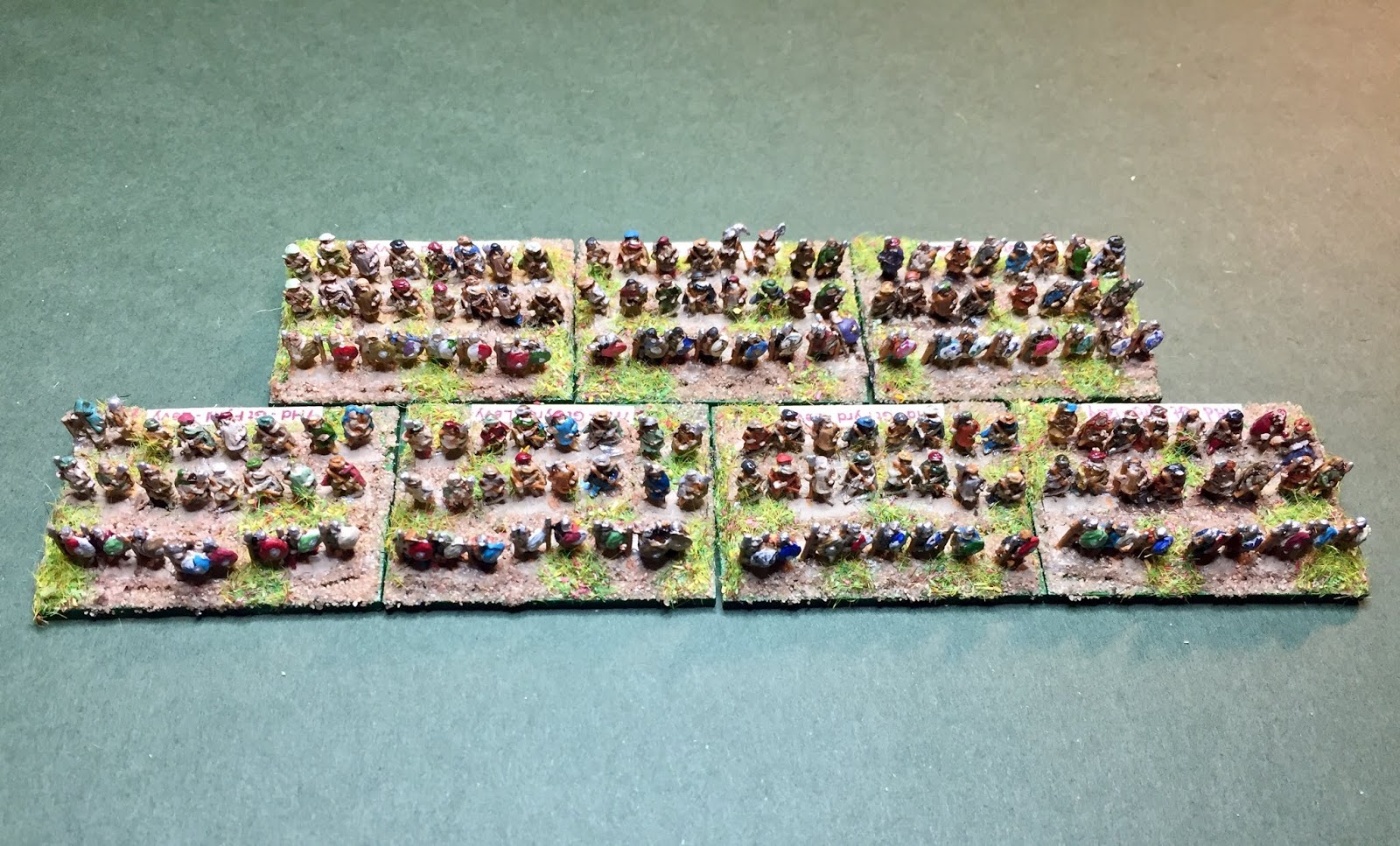
First up are the 9th Century Anglo-Saxons.  General Fyrd (Horde) at the back in three ranks on each base.  Select Fyrd and Hearth Troops at the front.  To me this really looks like a shield wall army in a way that my old 25mm troops didn't. Tactically it’s a bit simple minded as there isn’t a lot of subtlety available when all you have are melee focussed infantry to play with.

Middle Anglo-Saxons 
Next up are the Vikings These are intended to cover the period of the initial raids at the end of the 8th century through to the invasion of The Great Heathen Army and its campaigns in the 860's onwards.  They have a lot of fast swordsmen plus some Axemen (a different class in ADLG), and Hird who are close order for ADLG but 4Bd for DBA.  They also have the option of berserkir, who doesn't love to have an option to use loonies with axes once in a while?  In time I will add more close order swordsmen to cover the armies of the Danelaw from the end of the 9th Century onwards.

Vikings - the loonies with axes have been made to stand by themselves 
Following on from the Vikings come the Strathclyde Welsh.  These are the last of the Sub-Roman British sub lists and are actually a decent bet against other British Dark Age armies.  They have cavalry , both heavy and medium cavalry in ADLG terms along with some halfway decent spearmen, both medium and heavy infantry options in ADLG.  DBA with its 12 element armies over powers them as historically they struggled to hold their own as they were always over faced by the sheer numbers facing them.  in reality they only survived by the careful use of  off of alliances and accepting client kingdom status.  A fun option to use in a Dark Age campaign though..

Strathclyde Welsh - almost combined arms by 9th Century British standards
The Welsh Princedoms or more simply the Welsh are culturally the same people as the Strathclyde Welsh.  The two groups were separated by the expansion of the Anglo-Saxons into three geographical areas wales itself and modern Cornwall who are covered by early welsh lists and the strathclyde welsh of south west Scotland and North Western England.  The  southern Welsh seem to have reverted to a more traditional tribal way of fighting while their northern cousins retained some Roman ideas probably because they were more more romanised in the first place. Their main strength in DBA is in their fast warbands.  ADLG makes them medium swordsmen.  Personally I think a LMI javelin option would suit them quite well.  I haven't tried them out on the tabletop yet.

The welsh Welsh - Fast Warbands are us 
I haven't included the other main forces in Dark Age Britain, being my  the Picts and the Scots-Irish as those armies haven't been worked on since I last posted about them.  Pictures will follow in due course.

Moving on to the more traditional 'Ancient' period we have the ever popular Late Imperial Romans.  I have always had these in my collection going back to the middle 1970's, first in 25mm from Hinchcliffe, then as Irregular Miniatures 6mm and now I am upgrading to Baccus figures. 

As you can see this is an army in transition.  The heavy cavalry and the legionaries at the back are going to be replaced in the very near future.  You can see the difference in basing styles between the Irregular Miniatures castings and the Baccus equivalents in the front ranks.  I have salvaged some light cavalry and Auxilia which have been rebased but the close order castings from Irregular will be retired as soon as the Baccus figures leave the painting table.  This is a true combined arms force with shock heavy cavalry, Cataphracts, artillery. and good heavy and medium infantry options supported by light cavalry and light infantry.  My go to ancients army and it will only get bigger.

Late Imperial Romans - Western Empire
Of course they need something to fight so here are the Early Sassanid Persians.  Levy at the rear of the elephant corps.  You can't see it but the front rank of levy have shovels while the rear ranks have buckets, very big buckets for collecting elephant dung!.  They all have really nice rose gardens at home!  Cataphracts and heavy cavalry backed by horse archers give this army its punch.  Awaiting a couple more heavy cavalry and some LMI javelinmen to complete the basic ADLG 200pt army.  This is another army I used to have in Hinchcliffe 25mm.

Early Sassanid Persian
Last but not least are the Dacians.  At some level I must really have a taste for barbarian infantry armies and this one is better than the average uncouth hairy non Roman.  After all they have a large proportion of semi naked loonies with big choppers, AKA Bastarnae falxmen.  This is an army where you either have to think very carefully or not at all when deciding on how to use them!  For extra oomph Dacians get a Sarmation ally with heavy cavalry, in this case they are Irregular Miniatures and need replacing so they are not so clumped together on the bases..  Again this army needs some expansion but it is a fair way down the to do list so may not get the attention it requires until the back end of the year.

Dacians - We have a cunning plan....rush forward and chop the enemy into teeny weeny pieces
I haven't included the Maurician Byzantines which were my first 6mm army.  They were bought as an Irregular Miniatures battlepack and really need updating  as a lot of the figures are close order castings and don't work for my current basing style.  I'm currently looking around for available 6mm figures (but with no success) or at least decent proxies.

That's the current based and ready fight troops there are a goodly number of additions on the painting table or at least in the queue to get onto the table as listed in the previous post.  Hopefully I can make some serious in roads into those in the next few weeks.  

Sunday, 5 April 2020

The Leadpile - March update

Having decided what to do for the weekend, the choice being upstairs, downstairs or garden, Mrs E and I decided on doing some gardening.  Nothing too heavy as Mrs E's arm is still healing so just planted a few bits and pieces and set some seeds for transplanting later in the year.  If the world comes to a grinding halt I should have spinach, courgettes, lettuce, coriander and chillies available.  How many chillies for a pack of Baccus soldiers do you think?

While I was outside I took advantage of the dry weather to spray prime the next batch of figures.  In this batch there are 20 Hun LC, 10 Late Imperial Roman Horse Archers, 10 Goth Medium Cavalry, 20 Sassanid Heavy cavalry 24 Moorish Infantry and Greek psiloi who will become Sassanid LMI, and  64 Late Roman Infantry.  That's everything I need to complete a 300pt ADLG Sassanid Army and most of the balance of a Late Imperial Roman Army too.  That's going to make a reasonable dent in the leadpile, but it doesn't look like Horse by Horse is going back on the bookshelf anytime soon.

The leadpile is still ahead in the painting stakes. After Vapnartak in January I had an additional 594 6mm figures in the pile.  By the end of March I had painted and based 104 mounted figures and 109 foot, so the leadpile is still ahead by 381!  On top of that I have rebased a further 64 foot and 40 cavalry which were those Irregular Miniatures figures that are open order castings and can be separated from the strips they are cast in to be based in the same way my Baccus stuff is.  Those provided two units of Hunnic Light Cavalry and two of Auxilia Palatina.  Not as nice as the Baccus equivalents, but waste not want not and all that.

The transfers I made are working well on the Roman shields although I have found that the red printer ink can bleed through the back of the transfer if soaked too long.  The trick is to hold it with tweezers for a short a period as possible, just enough to get the transfer to slide off the backing paper with a bit of help rather than waiting for it to float off.  Pictures of the results will follow once I have a couple of units done.

I now have completed DBA armies for both Sassanids and Late Imperials and both are almost there for ADLG at 200 pts albeit without much flexibility for alternative troop selections.  After I have done these I think a bit of infantry painting is on the cards.  I have Picts and Scots-Irish from Irregular Miniatures sat waiting for attention, which when done will bring those two up to DBA sized armies.

I also decided to make some more terrain so with help from the ever useful Milliput and cardboard I set to making a marshlands piece.  I'm not 100% happy with it but it will serve I can't get the surface of the water to look completely still.  I have a better result with varnish than I do with Woodland Scenics' realistic water but it still isn't the dead level smooth finish I crave .  Their burnt grass fine turf works well though and I'm very happy with the look of that part of the build.  I have done two versions one as a 3D terrain piece and also a felt outline that will replace it when troops occupy that terrain.  I think that I might try using an image from google earth as the outline as the felt looks pretty naff (do people still say that?) on its own.

See what I mean about the felt?
More self-isolation excitement tomorrow when I may vacuum clean, hell I may even go as far as dusting.  I can hardly wait.

Hoping everyone who reads this is doing well and staying safe.  Take care all.

Thursday, 19 December 2019

Second sight - 2D6 Anglo-Saxon Buildings

Second sight posts will be where I give my thoughts on new products after I have painted, based or for rules after I have played a game with them.  In this case its a chance to provide some pictures of the painted Anglo-Saxon buildings from 2D6 which I gave an initial review of a few days ago.

The evidence for the appearance of Anglo-Saxon housing isn't great as most buildings were of timber construction so little remains of their architecture other than archaeological evidence.  That gives us a good idea of the footprint of the buildings and evidence of the type of construction and the materials used but little or no idea of the look of the finished buildings.  For makers of model buildings that means that they have to look at the best reconstructions of these buildings.  In this case 2D6 based their models on the structures at West Stow Anglo-Saxon village near Bury St Edmunds.   From what I can see on the village's website they are a pretty good reproduction too.  Wattle and Daub is known to have been used and there is good evidence for timber planked structures and that latter style is what 2D6 have modelled.  There is less evidence (that is to say none that I am aware of) as to how they treated the exposed woodwork to preserve it from the elements.  It might have been lime washed or even painted if the building was the hall of a Thegn or an Alderman but for the less wealthy it was probably just as simple to replace planks as they rotted.  I have read that the Anglo-Saxons preferred to use logs split in half as planks rather than flat split logs and the models reflect that.

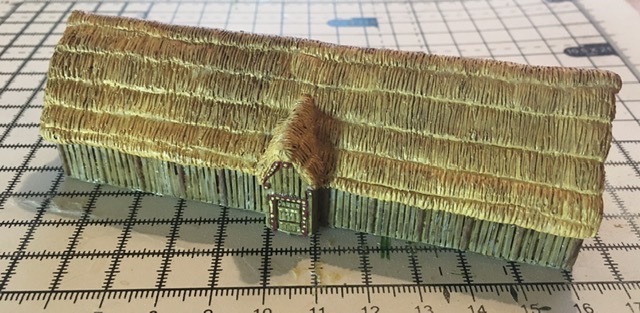
The Great Hall - Timber walls and a thatch roof

Painting is easy as there is good definition to work with.  The thatch is particularly well modeled which means a simple straw yellow block paint with a wash of Agrax earthshade is sufficient.  The newer the thatch the more yellow the block painting needs to be and the lighter the coat of Earthshade.  The downside to the design is that timber and thatch doesn't create a lot of colour contract for the finished paint schemes, which probably reflects the nature of the original structures really well.  Looking at examples of older thatched buildings in real life shows that the thatch quickly weathers to a dark grey-brown colour. As cut timber weathers to a grey almost silver shade I tried a couple of techniques to break things up a bit.  For the timber I started with a Vallejo Green Brown (70.879) washed with Earthshade and then dry brushed a really heavily thinned Vallejo Sky Grey (70,989) which creates a bit of contract.  I also tried block painting in the Sky Grey and then washing with Earthshade which was OK and had the benefit of being fast but wasn't as nice a finish as the grey dry brush.

The pit dwelling in the centre plus two huts the light thatch gives the best contrast
The photos are a bit lighter than reality as the lighting was a bit harsh.  I should really make a light box!

Cottage with wood shingle roof - the timber walls look lighter here than in reality

I'm reasonably happy with the results and will be buying more of the 2D6 buildings as they are released.  There are palisade sections due for release next which will allow me to create fenced enclosures around a Hall complex.  These were usually ovals so some curved sections would be nice. I should really like to see some wattle and daub versions of the existing cottages and Great Hall too to give a bit of variety.

Lastly if you want to order some for yourself the webshop for 2D6 can be found at https://www.2d6wargaming.com/


Saturday, 14 December 2019

Hordes of ..........

........well hordes if I'm honest.

A few posts back I was creating some generic hordes using Irregular miniatures Peasants and Pilgrims fronted with a rank of Viking spearmen.  I used the vikings as they are cast in open order and that lets me break the castings up so I can space them out a bit more and get a frontage of eight figures.

All seven elements I'm not sure where Bruce Willis is standing

I haven't been able to paint as much as normal for the last few weeks as I have been doing a lot of travelling with work so I hadn't made the progress I had hoped for with these.  That changed last week and I was able to finish the rest of the job.  So here it is a horde.  They may not be able to fight but they look good.

I made the ranks less than perfect, well they are only peasant levies! 

Friday, 13 December 2019

More Welsh

I had a couple of days leave a couple of weeks ago and between some more sorting out of my office and one of the  outside storerooms I did some figure painting.

After I posted the photos of my Welsh infantry and cavalry I realised they had no Light Infantry support.  A quick flick through the army lists for DBA 3 and ADLG showed that I could have up to four elements of light infantry Javelinmen under ADLG.  DBA with it’s smaller armies was less generous but as they also show javelin equipped Psiloi it didn't really matter.  Four units of Javelinmen it was to be.

I base Light infantry on deeper bases than the ADLG rules allow, but I’m never going to play a competition game with these armies so it doesn’t really matter.  I think the extra base depth works better then the standard depth as it creates a deeper buffer zone in front of a main battle line.  I put eight light infantry per base with 6mm figures which makes skirmisher elements fairly quick to create as there are a lot less figures to paint per element compared to the sixteen per element for the infantry in the main battleline.

The Welsh - just lacking some four legged booty
The figures are Baccus Greek psiloi with javelins which create a slightly different look to the light infantry figures I have used in my other armies as they are shieldless.  They are really nice sculpts and have two variants one is standing throwing the javelin while the other is running forward with javelin held across the body.  The nice dynamic poses work well for light infantry who should look like they dash about rather more than their more stolid brethren in the shield walls.

I'm happy with them and it has added a bit more resilience  to the Welsh army  I need to get some sheep or cattle to act as booty for them - not that I'm suggesting that Dark Age welsh were a buncj of cattle thieves or anything!.

Friday, 22 November 2019

Proxy Dark Age troops - The Welsh Princedoms

By the late 8th century the Welsh had been pushed back to the area of the modern principality and the south west of England (Dumonia).  Wales itself was made up of a number of small princedoms although for short periods they would be unified under a successful leader such as Hywel Dda. Originally Romano-British in outlook by the late 8th century they had reverted back to something closer to the military organisation and tactics of the tribal societies who had replaced the Romans throughout Western Europe.  Each Welsh King had a small band of personal retainers and relied on the land owners (Uchelwyr) to raise their own retainers (Teula) for military service.  Kings seem to have had a military house hold of around 50 men but may have hired mercenaries to boost numbers.  A Teula may have been a unit of 300, but given the fixation in early Welsh literature with multiples of the number three that can't be guaranteed.  There was also a unit called a nifer which may have been a subdivision of a Teula or it may have been an alternative name for the same thing.  What we can tell is that the welsh were never able to field huge forces and small raiding forces of between 50 and 300 would have been the norm.  These would have been drawn from the Uchelwyr and their retainers and service by bondsmen tied to the land seems to have been rare.

Period accounts speak of their raiding over Offa's Dyke in hit and run attacks.  There was some use of light cavalry for scouting but the bulk of their forces were infantry.  These are described as fearsome in the initial charge but liable to fade away from a determined resistance.  They would precede their charge with showers of javelins but were only a serious threat to a shield wall if it broke.  They were fleet footed and little slowed by rough terrain and often based tactics on the use of that terrain to disadvantage more closely formed foot.

This suggests that they were not fighting in close order bodies themselves but were more akin to what the old WRG ancients rules termed Light Medium Infantry (LMI).  DBA 3.0  treats them as Warband, DBMM as fast warband and ADLG as MI sword.  Personally I'm not fully convinced by the ADLG definition and feel that they could be better represented by using LMI Javelinmen as the standard type but giving an option to upgrade to MI Sword.

Welsh Infantry or Moors in disguise perhaps?
No one does figures specifically for Welsh viking age figures in 6mm so its back to looking for a good proxy.  I have chosen to use Baccus Moorish Infantry as these are nicely animated in a variety of poses that suits the less regimented style of combat formations I imagine these troops to have fought in.  Phil Barker suggests the Welsh troops of this period were armed with swords and targets so there may be an option to use Irregular Miniatures Scots Irish swordsmen figures for them.  For their mounted troops I have used the ever popular Gothic Medium Cavalry from Baccus 6mm's Roman Range.

Uchelwyr (No I can't pronounce it either)
They give opposition to and a different tactical style to the Anglo-Saxon and Viking forces which form the bulk of the forces in play during the period.  I just need more of them so I can field a decent force and probably some sheep and cattle for them to steal!


Thursday, 14 November 2019

Peasants and Pilgrims

For Billington Moor (see earlier posts) I am going to need to represent the less well equipped Great Fyrd.  ADLG counts these as levy and DBA 3.0 as solid horde (7Hd).  Now hordes or levy crop up in a number of army lists in both sets of rules so I decided that some generic units of ill armed peasant types would give me the flexibility to use any thing I created in a number of different armies.

Baccus is my preferred figures range but the nearest they have for representing what I wanted were clubmen from their 17th century range.  So I went with Irregular’s Peasants and pilgrims from their medieval range.  These are noticeable smaller than Baccus but using a slightly thicker base would help disguise that.  I also wanted to have some figures representing slightly better equipped troops in the front ranks.  So off went an order to Irregular for the peasants and pilgrims along with some Viking spearmen.  I also took the opportunity to order some laser cut 2mm PDF bases from Warbases which would give me a thicker base than my usual 1.5mm plywood bases.

Ordering was easy Irregular now having a proper online ordering and payment system which is much easier to use than the old system.  Both orders came within a couple of days, well packed and with no damage.  The laser cut bases were a bit of a revelation to me as I have always cut my own using a straight edge and a Stanley knife.  Because these are laser cut there is no variation, all totally accurate. I’m a convert.  Next time I will try the 1.5mm plywood option.  The figures were less impressive but acceptable for what I wanted.  There was a fair amount of flash between the figures on all of the peasant castings.  The Vikings were much better but compared to Baccus the casting detail is much less well realised.  Still these are figures from an earlier generation of sculpting styles so differences in quality are to be expected. It was nothing that a couple of hours with some micro files and modelling tools couldn’t deal with.

Ready for priming.  There is detail there just in low relief.

Unlike Baccus who cast figures as strips with space between each figure Irregular has three styles of castings  based on old WRG base width requirements.  Close order castings  are shoulder to shoulder 6 figures wide.  These can’t be separated into smaller groups unlike the open and loose order blocks which have some gaps.  Both castings I had chosen were loose order so out came the side cutters to break the castings down into the smaller groups I needed.  I wanted to have a frontage of 8 figures per rank so groups of four and of two were the order of the day.

Painting makes a huge difference to Irregular’s 6mm figures.  The detail is there but it is often surface detail with little depth so careful painting is vital to pick this out.  The thing about Irregular's 6mm figures is that initially they look a bit like vaguely man shaped blocks but after painting they look fine.  I tried a different undercoating technique for these, using a coat of Vallejo ‘Earth’. I wanted these troops to be less colourful so I used a range of muted earthy shades with the odd bit of colour on headgear to make the figures show as individuals.

I will let you judge if the final result passes muster.  Only another 144 figures to make the remaining 6 elements to do then.

Monday, 14 October 2019

Do I do any actual wargaming?

From reading this blog you might be forgiven for thinking that I spend my time painting figures which never get used in a wargame.  To some extent it is true that I have been doing a lot of 6mm painting of late courtesy of having a painting table set up 24/7 which makes it easy to do a few minutes here and there most days.

My gaming has mostly been provided by the Monday Night Group, you know the ones who meet on a Tuesday evening.  Graham blogs the details of the games over on Wargaming for Grown Ups and as they are his games, by and large I don't like to steal his thunder.  This year we have had some excellent games ranging from Ancient Mesopotamia through the mid 20th Century Spanish Civil War.  What I have not done is provide the game rules or scenario for any of these run outs.

With that in mind and considering that I don't really want to inflict an untried game on the MNGWMOAT (Monday Night Gamers Who Meet On A Tuesday) I am thinking of suggesting a game I have played solo a couple of times before using BBDBA and DBM.  This is the first Battle of Whalley, not the one fought in 1643, but the one from 798 during one of the regular Northumbrian Civil Wars, AKA the Battle of Billington Moor.  Unlike the later ECW battle where there is a reasonable amount of information available, this one is shrouded in mystery.  The Anglo Saxon Chronicle has a very laconic entry.  It reads:

'AD798.  This year a severe battle was fought in the Northumbrian territory, during Lent, on the fourth day before the nones of April, at Whalley; wherein Alric, the son of Herbert was slain and many others with him.'

I had to look up Nones of April.  Its Roman calendar reckoning and in the shorter months fell on the 5th day of the month so by my arithmetic this means the Battle was fought on 1st April.  I'm pretty sure that the name in my copy of Stenton's translation of the Anglo-Saxon Chronicles isn't Herbert but as I can't get to it at present I will have to accept it for now.  I'm guessing that it will turn out to have been Eardberht or similar and that he was famous enough to warrant mention by virtue of his rank although it is of passing interest that his son's name wasn't worth mentioning.

Not much to go on there then.  We know from other sources that the Northumbrian crown was in dispute at the time and one of the claimants,  the previously deposed King Osbald, seems to have held lands around York at Osbaldwick and more importantly based on place name evidence perhaps also close by the site of this battle at Osbaldeston.

Osbald's claim seems to have had support from Mercia who following the death of King Offa were struggling to keep their status as the leading English kingdom.  They were campaigning in the East and South East and an internal succession dispute would have been useful to keep their Northern frontier secure.  The Northumbrian dispute could also have roots in the earlier organisation of the kingdom which had two power bases Bernicia on the North East Coast and Deira based in Yorkshire and the Pennine valleys of what is now East Lancashire.  The pro Osbald party was lead by Alderman Wada possibly from Waddington a few miles up the Ribble valley.  He met and was defeated by King Eardwulf at Billington Moor.

There is little evidence as to exactly where the battle was fought but there is a well used Roman Road which runs down the Ribble Valley along the East bank of the Ribble angling of to the west after Whalley to the old Roman fortress of Ribchester.  It would make sense for the combatants to have used this route.

So in my scenario I have Wada rallying support from Osbald's holdings between Ribchester and Whalley and calling in others from his own supporters.  The easiest way to move into the Northumbrian heartlands would be march North East along the Roman Road with a view to attempting the Aire Gap at Skipton.  Some historians suggest that the battle was fought somewhere close to Billington or Langho South West of Whalley (Hence Billington Moor).   So that's the ground I'm recreating and as a bonus it helps me to visualise the location as I went to school at Billington!

The Ribble valley is open here with flat land to the east of the river rising to a steep ridge above Billington with a number of small streams running down from the ridge to join the Ribble.  Slightly further to the North East at Whalley itself the River Calder joins the Ribble and personally I wouldn't want to fight with that to my back so I'm placing the action a little  further down the valley towards Old Langho which matches with the description of the Battle as being at Billington Moor.

The two forces are both essentially similar consisting of the Nobles Hearth troops backed up by Fyrdmen drawn from the rest of the local population.  Neither side would have been particularly numerous so I'd guess at no more than 1,000 a side.  The Royal Army would probably have an edge in quality over Wada, but Wada knows the ground so gets to choose the battlefield.

I'm going to allow Wada his own Hearth Troop plus some supporters of Osbald who are equally well equipped as a second unit of Hearth Troop.  The balance of his forces will be Fyrdmen split roughly 1:2 between the better so called 'Select Fyrd' and the the less well equipped 'General Fyrd'.  The Royal Army will have the Kings Heath Troop, plus Herbert's and one other Hearth troop unit.  The balance of his force will be 'Select Fyrd' quality.  Both sides will have some light infantry as skirmishers.  I normally give slightly more of these to Wadda as he is on home ground and can drum up more support from the locals.

I need to think about how many units to use overall as I may work to a lower figure:men ration to get more toys on the table.