Sunday, 24 December 2023

It's Christmas (in a Noddy Holder voice)

And if you don't know who Noddy Holder is look up the 70's glam rock band Slade and their massive Christmas hit.

Just a short post to wish all my readers a very Merry Christmas and to confirm (in Granny Weatherwax's words) "I aren't dead".  I have been working on the next post on 17th Century armies covering the Dutch and it has taken longer than expected to pull the various strands together.  Especially post 1648 details.  Still I'm almost there and should be able to post the information before the new year (not saying which one though!).

Here's hoping that Santa is kind to you all and you avoid the dreaded lump of coal in your stocking.

Saturday, 18 November 2023

A bit more about the Spanish Army

 While reading about the Dutch Army of the 17th Century I stumbled across the following image showing two stages of the Battle of Nieuwpoort in 1600.  What is interesting is that in the lower half of the image the Spanish infantry squadrons are advancing with their corner Mangas of shot ahead of the pike blocks. Notice how they are still in the same relative positions to each other though so that the pike only needs to keep advancing into the centre of their formation to create a traditional 'tercio' formation.


In the upper image the pike blocks have closed up on their Mangas and the shot have taken post to either side of the pike blocks.  in the very top right of the upper image there appear to be two mangas on each flank of the pike forming wings, while in front of them the shot are in columns on either side of the pike.

How accurate this image is is open to doubt as it was published in 1649 in the Atlas van Loon. So was created almost half a century after the event.  However Henry Hexham shows the Spanish Infantry exactly as depicted above in the lower image (probably in) in his "A trve and briefe relation of the bloody battel of Nievport in Flanders found betwixt Prince Mavrice of happy memory and Albert arch-duke of Avstria vpon the second of Iuly 1600" Published in 1641.  I'm saying probably as the images come from "Steve's Balagan" blog which you can find here Battle of Nieuport 2 July 1600 - Steven's Balagan.

I'm going to make an assumption here, Hexham served with the English Regiment of Sir Francis Vere in the service of the Dutch Republic.  He was certainly with him at the Seige of Ostend in 1601 (aged 16 or 17) so had first hand knowledge of events. In fact he lived most of his life in Holland serving in the regiments of Sir Horace Vere and then Sir George Goring after Francis Vere returned to England.  I'd tend to think that any sketch of field deployments would have some basis in truth.

So what this seems to be showing us is that the corner Mangas did operate semi-independantly.


Tuesday, 14 November 2023

Another sad day


Barney passed over the rainbow bridge this afternoon.  He was the first of our rescue dogs, arriving from Spain with George but coming to us before George needed a new UK home.  He had been unwell for a few weeks but nothing serious.  The vet gave him a course of Steroids to deal with an abscess in his ear where another dog had nipped him when playing.  He then developed a stomach but and was prescribed a course of antibiotics.  While he was on these he started to loose weight.  That didn't seem like a major issue as we were restricting his diet to cut out a lot excess calories from treats, in fact we were really quite happy as he came down to his target weight.  

Barney in the sun

The problem was that he continued to loose weight. We knew he had a liver problem which was responding well to a dietary supplement (with milk thistle extract what ever that is). It was when he started to be very quiet and not want to climb the stairs or go for walks that alarm bells started to ring. He was still eating though. In fact last night he ate a large part of my Pork Chop! What was really worrying was that he started to loose coordination in his back legs. Nothing major just occasionally skittering rather than standing straight up. That was until this morning when he didn't want to stand up and most concerning he had a nose bleed. So off to the Vets he went. They kept him in for some tests the results showed his liver function had improved, but his heart rate was high, he was running a temperature and his blood sugars were through the roof. we got a call to say that they were extremely worried. To carry out further tests would need him to be anaesthetised and they didn't think he would be able to cope with that. The incipient diabetes could be treated but the biggest issue was that he was probably had some sort of tumour in his nose or head which was causing his nose bleeds and general lethargy. We were given the choice of a lot of unpleasant tests he may well not survive and which probably wouldn't help or having him put to sleep. Not a great situation.

We drove over to the Vets, a drive of 30 minutes, and when we got there his condition had deteriorated even further.  His nose bleed was worse, he could only just manage to turn his head to look at us and couldn't summon up the energy for a tail wag.  His gums were very pale (which they hadn't been that morning) and generally he just wasn't in a good state.  The decision was as easy as it ever can be and he was PTS after we had time to say our goodbyes and give him a last cuddle.  He slipped away very calmly and quickly.  He was ten and a half years old.

Mrs E and I are very upset as you might imagine even though we know it was the right thing to do for Barney.  Whoever said 'Grief is the price you pay for love' knew what they were talking about.


Monday, 13 November 2023

17th Century Armies - The Spanish part two

THE INFANTRY

I left the infantry section on the Spanish army until last part as it's the most complicated to explain.  The Tercios of Spain, both those of the native Spanish and the other nations, were the best part of the Army.  Indeed the best of them were regarded as the best infantry in Europe until after Rocroi (1643).  The Infantry consisted of the Spanish Tercios, The Tercios of the Nations (drawn from other Hapsburg possessions in Flanders and Italy and lastly mercenary units tercios of Irish, Scottish and English troops and regiments of Germans and Swiss.

The Tercios

Tercios were infantry formations of Hapsburg subjects (Spainish, Walloons, Italians) and volunteers from other countries primarily Ireland.  The formations and tactics of the Tercios were emulated by both the Holy Roman Empire and the allied Catholic League until the 1630's.  They fought in Flanders in the 80 Years War (aka the Dutch Revolt), in Italy in the War of the Mantuan Succession, in Switzerland, in France, and in Iberia itself against the Portuguese and Catalan rebels as well as in North Africa and of course saw action in the Thirty Years War.  During the period I'm covering they went from being the traditional Tercio with the four corner bastions of shot to something more akin to the pike and shot formations recognised from the BCW.

1. Period illustration of a Tercio showing the four corner Mangas of shot

The long established view was that they were ultra conservative tactically, and struggled to adapt to the changes brought in by Prince Maurice of Nassau (the Dutch tactical style) or Gustav Adolphus (the Swedish tactical style).  Yet at Nordlingen in 1634 the Tercios destroyed a Swedish Army and previously they had done the same to the Dutch.  In fact many of the tactical changes brought about by Maurice were already used in whole or in part by the Spanish!  The basic story of the evolution of Spanish infantry  squadrons (the battlefield tactical formation) is that over time they became smaller, less deep but wider and with an increasing proportion of shot.  Of that shot a larger proportion of the shot became armed with muskets.  At some point the corner formations of shot (the Mangas) became the wings of shot at either side of the pike. What is less easy to tell is when these changes happened so as to be able to say that at a specific battle the squadron looked and fought in a definite way. 

A Tercio at the start of the century had an official strength of 3,000 men, although in reality they usually had less men than this, around 1,500 of all ranks in Spanish and Italian tercios and under 800 in Irish and other volunteer Tercios.  The Spanish preference for large infantry formations meant a single Tercio could form a squadron on its own or companies from two or more would be merged together.  Writing sometime in the early 1630's Gerat Barry (An Irish volunteer who served in the Spanish Army between 1602 and 1632 retiring with the rank of Captain in the Army of Flanders) states that:

"The 4. formes of squadrones moste acustomed and moste in use,is the square of men, the square of grounde, bastarde square and broade square, which the Spaniarde caule quadra de gente, quadra de tereno, prolongado, y gran frente"

(Gerat Barry - A Discourse of military discipline - published 1634)

Based upon Barry we can be fairly sure what the common formations were during the 1620s  and possibly until Nordlingen in 1634 as Barry was writing prior to 1633 (when his text was submitted for official approval!).  Barry goes into great detail on the arithmetic required to determine the number of ranks and files to form up in (square roots are a bit of an obsession with military writers in the period) but less on the other aspects of deploying a squadron.

The core of those formation was the central pike block, which throughout the period always had two small wings of Arquebusiers permanently attached, known as 'Garrisons'.  To that were added four bodies of shot (The Mangas) which were armed with either arquebus or musket.  In the mid 16th Century these formations were around 3,000 men strong as shown below (images of the formations are from Pierre Picouet's web site on the evolution of the Tercio via the Internet Archive).  The basic formation seems to have continued in use until at least the early 1620's but with a lower head count.

2. A 'Field Square' consisting of 2922 men of the mid to late 16th Century 

Other variations on the formation existed as noted by Barry. The extended square sacrificed depth for width to increase frontal firepower while the square of men was deeper than it was wide.  Again examples from Pierre Picouet’s now defunct website are below.

3. 16th and early 17th Century formations

By the early 1630's we are starting to see a more easily recognisable German style formation with a pike centre and two wings of shot but still with the garrisons of arquebusiers.  This may actually  have been the most common formation from sometime in the 1620's (see the section on sources below).

4. Deployment of 1,057 men from the mid 1630's with Pike 10 deep and shot wings 9 deep

The key thing to note is that arquebus armed shot are still in use in the above formation and this continues until at least the Ordinance of 1685 where a third of the squadron still had them, perhaps because an impoverished Spanish Crown had to make do with the firearms they already had!

Pierre Picouet provides some useful statistics in his book 'The Armies of Philip IV of Spain 1621-1665 (Helion 2019) on the size of battlefield squadrons and the weapons mix being used.  I also picked up useful stuff from the Osprey on the Spanish Tercios so other authors (other than Mr Picouet) are available!

This is where it starts to get complicated.  Tercios in Flanders, Italy and Iberia were organised in slightly different ways and were of different official sizes to each other in any given year.  I have no idea why this was.  German mercenaries brought a totally different organisation to the party (see below) and there were several reorganisations across the period.  It is possible to ignore this though, as the squadron was the fighting unit not the tercio, but the differences in manpower pools and weapon ratios could have had an impact.  Still for wargaming purposes a bit of standardisation can be applied.

The average size of the Infantry and Cavalry squadrons varied  by army and date but the following table adapted from Mr Picouet's The Armies of Philip IV of Spain 1621 - 1665 gives an idea of the formation sizes we should be using on the wargames table.

5. Average squadron sizes at major battles (source Pierre Picouet)

Bear in mind that these are averages taken from the overall size of the forces involved and divided by  the number of squadrons deployed, so some variation would not be unreasonable provided the average unit size stays close to the above.  

That's the easy bit, now onto the weapon's ratios within the squadrons, I have had to make some assumptions here the key one being that the ratios within combat formations are the same as the parent tercio, which is by no means certain.  Again the data is drawn from Pierre Picouet's Helion book.

6. Weapon splits and rough ratios

The percentages are from Mr Picouet's work the ratios are my (very) rough approximations based upon those splits.  Ordinances are the official instructions for how a tercio should be composed and muster rolls are actual head counts at pay musters.  Care has to be taken with the later as there was a tendency to claim pay for dead or deserted soldiers.  Muster data for the earlier periods tends to be in line with the ordinance requirements.

German Regiments

German infantry were recruited in the same way as was done in Imperial and Catholic League service, by issuing warrants to military contractors.  The basic unit for German formations being the Regiment.  These seem to have been organised in the same way as infantry formations of the Catholic League.  I take that to mean that until the mid to late 1620's they would be using the same formations as the Spanish (Possibly 'el Prolongado' as they were musket heavy formations) and then changed to the mid 1630's formation shown in image 4.  However Daniel S on his Kreigsbusch blog considers that German infantry (both Leaguist and Imperial) may have abandoned Spanish formations earlier in the century.  Giorgio Basta's military manuals recommend formations 10 deep as early as 1610 which is different to Spanish doctrine, I would use 12 ranks as that is the best I can do with the 2mm blocks I use.  At Lutzen (1632) Wallenstein deployed his German infantry in Battalia of 1,000 men deploying them 10 ranks deep (some sources state 7 ranks) which was probably also the formation used by mercenary formations..  As with the Tercios the actual numbers in field formations slowly reduced and formations became wider and shallower.  Between 1630-33 average size was 1,923 men falling to 1,500 men in 1640 and 851 men by 1643.  In the 1620's the split between weapon types was 40% pike, 10% Harquebus and 50% muskets giving a ratio of 2:3 pike to shot overall.  In general terms I would go with unit sizes and formations similar to Catholic League and Imperial  battalia and with the same weapon splits.  For training and experience I should start with Trained and Experienced and adjust upwards or downwards depending on the actual performance of the troops in the battle being refought.

CAVALRY PERCENTAGES

The Spanish never deployed the percentages of cavalry seen in other armies, depending on their infantry to win their battles.  In 1622 the Army of Flanders had 338 companies of foot but only 56 of horse.  By 1659 the numbers were 1,104 infantry companies compared to 219 of horse.   That's 14.2% and 16.5% cavalry respectively.  This is of course a small sample and takes no account of the number of men per company.  To try and get a better view I looked up troop numbers at major battles fought by the Spanish (via Wikipedia so perhaps not as accurate as I would like) which gave me:

7. Cavalry as a percentage of the army
 
The figure for Nordlingen (marked *) is actually the split at the Spanish rendezvous at Rheinfelden a few days prior to the fight.  Again these do not form a big sample but it does show  that cavalry was not normally a big proportion of the army.  In fact the average of the above table is only 26.5%.

ARTILLERY

The Spanish army standardised the different calibres of artillery at the start of the period and the result fits well to the normal wargaming split between siege artillery (Cannon and half-cannon), field guns (quarter-cannon; 10 or 12 pounders) and light guns (quarter-culverin and sakers of 4 to 7 pounds).  The number of guns varied a great deal with 18 at Rocroi to 38 at Lens.  The intention was to have 1 to 3 guns per 1,000 men in an army.  I would treat artillery as trained and professional throughout the period and as pure firepower tactics.

CREATING A SPANISH WARGAME ARMY

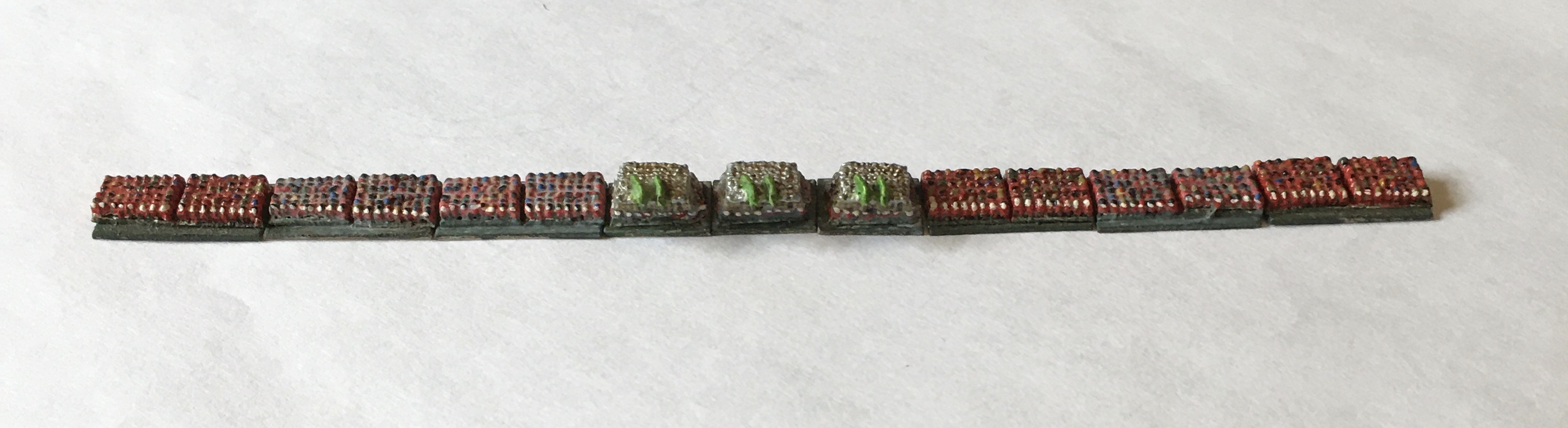
Bear in mind when reading this section that I use Irregular Miniature's 2mm castings which restricts the unit deployment to those possible with the castings.  I base infantry in blocks of 50 or 100 shot in 6 ranks and use the single pike block casting to represent 100 pike in 6 ranks.  For cavalry I use the three rank Armoured Pistolier casting of 15 horse in three ranks to create blocks of 50 horse (three castings plus five single figures as officers etc).  For the Garrisons I will use the horse and musket castings of infantry in three ranks but position them 'sideways on as it were along the flanks of the pike block.  If you are using 3D printed figures or Oddizial Osmy 3mm castings you will have to experiment with your basing to get the look of the formations correct.

1. Spanish armies 1618 - 1634
I would use the various versions of the infantry squadron with four corner mangas of shot as shown in Image 3 in this period.  Treat the corner mangas of shot as sub-units of the pike block to allow them to deploy without full edge to edge contact and to also allow them to operate at a distance from the pike if required.   As early as Nieuport (1600) it seemed to be normal for the shot mangas to operate at a distance from the pike.  Both the pike block and shot mangas deploy 12 ranks deep (two bases).  To keep things simple for calculating firing I suggest each manga have arquebusiers deployed on the edge of the manga closest to the pike block.

Spanish and Italian infantry squadrons will be a minimum of Trained and Experienced. They may be Elite, Veteran and Professional if drawn from the 'old tercios'.  Pike blocks (and attached garrisons) will be classed as shock and Mangas will be mixed fire power fighting style.  The standing order should be for mangas to use steady firing rather than volley fire.  Tactically Spanish tercios should be aggressive and attempt to close to contact with the enemy.  You might also want to reflect the all round defensive capability by counting the Pike block as being equivalent to a mobile pike stand so always without vulnerable flanks or rear.  Period engravings seem to show pike formations deployed both deeper than wide and wider than deep and with blocks of shot operating close by but not as corner bastions.  I have assumed these are the mangas operating semi-independently.
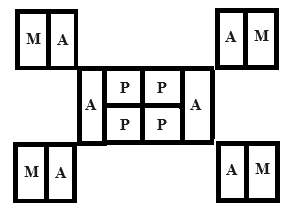
8. An example of how I might portray a Tercio

In image 8 I have drawn a rough plan of how I might construct a Squadron in this period.  P's are blocks of 100 pike.  A's are blocks of arquebusiers and M's are musketeers.  The Mangas are made up from castings of 50 shot (48 shot  plus a couple of separate officer figures) in 3 ranks giving a frontage of 16 men.  Placing two of these behind each other gives 100 Arquebusiers in 12 ranks and 100 Musketeers alongside in the same formation.  A total of 800 shot in the four mangas plus two garrisons of 100 Arquebusiers each and 400 pike.  This gives a total of 1,300 men split 4 : 10  Pike to Shot or 1:2.5 slightly too many shot but about as close as can be achieved using Irregular's blocks.  The shot breaks down to 3:2 in favour of Arquebusiers over Musket and not the 4:1 that actually existed.  Making the two rear Mangas entirely Arquebus armed would change the ratio to 4:1.  This is entirely conjectural for gaming purposes only though, but it has the feel of an early TYW formation.

Cavalry fight in 6 ranks using mixed fire power for both Cuirassiers (Reiters) and Harquebusiers.  Class as Trained and Experienced (if mercenary units) or Trained and  Raw if Spanish subjects.  Demi-lancers (if used) fight in 3 ranks as shock and class as trained and experienced.  Cavalry should not exceed 30% of the army head count.   There should be twice the number of Cuirassiers compared to Harquebusiers. 

No Croats (light cavalry) are available and native Spanish Jinetes light cavalry seem to have been abandoned in the early 16th century.  The first Dragoon units were raised in 1632 but you may only have one unit in an army counting as part trained and raw and firepower tactics. Harquebusiers may dismount to fight if there are no Dragoons available.

2. Spanish Armies 1635 - 1643 ( up to and including Rocroi)

After Nordlingen in 1634 switch to the more traditional pike and shot formation with two wings of shot similar to that shown in image 4.  I would remove the sub-unit status for the shot wings so they have to stay with the pike block. Infantry squadrons are of between 1,300 to 1,000 men in 1635, dropping to 800 - 900 by 1643.  Keep both German mercenary and Spanish subject infantry formations as 12 ranks deep.  A pike to shot Ratio of 1:2 is now pretty standard and the shot is now around 50-50 Arquebus to Musket apart from in Squadrons created from Provincial Tercios in Spain (Army of Extremadura) where there could be slightly more Arquebus armed shot.  Status and training stays as shown in the previous period until after Rocroi.

No Demi-Lancers are allowed.  Cuirassiers (Reiters) and Harquebusiers still fight in 6 ranks but now both have the option to be classed as mixed shock or mixed fire power.  As cuirassiers are shedding armour in this period the distinction between the two types is becoming less clear.  As a result there must be two Harquebusiers for each true Cuirassier in the army.  Dragoons are available but only one unit in an army and they should count as part trained and raw unless raised in Lombardy or Flanders where they are trained and experienced.  Harquebusiers may not dismount to fight where dragoon units are present in the army.  Croat Light cavalry appear after 1638 but there may not be more than two units in an army and only in armies fighting in Italy or Germany  Cavalry may not exceed 33% of the armies head count.

3. Spanish Armies 1643 (Post Rocroi) - 1660
After Rocroi infantry formations reduce to six ranks deep.  It isn't clear exactly when this occurred so it would not be incorrect to continue with deeper formations until the latter part of the 1640s.  They also become smaller between 900 and 400 men with a pike to shot ratio of 1:2.  There are still arquebusier armed soldiers forming 50% of the total shot in all armies except that in Extremadura where the balance is slightly in favour of Arquebusiers.  Class mercenary units as trained and experienced.  Troops from Tercios in the Armies of Flanders or Lombardy are trained and experienced and those from the 'Old tercios' may be trained and veteran.  Troops fighting in the armies of Extremadura or Catalonia are lower quality if recruited within Spain.  Class these as part trained or trained and raw or experienced.  There are now no elite formations but troops raised from Spanish Militia serving in the Army of Extremadura or Catalonia may be considered as unwilling.  All infantry squadrons of the armies of Flanders may be classed as mixed shock, those of other armies as mixed firepower to represent the lessening willingness to close on the enemy.

For the cavalry, accounts of Rocroi seem to suggest that the Spanish cavalry consisted of a large number of German Reiters.  This may be a holdover in terminology from the earlier periods and I would only allow a small proportion of horse to be classed as armoured.  Lets call that one in four for Spanish Hapsburg units and one in three for mercenaries.  Light cavalry availability remains as before. 

The cavalry at Rocroi still appear in Merian's engraving as being in deep formations but others seem to show them as fighting in three ranks.  By Lens in1648 they seem to be in three ranks in the engravings of the battle.   I consider it to be reasonable to allow 6 rank depth until the late 1640s but with an option to use three ranks.  That said this is not a case of start in one formation and change to the other.  The army must decide on the depth it intends to use and stick to it.

In terms of training and tactics Mercenaries should be considered better trained and experienced than 'Native' Hapsburg troops be those Spanish, Walloon or Italian.  Use the classifications from my previous article with mercenaries using the better classifications.  Note that from 1648 the bulk of the cavalry was recruited as mercenaries from Germany.

All of the three versions of a Spanish Army are conjectural and apart from where based on data from quoted sources are simply my attempt to create an army with the 'flavour' of the original.  This is especially true of the splits between the various types of cavalry which should be treated as extreme guess work on my part, so feel free to play around with any or all of the above suggestions.

SOURCES

Primary Sources

Giorgio Basta - Il maestro di campo generale...(Venice 1606), and Il governo della cavalleria leggiera (Venice 1612).  (OK I will admit my Italian isn't really up to reading the originals so I have relied on translated extracts in secondary sources).

Gerat Barry -  A discourse of military discipline -  (Brussels 1634).  Available through Early English Books Online free version but without illustrations.

Secondary Sources (contemporary)

Period paintings and engravings by contemporary artists (I have counted these as secondary sources as we can't be certain the artists were actually present or how accurate their depiction of fighting formations are.  These are all from internet sources.  Different artists sometimes portray the same battle with different infantry formations, one must be wrong, but which one?

Pieter Snayers' Paintings.  These over a lot of important TYW battles.  Although he was not present at them himself, he did use input from those who were and his patrons were military men who may have had an input to the technical details.  As a result his paintings are considered to be reasonably accurate.  I treat them as giving some indication of army deployments and possible unit formations.

Battle of The White Mountain 1619 by Pieter Snayers - note the infantry formations

A number of contemporary engravings ( for example those of Matthias Merian The Elder's) .  These do not always provide the detail of Snayer's paintings but they give a different view of the formations used.  Many are by unknown artists so the accuracy cannot be vouched for.

Secondary Sources (Modern)

The Armies of Philip IV of Spain 1621-1665 - Phillip Picouet - Helion & Company 2019

In the Service of the Emperor, Wallenstein's Army 1625 - 1634 - Laurence Spring Helion & Company 2019

Imperial Armies of the Thirty Years War (1) Infantry & Artillery - Vladimir Brnardic - Osprey

Imperial Armies of the Thirty Years War (2) Cavalry - Vladimir Brnardic - Osprey 2010

Pike and Shot Tactics 1590 - 1660 Keith Roberts - Osprey 2010

Plus various Wikipedia pages and websites on Battles of the Thirty Years Wars too numerous to list (or remember).


Sunday, 22 October 2023

17th century armies - Part one The Spanish

Having done my best to define the key troop types used in 'Stand with me to fight the field' (I'm beginning to think that title might be a bit too long!) I had to think about the way the main armies of the period differed one from another during the period and how they evolved across it.  Before starting into defining them, there are a couple of things to bear in mind.

Firstly period accounts, including drill manuals and also modern sources especially wargame guides can be a bit 'loose' in their terminology!  They tend to mix and match Regiment , Battalia, Squadron, Troop and Tercio with no regard to what they actually represent.  The second thing is that the actual building block for tactical units was the Company for foot or the Troop (or it's equivalent) for horse.  These were not the actual tactical units but the parts which were assembled to make them.  Lastly seventeenth century generals seem to have had a liking for having infantry units of  the same size across their armies and to have a minimum number of them available to deploy, which means that they could be larger or smaller as circumstances dictated.  Plus different armies had different views on the optimal unit size and that could differ quite dramatically!

We are used to thinking about Regiments as the tactical unit but in reality these, along with Tercios were an administrative unit which were split or merged as required to create the actual tactical formations.  These tactical formations were described in a number of different ways depending on the nationality of the army and sometimes the time period.  Common terms used are Battalia, Battalion, Squadron, Escuadron and of course Regiment.

Cavalry also suffer from a change in terminology across the centuries.  I'm a child of the WRG ancient rules so I have distinct views on what light medium and heavy cavalry are.  I suspect Napoleonic gamers share a similar mental map to mine.  Seventeenth century writers seem to have had a different set of definitions.  Harquebusiers and Finnish Hakkapeliitta are defined as light cavalry in a lot of sources as they are not in three quarter armour!  I would define them as being the standard melee cavalry type used in the rules with Reiter's and Demi-Lancers classed as armoured to account for the three quarter armour.  Light cavalry are the likes of Croats and similar types who do not charge into melee as a matter of course.  So in my rules we have three categories of cavalry, Light Horse, Horse and Horse with the armoured dice modifier.  I hope that makes sense.

This is a big topic (actually a huge topic if I'm being honest) so I'm going to take a few posts to look at some of the main players within the timeframe 1618-1660AD within Western and Central Europe.  Starting with:

THE SPANISH

Why start with the Spanish?  Well in the early years of the 17th century this was the military benchmark every other European nation measured themselves against.  It was a multi-national force with troops not just from Spain but also drawn from  Italians, Walloons, Germans, Swiss and Catholic volunteers from England and Ireland as well.  The Spanish Army was a professional force with some excellent infantry.  Their cavalry was not so well regarded and they made use of mercenary troops to offset this.   

It's a difficult force to define as it evolved steadily across the period and the army of 1618 looks very different to that of the 1650's.  This isn't helped by a lack of sources in English (well a lack of any sources on what formations were used in which battles is pretty scarce full stop) and a number of web based sources having disappeared, Pierre Picouet's excellent site  on  the Tercios being a prime example, (although I have found bits of it on the Internet archives way back machine).  Other printed sources are hideously expensive as they are out of print.  So what follows is the best I could come up with from those sources available to me. 

The Spanish army was a conservative one which stuck with large formations deployed in depth longer than most of their contemporaries.  They also continued using large numbers of Arquebus armed shot well into the 1640s.  Despite being conservative in some regards their tactics were exceptionally flexible with their shot acting almost as semi independent bodies capable of acting separately to the parent body of pikemen.

THE CAVALRY

I'm starting here as it's fairly straight forward.  In 1618 the Spanish cavalry consisted of just three types:

  • Cuirassiers (Reiters)
  • Demi-Lancers
  • Harquebusiers 

Light Cavalry was added in the late 1630s.  Most of the heavier cavalry were supplied by German or Italian mercenaries.

 Painting by Sebastiaen Vrancx cica 1610- 1615 Showing a Harquebusier, Demi-Lancer and Reiter (from Wikipedia).  Probably the Siege of Ostend.

The quality of Spanish cavalry was lower than the infantry and did not improve until 1648 when large numbers of experienced German mercenaries became available at the end of the Thirty Years War.  Both native Spanish and Mercenaries fought in squadrons of around 150 - 250 horsemen.  Although on occasions much larger formations were fielded to maximise the number of ranks for firepower attacks.

Demi Lancers 

Armed with Lances and melee side arms.  These were only available in small numbers as General's Lifeguards.  I'd suggest deploying as single troops of 50 horse. They were formally abolished in 1633.  They seem to have fought in shallow formations to maximise the effect of the charge.  Reiters and Harquebusiers would provide fire support prior to the charge.  Give a weapon reach advantage for being lance armed and the melee bonus as armoured.

Experience: Veteran & Elite

Training: Trained

Fighting style: Shock

Cuirassiers (Reiters)

Cuirassiers aka Reiters

Armed with pistols and melee side arms. These were the commonest cavalry type in Spanish armies.  Fought in 6 - 12 ranks using fire by ranks although not in the caracole style.  Instead they stood and fired one or two ranks at a time before retiring to the rear of the body.  After 1635 they may reserve pistols for use in melee rather than shooting from a distance.  From 1635 to 1640 they started to reduce the amount of armour worn.  Between those dates they may have the armoured melee trait or not. After 1640 they can no longer count as armoured as their armour was on a par with Harquebusier armour.   Unit sizes of around 250 up until 1630 and 150 - 200 there after.

Experience: Before 1648 Raw or Experienced.  From 1648 Experienced or Veteran

Training: Trained

Fighting style: 1618 - 1635 Mixed firepower, 1635 - 1660 Mixed shock

Harquebusiers

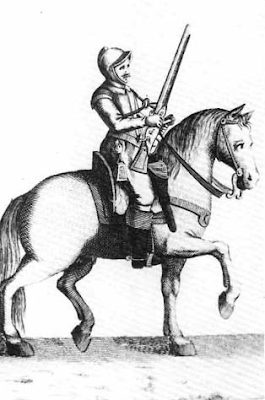
Harquebusier or possibly a Light Horseman (Note the lack of back and breast plate)

Armed with an Arquebus or carbine, pistols and a melee side arm and commonly armoured with a buff coat, helmet, and back and breast plates.  At the start of the period their main role was to provide fire support to the Demi-Lancers or Cuirassiers and fighting in melee was a secondary role.  As cuirassier armour was reduced they became more capable of fighting in melee on an equal footing.  They could also dismount and fulfil the same role as dragoons albeit with less effective fire arms.  As Cuirassiers began to disappear the Harquebusier became the primary cavalry force, probably from the 1650's onwards.  Unit sizes were probably the same as for Cuirassiers.

Experience: Before 1648 Raw or Experienced.  From 1648 Experienced or Veteran 

Training: Trained

Fighting style:1618 - 1635 Mixed firepower, 1635 - 1660 Mixed shock (if dismounted post 1635 count as mixed firepower.  

Light Cavalry

17th Century engraving of Croat light horse

Spanish armies started to use light cavalry later than most other participants in the Thirty Years War.  This was due to the nature of the warfare they engaged in which mainly consisted of sieges until 1640.  It was not until 1638 that they hired similar mercenary light horse types to those in use in Imperial armies.  These were sourced from Eastern Europe and would have consisted of Croats and Huzzars (Hungarian or Polish).  These would be unarmoured hussars rather than the Winged Hussar heavy horse.

They were armed with arquebus or carbines, pistols and melee side arms.  A lance was an option in Imperial service so this may have carried through to Croats and Huzzars in Spanish service.  Count as poorly equipped horse for melee purposes.  If they entered into melee they are at a disadvantage so would only do so against flanks or rear of units already engaged frontally or against a fleeing enemy.  They were hired in regiments of around 500 men but these seem to have been split into 2 or 3 squadrons in combat.

Experience: Experienced

Training: Trained

Fighting style: Skirmish

DRAGOONS

Armed with a musket and sword.  The Spanish only started to raise Dragoon units from 1632 onwards.  Prior to this Harquebusiers had provided dismounted fire support if required.  Like Harquebusiers Dragoons can shoot while mounted.  They may charge and fight in melee while mounted as described in the rules.  The quality of these troops was not particularly good and those engaged in fighting in Spain and Portugal had a very poor reputation.  Units were around 500 strong.

Experience: Raw or experienced

Training: Part trained or trained

Fighting Style: Firepower or mixed firepower

As this post is getting a bit lengthy I will look at the Spanish Infantry in my next post.

Wednesday, 18 October 2023

I'm not a well man, Carstairs!

Back in the far off days of my youth I read a set of humorous short stories about mountaineering which I can now find no trace of using my Google-Fu.  The two central characters were a pair of Brits; Carstairs and Carruthers.  One of the running jokes was that Carruthers was always complaining of various ailments while actually having the constitution of an ox (do people still say that?).  His running refrain being "I'm not a well man Carstairs" before successfully performing some herculean feat of physical performance.

Well here is the thing, unlike Carruthers, it turns out I actually am not a well man at the minute (Carstairs).  Out of the blue last Friday evening  I had a 'significant cardiac event' which is medic code speak for a heart attack.  On Friday the thirteenth for God's sake how unoriginal! As a result, I was rushed into the local cardiology unit where I was fitted with two stents as soon as they wheeled me through the door.  Well not immediately they had to have a bit of a look see and poke around first, but certainly within 15 minutes of arrival!  

Thanks to the wonders of the NHS I'm now back at  home and on a recovery plan and lots of tablets ( I swear I rattle if I move about too much) but I have to avoid sitting for too long.  I have to take things easy for a week or ten days to allow the stents to bed in which will have an impact on research and blogging,  Tabletop gaming is right out for the present as well.  Oh the joys of getting old ....... getting, be honest you are there already - it's the joys of getting even older now!  

But fear not dear reader I feel fine as a result of the stenting and will be back in full harness before too long.


Friday, 13 October 2023

Defining the troops in 'Stand with me to fight the field'


2mm Infantry Battalia 2:1 shot to pike so classed as mixed fire power
Now this looks like a big body of troops

Because I started these rules with a single battle in mind (Naseby 1645) I didn't give a great deal of thought to any troops other than the basic British Civil War types. As time passed and the rules started to take on a life of their own other troop types started to make their presence known! This started with the Scots at Marston Moor, led me to the 1645 campaign of Montrose and onwards to Cromwell in Scotland. Then other wars and campaigns started to impinge, what about Irish troops for Montrose or the Thirty Years War or the Irish Confederate wars or ..... well you get my drift!

I realised that when I started drafting the rules the definitions and traits used to calculate a units combat effectiveness (CE) actually acted as a 'pick n mix' troop generator and with only a little tweaking I could use them to create almost all of the 17th Century troop types found in Western and Central Europe.  Whether it will also work for Eastern Europe remains to be seen as I haven't considered the Polish Lithuanian Commonwealth and their enemies or the Ottoman armies as yet.

I will start with a recap on previous posts on the rules, A units ability to stay in a fight is measured by it's initial Combat Effectiveness (CE) rating.  As this reduces they become more brittle until they eventually break and flee on a CE of zero (assuming that they are not replaced with reserves before that point.   A unit’s CE is reduced by one step once one hit per base has been inflicted on the unit.  This makes larger units more robust than smaller ones as they have more bases. To offset that advantage large units suffer movement penalties. 

In turn CE is calculated by starting with a base value of five and adding or subtracting from that based upon training, experience and status.  That latter factor is based on whether the unit is elite or unwilling.  The resulting value is the units CE and has an impact on reaction tests and is reduced by combat outcomes and reaction test results. On top of those factors a unit may have a trait of being armoured, poorly equipped and for melee have a weapon reach adjustment.  Basic weapons differences for ranged combat are also included.  All units have a combat style ranging from Shock to Skirmish which create different combat adjustments and impact willingness to enter melee.

A units Experience, training and status will be tied into the army they are part of, based upon historical performance.  More on that in future posts though.

At the moment I have:

Reiters/Currassiers are defined as armoured with a weapon reach advantage for pistols in melee.  They fight as shock, mixed shock or mixed fire power.  They tend to deploy in deeper formations than either Lancers or Harquebusiers 

Demi-Lancers are Reiters armed with a Lance and close combat weapon but no firearms.  They are classed as shock.  Just about unknown in Western Europe in the period.

Harquebusiers are defined as cavalry with a weapon reach advantage for using pistols in melee.  They may also be able to stand off and shoot in support of Reiters if armed with carbines or similar early in the period.  Later they replace Reiters as the mounted melee arm.  As a result their fighting style may be mixed fire power, mixed shock or (pure) shock.

2mm Irregular Miniatures Horse using their Armoured Pistolier castings
These could be Reiters or Harquebusiers depending on the paint scheme

Poorly armed horse are defined as Harquebusiers who lack back and breast plates and rely mainly on close combat weapons such as swords.  They have the poorly armed combat adjustment and have no reach advantage in melee.  These represent units such as the Royalist Northern Horse.  They will count as mixed shock.  They are not classed as light cavalry as they are still a melee type.

Scots (and other) unarmoured lancers are treated as having a melee reach advantage for using lances.  Otherwise they count as Harquebusiers or poorly armed horse depending on the level of equipment.  In all cases they will be shock or mixed shock.

Irregular Miniatures 6mm Covenanting lancers

Light Horse are defined as skirmishers.  They have carbines, or arquebus, pistols and close combat weapons.

For Infantry I have;

Bodies of pike and shot are classed as mixed shock if pike outnumber shot or mixed firepower if shot out number pike.  Pike bases (only) gain a bonus in melee and a reach advantage.

6mm mixed fire power infantry, these are later Irregular Miniature sculpts


Same again but in 2mm and a deeper (Dutch style) formation

Musket only units will count as mixed firepower or firepower depending on their willingness to enter melee.

6mm Musket only formation

Scottish Highlanders are given mixed shock as a combat style and all fight as if pike armed in melee but with a pole arm reach advantage.  If they lack firearms they count as having bow support from the rear ranks which gives a melee bonus in the first round of combat.

6mm Highlanders from Irregular Miniatures (some of my earliest 6mm)

That about covers the main troop types.  Play tests will tell me if it all works as intended.