Showing posts with label Military history. Show all posts

Saturday, 1 November 2025

Helion's Bavarian Armies during the TYW - a review

I'm a bit of a fan of the Helion Century of the Soldier series as it covers one of my core periods of interest, the 17th Century.  I have three or four on my bookshelf already including another by Laurence Spring the author of this book.  It is only cost which prevents me having many, many more.  They are best thought of as an step up from Osprey's offering as they are of a higher page count so can go deeper into their subjects.  I'd normally go with Osprey as an introduction on a topic and then the Helion if I then want to delve deeper.  As a bonus Helion have opened a second hand section to their webstore where books both second hand or with minor cosmetic damage (as was the case for this purchase) are offered at a discount.  With this book I made an offer of £7.50, which included postage, against a list price of £25.00 for a new copy and it is the latest updated second edition.

Looks interesting

I have wanted this particular volume for a while now as my re-enactment unit within the Sealed Knot has a connection to Bavaria in the Thirty Years war due to our links with the Memmingen Pikeniere who invite us to join them in the four yearly 'Wallensteinfest'.  If I'm going to take part in a Bavarian Thirty Years War event I felt that it would be nice to have some background information.  This book gives me that, in spades.

My copy is softback but quite robust.  Excluding the rather useful bibliography the main text runs to 212 pages including 16 pages of colour illustrations.  the contents page shows the main areas covered.

There is a lot of information crammed in here

From a tabletop wargamers perspective not all of those chapters are of key importance although for creating a living history background for a re-enactor the information is a gold mine of detail.   So for example Chapters 8,9 and 11 and 12  cover things that don't see much coverage when the dice are being rolled but will add a lot of depth to a living history persona.  On the plus side the plates have some lovely illustrations of colours carried by the Bavarians.  The chapters on "The rank and file and "Organisation" give clues on unit headcounts at various points in the war.  The appendix on Regiments of the Bavarian army gives a potted biography of every unit, even the minor unit we recreate (not brilliantly it has to be said) when over there.  The bibliography is useful even if it does cite a couple of Osprey titles amongst the primary sources.

Now for the not so good points.  For a book subtitled 'The backbone of the Catholic League" it doesn't give a chronology of the League or any information on it's composition.  I had to turn to Wikipedia to for that.   There isn't an index, to me this is a major omission in what is significant reference work.  Then, despite having chapters on Organisation and Tactics it doesn't give me all the detail I had hoped for to allow me to create a table top representation of the units that make up the Bavarian army and to show it's combat deployments, unit formations and battlefield tactics.  I was hoping to have a run down on how Tilly organised and fought his forces and how those things changed after his death.  After all we know Tilly favoured larger infantry combat formations but very little detail is provided.  In fact Tilly is hardly mentioned after the short biography in Chapter 1!  I'd tell you exactly how few but there isn't an index to let me easily do that.  Some information on how the Army fought is there but it is a pretty broad brush approach over all.  We do get some data on unit sizes and pike to shot ratios but very little of the depth and width of infantry formations.  Period military textbooks are quoted but these range from late 16th century material, Gerat Barry's description of the Spanish formations from the early 1630's, through to English sources and post Thirty Years War material without any explanation of what might be relevant and why.

I know hard information is difficult to come by but it would be nice to have comments to say this author writing in 1600 gives us an idea of where tactics stood at the outset of the war, this from 1632 despite detailing Spanish doctrines may show what influenced Tilly.  Such and such a source although written in 1650 may be showing us the final tactical developments.  From a wargaming perspective I have seen this stuff done in much better ways.

Like the other Helion book I have by this author (In the Emperor's Service which covers Wallenstein's armies) it has the feel of an academic paper rather than a book aimed just at wargamers alone.  For anyone doing living history it is a treasure trove of background information on Bavarian forces.  For the pure wargamer it is a little light on the nitty gritty of formations and tactical usages, but still a good source.  I suppose I bring my own bias to the book as what I really want is guidance on how to portray the army on a wargames table and which tactics to use with it.  After reading it I'm still unclear on how (for example) Tilly deployed a foot Battalia and how this changed after First Breitenfeld, There is too great a relance on sources that even at the time would have been considered a secondary source and there are sources used that have no direct bearing on the Bavarian army.  Those are used to show general trends in tactics but if you are buying a book about a single army in a single period it's likely that the reader knows that stuff already. Overall I'd score this book as a 7/10 and I'm glad I obtained it at a deep discount.

Tuesday, 26 May 2020

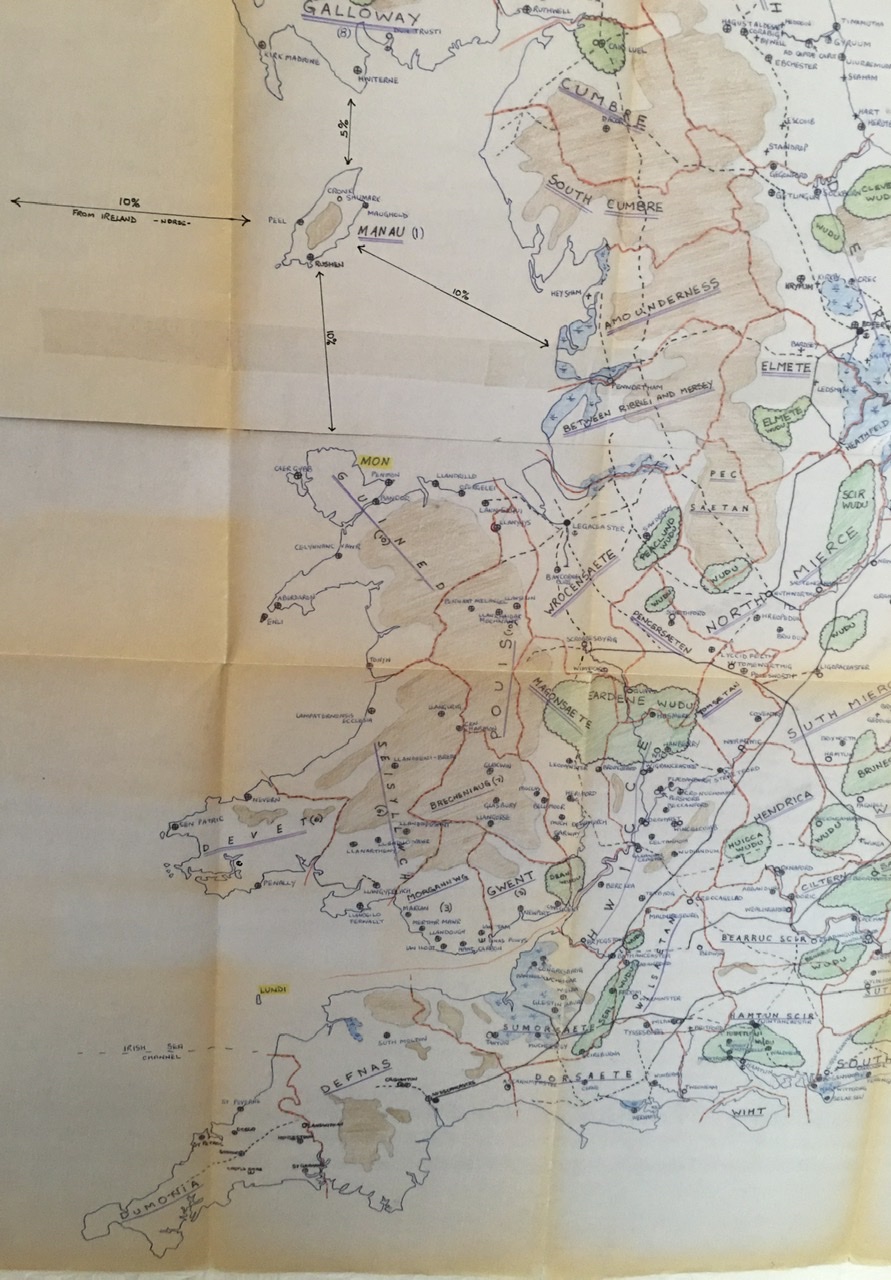
The Dark Ages Campaign - Master Map

A short post as Nundunket and Jolly Broom Man are interested in the map.  I took a few minutes to unfold the master map I created back in the early 1980's and to get some photo's.  Its a big beast printed out on three sheets of A3 or maybe A2 paper, I should have measured it shouldn't I.  The original was hand copied from the OS Britain Before the Norman Conquest map (now sadly out of print).onto tracing paper selecting the details I needed and adding a few other things.  I then took it down to a printing and copying shop in York (when they still existed in most towns) who copied it onto paper for me on a dyeline printer.  I hand coloured the dyeline print  and taped the three sections together.  It has spent most of the last 35 - 40 years folded up which is why it hasn't faded too much.  I got bored with colouring in the hills and mountains within Scotland which is why the detailing stops at the line of the Firths of Clyde and Forth.  Most of the rest of the map would have been brown and for the solo campaign I don't need that level of detail anyway.

Dyeline was a system used before digital printing to copy and print large plans. Because it pre-dates digital imaging technology there is no electronic back up copy. which has always worried me.  I really should get a back up although who would need it is beyond me.

The entire master multiplayer version of the map

I'm quite proud of it to be honest.  I was a geology student and then worked for a very short time in a County Council road planning department and was taught a bit about drawing up plans which helped a lot with this.  It's the only evidence I have of my abilities as a map maker from before the computerisation of imaging and storage.


The South Eastern part in detail


The South West part in more detail

Southern Scotland & Northern England
The bit of the map showing Northern Scotland doesn't seem to want to load at the moment.  I will try again later.

Be safe and take care of yourselves

Thursday, 13 December 2018

The Great Civil War in Lancashire - researching for a campaign

I started doing some research about 10 days ago, which is why I haven't blogged so far in December.  I have pretty much settled on a map using point to point movement.  Each location will have an initial recruitment value and a replacements value.  This became feasible when I came across population estimates derived from Heath Tax records from 1662.

The hearth tax was an 17th century tax on wealth based upon the idea that the more fireplaces or stoves a household had the wealthier it must be.  It was first implemented after the Restoration.  Fortunately the National Archives holds the records for Lancashire from 1662.  They are at file ref E179/250/11 if anyone wants to take a look at them.  Sadly they have not yet been converted to a digital document so at some stage I need to visit the archives at Kew to obtain additional details. 

I came across these from B G Blackwood's 'The Lancashire Gentry in the Great Rebellion 1642 - 1660' (Chetham Society 1978) which I found parts of on line.  Blackwood used the Hearth Tax records to estimate the population of each of the Lancashire Hundreds and the larger towns within them, by assuming 4.5 people per household.  How he settled on a multiplier of 4.5 I have no idea, but as it derives from his university thesis I'm happy to accept that there was some logic behind it.  He further assumes that 20 years after the start of hostilities the population in Lancashire would have recovered from the deaths of the wars.  I'm happy to accept that theory as well if only due to the fact that no other equivalent records exist.  What he didn't do was publish his results for the smaller townships such as Garstang or Clitheroe which is why I'm planning a trip to the National Archives at Kew next time I'm in London.

Anyway that, coupled with the militia returns for 1639 (summarised  in Stephen Bull's book which I mentioned in the last post I published) gives me a start on the figures for estimating potential manpower.  The raw data is that the population of Lancashire was in the very close order of 150,000 with just under 17,000 living in communities of 1,000 people or more.  That breaks down as follows:

Hundred Population
Salford 48,451.0
Blackburn 21,330.0
West Derby 31,207.0
Leyland 10,656.0
Amounderness 17,667.0
Lonsdale 21,357.0
  150,668.0
 
The major town's populations run between Manchester at 3,690 down to Lancaster at 949 souls.

So that's manpower and recruitment estimates in hand and if I look at the rest of the Hearth Tax data I should be able to set a threshold for the minimum size of township to represent on the map.  My default for that is likely to be 250 souls.  Adding any vital defensive sites and magazines mentioned in Broxup or Bull should fill out the rest of the map locations.  A bit of editing to ensure that the locations represented are spaced by travel time and the map is about there bar the art work which will probably be based on John Speed's map from 1610.

Image result for Map of Lancashire in 1610

More next time on the supply, training and events generation system.

Thursday, 26 November 2015

Europe's Tragedy - A new history of the Thirty Years War

As readers will have probably worked out for themselves the 17th Century is one of my key areas of interest.  This came about almost by accident through a friends involvement in historical re-enacting with the Sealed Knot.  One day about 30 years ago he turned up at my door with a full set of musketeer's equipment and a set of period costume.  The rest as they say is history.  Mostly the history of the British Civil Wars.  As always happens trying to understand one period of history leads to a need to understand the events that lead up to it which took me into the development of tactics during the Thirty Years War.  Lets call it the TYW from here on in.


Recently I came across an offer on Amazon's kindle book pages I couldn't refuse. A free download of a recent (2009) history of the TYW. So I downloaded it.  Quite literally nothing ventured, but as it turned out quite a lot gained.  The book in question is Europe's Tragedy - a new history of the Thirty Years War by Peter H Wilson.  Sadly you will have to pay £9.99 for the Kindle version now, but if you want a good overall history that covers the military, political  and social aspects of the war and it's aftermath this book has everything you need.


From a war gamer's perspective it doesn't go into a lot of detail of the individual battles but it gives a good background as to why those battles were fought and the problems all sides had in keeping men in the field. That said most of the major battles do get a map and there is also a campaign map at the end of the book.  It also provides good background on some of the wars on the fringes of the TYW such as the War of the Mantuan Succession. 


The book starts with a look at the way the political and religious tensions built up within the Holy Roman Empire in the late 16th century.  It makes it clear that the Austrian Hapsburgs were prepared to allow a reasonable amount of religious freedom and that the war when it came wasn't a purely religious war.  The rulers of the various German states were instead manoeuvring for power one against the other within the confines of the Imperial system.


It then goes on to look at the various factions both religious. national and political and their interactions before turning to a chronological history of the war.  It ends with a look at the longer term impact of the war especially the economic consequences.


The kindle edition suffers from an inability to quickly jump back and forth in the text to look at maps or remind yourself of earlier events.  I found that downloading a decent map of the geography of central Europe in the early 17th century helped enormously as my modern geographic knowledge of the area wasn't of any help with the location of early modern central European states! That though is a minor criticism of what is other wise a decent introduction to a very complex subject.