Showing posts with label Irregular Miniatures. Show all posts

Wednesday, 8 October 2025

Bring on the empty horses

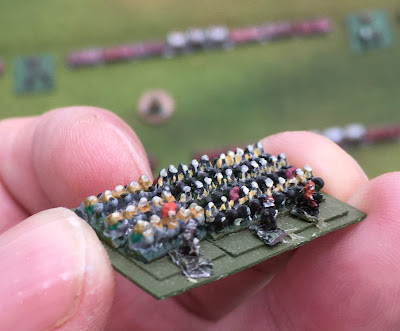
Apparently said by Cecil B DeMille according to David Niven and who am I to doubt David Niven.  He meant horses without riders but empty horses has a certain ring to it don't you think?  My version of said empty horses are accompanied by their riders though.  These are dismounted dragoons in a firing line.  It's a basing idea I came up with for my 2mm ACW cavalry and as I liked the resulting look I have gone for the same look for my 6mm pike and shot dragoons.  On the plus side it shows they are dragoons rather than skirmishing musketeers and reduces the number of bases I have to create, but on the downside the horse holders and dismounted dragoons are too close together.  Still I doubt anyone will complain.


The empty horses (Which would be a great name for a band don't you think)

As well as the empty horses, as a bonus, here are some full horses, AKA the mounted variant for these dragoons.  I have painted both the mounted and dismounted versions in the same style I used for the dragoons I already had, which were painted a couple or three decades ago.  It's not how I would do it now but it keeps the same appearance with the existing dragoon base they will be deployed alongside to form a combat unit.  So that's me out of the starting blocks for October's painting work.


And here they are all full of riders

The phone camera struggled with direct sunlight and over exposed the shots by a couple of stops.  I may have to play with the images and repost them.  The black background might have been part of the issue, who knows my phone camera seems to have a mind of it's own.  Strike one against AI?

Both together


Friday, 26 September 2025

More 6mm Pike and Shot troops

 A few weeks back I made a purchase from the new supplier of Irregular Miniature 6mm.  These consisted of some Cuirassiers, some early pike and shot (in helmets), light artillery and as a bonus a free base of sheep (of all things).  I have also been rebasing a few bits and pieces I hadn't gotten around to when I was doing the rest of my Irregular pike and shot figures.  I still have a fair number to paint but I moved these new figures to the head of the painting queue to see what they look like when completed.  The others, well that is a job for next month.  At the last count I actually have over 1,000 unpainted 6mm figures airplanes and vehicles languishing in the lead pile, so next month and quite a few months after in reality!

These figures are a joy to paint

And look just as nice from the rear

The pike and shot figures and artillery are nice castings but the cuirassiers are starting to show their age and have more flash between figures than I would like.  Rather more than I could manage to remove in fact.  Thankfully once painted it doesn't really show up too badly.  I could go with Baccus for any further cuirassier purchases but the rest of my troops for this period are from Irregular so I'm going to stick with them and maintain continuity.

The heavies!  Three quarter armoured cuirassiers

As always with Irregular's 6mm stuff they paint up far better than the raw castings suggest will be the case and I don't think they look half bad once finished and painted.  I have painted the foot as part of the Swedish Yellow Brigade, but will actually split them into two units when I add an additional pike base to give me two thirds of that brigade as it was deployed at first Breitenfeld.  The Cuirassiers are more generic TYW types who will be equally at home in several different armies for that conflict.  The same goes for the artillery.  As for the sheep they don't seem to care whether they are Catholic or Protestant sheep as long as there is grass to munch!

Artillery: smallest calibre to the left getting larger as you move right


Sheep may safely graze mainly because the Yellow Regiment is as far away as possible

Friday, 7 March 2025

Megalomania strikes again!

When I first started to collect 6mm BCW troops the plan was to play Marston Moor using the Forlorn Hope rules.  I don't think I really had a grasp on how large the armies would need to be to do that!  The plan stalled for various reasons, but as a result I had a decent number of Scots Covenantors both painted and lurking in the lead pile awaiting attention.  I also had a number of Highlander and Irish figures which are now just screaming Montrose at me!  That would have the advantage of needing rather less units for the actions from the 1644-45 campaign in Scotland than Marston Moor would require and gives a use for all those Hodden Gray hordes!  With that in mind I painted up some of the lead mountain refugees as O'Cahan's and Laghtnans Irish regiments, using some IM Irish pike and shot castings I found in the depths of the lead pile.  Yes it's a new rabbit hole to go down folks!

Two of the three Irish Brigade regiments plus some Highlanders

Of course that hasn't stopped me drooling over Marston Moor!  I need to organise my troops so I may as well use the Orbat for Marston Moor for that, don't you think?  I'm not overreaching honest!

Byron's Royalist Cavalry Brigade  (poor iPhone image soz)

I'm working on a rough (very rough if I'm entirely honest) 200 men per full base or 100 for a shot half base (as seen in the Irish Brigade).  I'm making no attempt to show proper pike:shot ratios as those differed across the period of the war.  Instead I will have a note of the actual number of pike and shot for each unit for use in combat calculations.

The rebasing project has also set me on a path looking for a set of BCW rules that is flexible on unit sizes versus the actual number of men in the original unit.  I suppose I could adapt my own set or use 'In Deo Veritas' but my curiosity has been peeked by the 'For King and Parliament' rules and you can never have enough rules; right?  Reviews online seem positive but what does the assembled brains trust think of these rules, anyone played them?

Wednesday, 19 February 2025

Irregular Miniatures 2mm and 6mm ranges update

Some good news to share.  Things have moved on at Irregular, Ron has retired at the grand old age of 98 after a mere 44 years of building up the business, Lawrence and Tara are moving on and Ian and Anne have decided to concentrate on the 10 mm to 54mm ranges.  The 2mm and 6mm ranges have been taken in hand by Nas Bat an ex-Irregular employee who will take on casting and handling orders for those ranges.  He currently has the 2mm moulds and some of the 6mm ranges.

More information at IRREG-2mm 

Wednesday, 12 February 2025

Painting Irregular Miniatures Covenantor shot

So far so good with regard to 2025 and painting, my mojo remains intact and shows no signs of wandering off on vacation again.  Painting Scottish Covenantors is fairly quick compared to the ancients I have been doing where there is a lack of uniformity.  Mostly its a case of give them a coat of Hodden Grey and pick out a few details and done.  The problem is I'm running out of Scot's infantry until Irregular reopen sales of 6mm figures or Ian Kay takes pity on me.  Still I have lots of other BCW 6mm to paint so all is well.

Hodden Grey...it's grey but what shade exactly?

So what shade of grey was Hodden Grey.  The answer is that isn't the right question!  Hodden Grey was a type of cloth rather than an exact shade.  It was made by mixing the wool of one dark fleece with wool from about a dozen white ones.  Now as white and dark cover a multitude of sins when it comes to sheep the resulting colour would vary from a neutral mid grey through to grey with a brown tinge!  which is nice when mixing paint shades as it is very forgiving.

For these I primed white and gave a thin wash of black ink to bring out the detail and a bit of pre-shading.  Bases got a coat of Vallejo Khaki as it is a good match for my basing sand and then it was time to slap on a coat (and britches) of grey.  This was literally a slap on job as at this stage accuracy doesn't really matter.  Dotting in the faces and hands and a dark brown for the muskets, a pale blue for the bonnets and a mix of red brown for hair and the job is almost done.  Last pick out some straps and scabbards in a light brown and a few lower legs in a contrasting colour to high light the hose (hoes?  long socks).  Once that's dry (a matter of a couple of minutes with acrylics) a coat of satin varnish for protection and a wash of Agrax Eathshade.  I leave them upside down on the painting sticks balanced between two paint pots to get the ink to pool where shadows would naturally be and then lastly a touch of silver where gun barrels can be seen and a bit of the light blue to ensure the bonnets 'pop'.  All done in under an hour if you ignore drying times.

The Irregular figures paint up well and have the advantage of being available in individual strips (or will be as and when they come back on the market).

These will be joining Crawford Lindsey's regiment

The castings have improved a lot over the years from the original dolly peg style figures and are not far behind Baccus now in terms of quality.  I emailed Ian Kay about filling the gaps in my project and he has said he hopes to be more organised in about a month's time and to ask again then, which sounds promising.  So for now it's on to some Scottish Lancers as the next units.


Wednesday, 29 January 2025

Catching up on old projects (a slight reprise)

I have actually achieved a target for 2025 before January is out!  My Irregular Miniatures 6mm British Civil War troops are rebased and a limited amount of repairing and repainting has been carried out as well.  The standard of painting is OK but some of the details needed updating as I know a bit more than I did when first painting them!  For example I had given  a handful of Scottish infantry royal standards (the red lion rampant on a yellow ground) when only the King or his appointee were allowed to carry it.  Most foot regiments had a white colonel's colour with perhaps the colonels coat of arms so a number of flags were updated.  The cast on bases had to be redone so they blended into the basing sand I use as well.

So here we are all the painted 6mm ECW are rebased

Scots at the front two lines and English behind them.

For the unpainted figures I managed to undercoat all of them as I had a day with low humidity, reasonable temperatures and no wind so out came the rattle cans of primer.  Some of these are on the painting table awaiting  my attention.  I'm considering giving for King and Parliament rules a try they sound interesting and are a reasonable price.

I like this view apart from the poor exposure on my iPhone camera washing out the green cloth's depth of colour

In other news there is a new Facebook group for fans of Irregular Miniatures called Highly Irregular.  It covers 2mm and 6mm as well as their larger scale lines.

Sunday, 8 December 2024

British Civil War 6mm forces

These are my oldest 6mm figures and are all from Irregular Miniatures.  I bought most of them from the wargames shop that used to be near King's Cross station back in the late 1980's or early 1990's.  After the intervening 30 plus years they are a little battered and in need of some TLC and a rebase.  Some are still awaiting the touch of a paint brush and a first base!

So here they all are.  Zoom in too see the details

Most of them are the original Irregular Miniatures designs with musketeers that are cast standing feet together with musket at port across the chest and that made them fragile.  Unsurprisingly a number have snapped off, or are in danger of snapping off, at the ankles.  Some are the later design which are more robust and have more animation to them.  Those have alternating firing and loading figures on each strip which isn't how I want them.  I prefer a rank to be all firing, all loading or all standing waiting rather than a mixture.  Still a bit of careful work with side cutters will solve that.

Old style musketeers on show here.  Painted 30 years ago.

And here are the newer style figures painted much more recently.

I'm struggling to decide how to rebase these figures.  The pikemen are cast in close order, shoulder to shoulder with no way to split them down. so I am stuck with the casting's frontages of 20mm or multiples of that.  The shot are on 30mm frontages and cavalry on 25mm so unlike DBA or ADLG I can't use a standard base frontage.  I may have to go old school and count each strip as being 100 men and just live with the different frontages as showing different order, pike in close order and shot in order.  No matter what I decide to do, there will have to be an order heading off to Warbases in due course as nothing in my pile of DBA style bases will match.  Plus as you can see from the first image there is some painting to be done!  The other issue is that I will have to ask  Irregular if they can supply the figures needed to complete some units as they are not retailing their 6mm range at present.

Monday, 6 June 2022

2mm ACW - Army of Northern Virginia infantry

This post is one of pure self-congratulation as I have now made and based all the infantry required for the Army of Northern Virginia for Gettysburg. That OOB has the most Confederate infantry stands of any of the Altar of Freedom scenarios for Eastern or Western Theatres, a total of 39 brigade bases. My order from Warbases arrived on Saturday so I have all the bases I am going to need for the rest of the project and as a bonus Mrs E and our guests went out to a Jubilee tea party so I was able to get a coat spray paint on them (The bases not Mrs E and guests).

I am reorganising the artillery onto bigger bases so that they have a more accurate frontage.  Altar of Freedom has an optional rule which puts artillery onto 60 x 60 mm bases rather than the standard 30 x 30.  I have split the difference and put three guns and limbers onto a 60 x 30.  That is because I forgot to order 60 x 60 and got extra 60 x 30 instead...DOH!  Still as the standard base is only 30mm deep I can live with that and I have the optional frontage right!  It will not really make any difference as I am building both sides of this conflict.

The standard bases are 30 x 30mm this is 60 x 30 mm

The next thing to do is finish the Army of the Potomac's infantry, then buy the necessary extra artillery, generals and HQ tentage castings.  Those will be from Irregular Miniatures but i will probably not purchase these until later in the summer.  All in including bases I estimate the two full armies will cost no more than £65 and that gives me enough units to fight any action of the war, East or West.  Terrain items will increase that a bit, but those can be used for other periods as well so I'm not counting that cost.  If Mrs E asks I scratch made everything so it was all free!

Sunday, 22 May 2022

The painting table - May 2022

My painting table is unusually crowded at the moment.  Mainly this is due to the 2mm ACW production line.  On the table are bases that just need the bases a dry brushing in green so they will be out of the way PDQ.  Towards the top right are a couple of 2mm artillery bases but I can't rebase these until more MDF bases arrive in the relevant size

There are also some Brigade Models small scale scenery buildings from their Medieval and ACW ranges and some 6mm Hun Light cavalry, from both Irregular and Baccus. The later have been waiting on my attention for quite a while now!  There are also a few bits n bobs awaiting repurposing for my 6mm ancient armies and a small number of O8 3mm armoured vehicles for the 1980's cold war gone hot games.

The current state of play

I'm going to try to make inroads into these before I post a June painting table update, well it would be embarrassing to keep posting the same picture wouldn't it!  Lot's to do and so little time to do it so if I don't make progress feel free to nag at me!

Wednesday, 4 May 2022

More 6mm World war two - this time the Home Guard.

 Did you know that when first set up the Home Guard was called the LDV - Local Defence Volunteers, although my Grandfather called the organisation "Look, Duck and Vanish"!  He served with the LDV and Home Guard as he was too old for the main forces in 1939 at 43 years old.  He'd done his stint in the latter years of the Great War.  I'm not sure if any of the vehicles below would have been familiar to him or whether they were more likely to be seen on and near the South coast.


Home Guard platoon.  I can see Pike's scarf in there!

First up is the PBI of the Home Guard.  The rifle sections are Irregular Miniatures from their Spanish Civil War range The MG section are also from Irregular but are a Lewis Gun team from their First World War range.  I want to have a look at the 2D6 range for World War two as they have a rather nice deployed Lewis Gun team.

Next are some improvised armoured vehicles from Irregular.  The desperate need for armoured cars and trucks was filled by Spanish Civil War style improvised stuff.  These are actual British designs which were built and placed into service!

A Beaverette.  Slap some steel plate onto a saloon car and call it done!

I'm not sure how effective the Beaverette would have been (or any of the others to be honest) but it's quirky and gives a scout car option.  The next three vehicles were more mobile pill boxes than anything resembling an armoured fighting vehicle.  Firstly the Armadillo with an open topped concrete fighting compartment.

An Armadillo.  Watch out for grenades lads!

Next up two other variants on the pill box on wheels, the Bison.  Apparently the Bison 1 (on the left) was so underpowered it could hardly move for the weight of the concrete box on the back.  The Bison 3 was a bit nippier as it carried a lighter steel fighting compartment.  The roof was a weak point though as it was a (IIRC) steel mesh covered with canvas.  Oh and the white squares on the bonnets are gas detection patches.


A pair of Bisons

Now for something a little more main stream and which could give the invaders a moments pause.  An Infantry Tank mark 2 (A12) 'Matilda 2'.  The 2pdr gun was effective against anything the Germans had although it lacked an HE round.  The only way to be certain of stopping these was with 105mm artillery or Flak 88mm in a direct fire AT role.

Matilda 2 from GHQ Models

Lastly (and sorry for the fuzzy photo) a Cruiser Mk 1 (A9) this is another GHQ model.  

Cruiser Mk1 also GHQ

These are not fully painted and have been sat in the lead pile for a few years so they will need a bit of tarting up.  Although the GHQ models are incredible castings they are only available in packs of five and are expensive compared to Heroics and Ros.  2D6 models are not doing early war stuff yet so any further purchases will be from H & R.  Still I have enough for a small game or two.


Friday, 18 February 2022

Let Battle commence - The Battle of Timerton part 3

So the table is set up and troops deployed so I shall hand over to the generals to describe events and only break the narrative to explain how the rules have operated.  There will be some stretching of the narrative to make it seem more like an actual battle account but no fiddling with the operation of the rules.  So instead of saying the rules limit visibility to x yards the narrative might say 'a slight mist hung over the field at this early hour limiting my view to no more than x yards'.   For me if the game allows a believable narrative to develop then the rules are working as intended.


From A True Relation of Timerton Fight containing all which it is needful to know of the designs of Prinz Ruprecht towards the Godly folk of Birmingham

"The army being drawn together close upon Northampton it was resolved that it should March to the East to find the forces of the German Prince Ruprecht.   Certain intelligences were provided that he intended to move against Birmingham and we were instructed to interfere with these designs.  Accordingly we went via Daventry intending to March through Rugby towards Coventry.  No sooner had the army left the vicinity of Daventry but we received word that a large force was some distance to the East.  We bent our course accordingly and two days after, the army's forage parties clashed with bodies of horse close upon the village of Timerton.  Scouts being sent forth it was ascertained that the enemy was less than days march from us and marching hither with alacrity.

A council being called it was resolved to meet the enemy on the morrow.  Accordingly an order of march and scheme of deployment was drawn up such that every officer should know his place.  Some time after sunset scouts came into with some intelligence of the numbers of the enemy,  they having espied them upon the road.  Their count was that the enemy seemed close to our numbers but had no artillery.  Five great bodies of foot and numerous bodies of horse were seen to be present."

Neither side's horse have the required numbers to 'out scout' the other so numbers of troops are reported with only a 10% variation.  It is always possible to reduce or increase the reported number of bodies by one hence the no artillery present report.  After scouting results are disclosed both sides draft a general deployment plan before terrain is generated.  Tactical orders are written once terrain is laid out and the initial deployments made.  There is scope to adjust the deployment as sketched but this is limited. In a two player game the Commanders are deployed first then the front lines of each army and then any troops visible to the enemy commanders.  Then tactical orders are drawn up.  If being used, standing orders covering things such as the range at which a unit will start shooting, or foot will form pike stands against cavalry can be drawn up in advance or the generic ones from the rules used (based on experience and training).

From the letters of Sir Robert Snell (Commander of the Royalists)

"The Prince had granted some discretion as to our actions subject only to the proviso that we should seek out any opportunity to bring the Rebels to the field of battle such that by so doing they should have no liberty to interfere with his plans.  In accordance with these commands I ordered the army to advance towards Daventry so as to appear to threaten Northampton and cut the great North Road.  Shortly after we commenced this motion I had word that a very large force of the rebels was ahead of me, which very much suited my purpose.  My officers being well appraised of my intentions there was naught to do except bring the enemy to battle, which we set out to do with great good will.  By some mischance we knew not how close they were until some skirmishes were reported close to our front and all we could ascertain was that the enemy was present in numbers akin to our own.  I therefore gave my orders for the next day as it seemed that we should fight in the morning, whether we willed it or not.

The ground was not such as I should have wished for, indeed it was greatly to our disadvantage.  Should the enemy not have been upon us I should have withdrawn a piece to seek better ground.  I considered what might be done and determined that we should close upon them as quickly as possible to reduce the advantage they held in artillery and also to occupy the enclosures around Timerton village."

The table is divided into 1 foot squares of and terrain is laid out using cards drawn from a standard pack of playing cards, one per square.  Any picture card, ace or joker creates a terrain item in the square, all others cards create clear squares.  Terrain items include the start of a river or stream which, if drawn, will run to a random table edge.  I have decided that the rules need a mechanism to allow players to move terrain to avoid battlefields like this one!  Once scouting reports are exchanged and terrain set out the players write orders.  These consist of an action, a target (location or enemy unit) and a speed of action.  There can also be a delay built in before acting upon the order.  Changes of orders during the game require a reaction test to be passed and the new order to be transmitted down the chain of command.

The Battlefield is split by a river which divides the Royalist deployment area into two roughly equal halves.  Because of the deployment decided on before the terrain was laid out the Royalists will not be able to easily co-ordinate their actions.  The Parliamentarians are not having things all their own way either as a stream is restricting the movement of their right wing.  Also if they advance too far then their left will be separated from the rest of the army by the river.  Lastly there is a low ridge directly to their front which masks one of their guns but would make a decent defensible feature.  Time to amend the deployment and write orders.  Back to the True relation.

"On seeing the lay of the land over which the battle were to be fought it was clear that the intended deployment would ill serve the Parliament men.  My Lord x determined to make a shift in the placing of the guns on the right to allow them to better play upon the enemy's ranks.  Other than this and the small adjustment to the right most Infantry battalia to allow this all else seemed to serve as well as may be...."

Using the change to deployment rules one field piece and an infantry battalia are exchanged no other changes are made by either side.  I'm wondering if there should be a turn one AP penalty for to any units whose location is amended under these rules.

 "...These changes being taken in hand orders were confirmed.  The left hand cavalry wing being over matched should make best speed to deny the enemy use of the bridge over the River Timer and to hold the ground betwixt the eminence on the right and the river.  It was desired that they should not do ought else but hold that place.  The centre was to advance with the greatest of haste and bring the enemy foot to hand strokes with only the minimum of musketry first.  The Horse on the Right were to advance apace to be forward of the foot and to drive the opposing horse from the field.  It was allowed that to achieve this they should extend their lines further unto that flank."

Parliament's adjusted deployment

The Royalist deployment. The wing furthest from the camera is stacked up deep!

In the photo's above the coloured markers behind each unit show the the current CE status which is based on the outcome (before situational adjustments) and assuming an average dice roll of 7 on 2D6 when taking the test.  They are colour coded for a general description but don't show the exact value.

From an account written by an unknown author (possibly Captain Leonard Deanswood)

"We were stood to our arms before sunrise and as the day dawned I saw the enemy before me standing in ranks and files just as were we.  Before we could be disheartened by the sight we were ordered to "Stand right in our ranks and files" and then to 'march on' We set off at a good steady pace towards Timerton Fields.  I discerned that our horse on the left wing commenced their advance by wheeling several bodies to their left hand to over bear upon the Roundheads they faced.  I saw not what transpired on the right.  As our Battalia advanced I saw that we faced difficulties in deploying the brigade as desired due the a river splitting our lines.  Two Battalia were on the far side of this and we unable to effect a juncture with them should need arise.  Though only a few yards away they may had as well been upon the moon.  I saw that we should be forced to fight two battles one upon either side of the river."

The game starts at 05.24 a few minutes before sunrise and with restricted visibility.  This is a random time based on dice rolls for a pick up game.  The two armies are a little over 600 yards apart and visible to each other as visibility is 1,000 yards during "civil twilight".  The Royalists won the initiative by virtue of a higher roll on 3D6 despite a lower command span and will move first.  Parliament were hampered by my adjusting their role for making changes to the planned deployment.  Well I did say I might create a disadvantage for doing that!  This is an IGOUGO game so moving first has advantages for taking advantageous positions but disadvantages as the second player may be able to fire with a closer range advantage, especially with artillery.

The Royalist advance is hampered by the need to extend their line to the flanks.  They have opted to give fast advance and assault orders to the front line which requires at least 50% of their action points to be spent on closing the distance between them and the enemy on contact they can spend a turn shooting before charging home.  The second and third lines have fast support orders which allow them to keep pace with the front line but to run over them.  Support means that they can shoot in support and replace units in the front line that fall back or for horse join in melee instigated by the unit they are supporting after the first turn.

At the end of the Royalist first turn, their troops are struggling to deploy for combat


By the end of the second turn they have some semblance of order! 


Turn 2 ends with Parliament in control of the high ground


And the cavalry on Parliament's left about to clash

The first two turns consisted of both sides frantically rearranging their cavalry wings which takes time as the manoeuvre rules are designed to make this difficult.  Parliament have their left wing in orderly formations as are the opposing horse.  Both sides infantry is struggling to deploy and the bridge is not closed to the Royalists but is going to be heavily contested.  The first clashes are about to occur and that will tell a tale (or perhaps not)! 

Tuesday, 8 February 2022

Are 2mm figures really no better than counters?

It's an accusation that gets levelled at 2mm and 3mm figures by those who normally play using larger scales. What's the point of 2mm figures they are no better than a cardboard counter is the common statement. I can understand where these questions come from if you are used to painting exquisite 28mm soldiers and can identify a unit by it's turn back colour and button patterns, but 2mm isn't intended for those gamers. Those tiny 2mm chaps are for the sweep of large units showing formations and playing out grand tactical problems. The other comment I hear a lot is how can you possibly paint these. Which is a little strange given the level of tiny detail many painters of larger scale figures are capable of showing. It's no harder than the frogging on the chest of a Hussar in 28mm.

Are the figures really no better than a counter?  Take a look at the picture below and decide for yourself.

Counter v 2mm casting.  The casting wins!

As for detail and the ability to paint them, well again a single picture is worth a thousand words as they say.

Some of those horses have forehead blazes and socks!  Note the Infantry Battalia in the background.

There is detail there and it can be picked out.  Some castings are better than others but careful use of paint helps with the less detailed ones.  The cavalry in the pictures are Armoured Pistoliers in three ranks of five.  These are grouped three castings to a base with separate officers added by splitting open order cavalry bases down.  It gives a look of mass and doesn't require the sacrifice of portraying the rear ranks.  Cavalry are an area where 2mm really does come good.  In larger scales I could never get the correct numbers of horse onto the table.  In 2mm it becomes achievable.

Infantry castings moulded shoulder to shoulder are the basis of most of the rest of my ECW forces although I use some loose order for clubmen and will do the same for highlanders when I start onto the 1645 Montrose campaign figures.  I also use those for ACW dismounted cavalry firing lines.


Six battalia of Foot each of 900 men

Deployed in six ranks, note how long and thin the formation is

The first thing which really struck me when I created these formations is how long the line is compared to it's depth.  Most rule sets for larger scales get the frontage right for the ground scale, but have to exaggerate the formation depth to get the figures to fit the bases.  Not a problem to depict in 2mm.  It also starts to show why battalia were divided into smaller formations of around six files width.  

To explain lets do some math!  A NMA battalia aimed for a 2:1 shot to pike ratio (as seen above) and based upon pay returns I estimate that at Naseby they averaged about 900 men each after deploying supply train guards and the forlorn hope.  So that gives 600 musketeers in two wings of 300 men and 300 Pikemen.  The musketeers formed six ranks deep which means that each rank consists of 50 men.  At the order they would deploy with one man every 3 feet.  So a frontage of 50 yards.  Imagine if using introduction fire (where the front rank fires and then retires to the rear to reload) making a single rank file around the entire 50 yard long block before the next rank can fire.  Firepower would be dramatically reduced instead the single large block was divided into 'divisions' of between 4 - 6 files with a space between the divisions.  Ranks moved from front to rear (or vice versa) using those spaces so they only had to traverse a maximum of 6 yards before moving to the rear.  Allowing a further yard (or so) between divisions I have based each block of 100 musketeers on a 20 yard frontage (100 men in six ranks gives 16 and a bit men per rank plus 3-4 yards for the spaces or close enough to 20 yards).

The formation in the photos above are three blocks of 100 musketeers on each side of the pike blocks.  The pike blocks are at close order so have half the frontage of the shot so overall the battalia has a frontage of 150 yards!  Depth between ranks was almost always at 1.5 yards until pike blocks closed ranks before coming to close combat.  So six ranks at 1.5 yards gives a depth of 9 yards.  (I cheated and used 10 to make measuring bases easier).  2mm allows the use of more realistic unit foot prints than their larger brethren and starts to show up some of the command and control issues a battalia commander would face when all he has to transmit orders are drums and a good shouty sergeant!

Hopefully this post goes some way to showing that these castings are far better than counters and can be painted to a reasonable wargames standard without going blind!


Monday, 7 February 2022

Getting back into the swing of things

It's been a bit slow around here for the last few months. Or more accurately I've been off my game. Partly this was due to the festive season but before that my drive to get things done was , well, a bit lacking. Probably a delayed reaction to retirement and to the heart surgery. However, things are settling down into a new routine now and I have spent a bit of time at the painting station over the last few days.

You may recall that before Christmas I bought some gasket rubber to try as a base for terrain.  So one of the things I decided I should get on with was some additional terrain using this.  I have now completed some river sections and I'm very happy with the results.  The rubber cuts easily with scissors and the final pieces retain some flexibility.  The technique I used is simple as well.  A layer of sand glued to the edges creates a textured river bank and the rest is just a matter of painting which makes them fast to complete.  As a new item  I made a spring area/river source piece for the ECW game I promised before Christmas.  Well I didn't have one and stupidly I have written terrain rules where a river can start on the table!

The new river sections (the ones with the trees)

Having created the terrain I actually also got around to setting out the table for the game and started placing troops.  I quickly realised that I may have overreached myself as I need a lot more cavalry than I actually have.  I mean a LOT more!  Plus the table isn't big enough, the deployment zone isn't large enough for the troop deployments as sketched out, so neither side can fully deploy their lines.  So rather like the New Model Army at Naseby the head of the column of march gets to deploy as intended but the tail is crammed in.  Some redeployment will be allowed under the scouting rules but for Parliament the priority is re-siting the guns so they are not masked by the hill in the centre.  I'm already facing problems that seem all too familiar from reading accounts of 17th Century battles.  I forgot who said it of the planned Royalist deployment at Marston Moor, when shown the sketch "it is all very well, but there is no such thing in the field" or something very similar.  I will put an order into Irregular Miniatures in the next few days and until then I have made up some 2D bases to cover the shortfall.  

The table will stay as it is after all ground is immutable a commander has to deal with the hand geography deals him!  Although I am of the view that no sane commander would have fought on the table the rules came up with.  For testing purposes I am going to leave it as it stands but going forward  I need to add a option for players to move or remove terrain and possibly to add terrain.  At the moment I'm thinking of using the numbered playing cards (2 -10 only as the ace is already being used) for this in some way.  Probably to show how many squares the terrain can be displaced by.

The field of battle using a 6 x 4 foot table.  The tape shows the depth of the deployment area

Details of the forces, deployment map and the table are in earlier posts here....if anyone would like to offer suggestions for a tactical plan for either side please do so.  

It feels good to have some toys back on a table!

Saturday, 18 December 2021

The Battle of Timerton - Pt 2

For the sake of the narrative this action takes place in the central Midlands of England early in 1643.  Prince Rupert is seeking to consolidate the Kings hold on the area north of Oxford.  To that end he has despatched part of the forces under his control towards Daventry with instructions to threaten local Parliamentary garrisons so that they cannot intervene while he deals with Birmingham and Coventry.  In response Parliament has pulled together what troops they can spare from the area around Northampton to block any advance against that town.  Speed is of the essence as the east of Northamptonshire and parts of Cambridgeshire are threatened by Royalist Militia from Spalding who are moving against Crowland and the routes out of the Eastern Association.  Neither side is particularly well trained but there are few experienced fighting men in either force.

What follows is a bit on the long side but it really will help in understanding how the battle plays out, and what all the pre-battle stuff was about.

Scouting

The results of pre battle scouting influence both the information on the make up and size of the enemy army but also the ability to make amendments to the declared deployment.  In this case neither side has out scouted the other as neither side has double the cavalry of the other.  Both sides must declare their strength with no more than a 10% variation upwards or downwards.  As this is a solo game and I already know the exact size of both forces I 'reported' accurate numbers to myself!  I did write general orders for Parliament before I diced up the Royalist force though on the basis that both sides would be roughly equal.

The Runners and Riders

The following show the units and their definitions in the rules.  The size is the number of combatants the doctrine are:

FP - Fire power a unit with little interest or skill in close combat.
MFP - Mixed fire power and shock, a unit which prefers to shoot but will engage in melee.
MSK - Mixed shock and fire power, as above except the preference is for melee over shooting
SK - Shock a unit with a preference for close combat and no ability to shoot.

Where there is a (A) after the doctrine the unit is more heavily armoured than the norm.  Here it represents 3/4 armoured cuirassiers.  The ratio shown for infantry after the doctrine is that of shot to pike bases in the unit.  This will be a factor in melee combat.

First up is Parliament

Unit

Size

Experience

Training

Doctrine

CE

Cost

Left Wing

A - Horse

300

Raw

Part Trained

MFP

5

30

B - Horse

250

Raw

Part Trained

MSK

5

25

C - Horse

250

Experienced

Trained

MSK

7

35

D - Horse

200

Veteran

Trained

MSK

8

32

Centre - Left hand Brigade

E – Foot

800

Experienced

Trained

MSK

7

56

F - Foot

900

Experienced

Trained

MFP

7

63

G - Foot

900

Raw

Part Trained

MFP

5

45

H - Artillery

1

Raw

Professionals

FP

7

7

I - Artillery

1

Raw

Professionals

FP

7

7

Centre – Right hand Brigade

J - Foot

900

Experienced

Trained

MFP

7

63

K - Foot

800

Raw

Part Trained

MFP

5

40

L - Horse

150

Veteran

Trained

MSK

8

24

M - Artillery

1

Raw

Professional

FP

7

7

N - Artillery

1

Raw

Professional

FP

7

7

Right Wing

O - Horse

250

Raw

Trained

MFP

6

30

P - Horse

250

Raw

Trained

MFP

6

30

Q - Horse

200

Experienced

Trained

MSK

7

28

R - Horse

200

Veteran

Trained

MSK

8

32


Followed by the Royalists

Unit

Size

Experience

Training

Doctrine (S:P)

CE

Cost

Left Wing

1 – Horse

250

Raw (Elite)

Trained

MSK

7

35

2 – Horse

150

Veteran

Trained

MFP (A)

9

27

3 – Horse

250

Veteran

Trained

MSK

8

40

4 – Horse

150

Veteran

Trained

MSK

8

24

5 – Horse

250

Raw (Elite)

Trained

MSK

7

35

Centre – Main Tercio

6 – Foot

300

Experienced

Trained

MSK (2:1)

7

21

7 – Foot

900

Veteran

Trained

MFP (1:1)

8

72

8 - Foot

900

Experienced

Trained

MFP (1:2)

7

63

9 – Foot

900

Raw

Trained

MFP (2:1)

6

54

10 – Foot

400

Raw

Trained

MFP (3:2)

6

24

11 - Artillery

1

Trained

Professional

FP

8

8

Centre – Reserve

12 – Horse

200

Raw

Part Trained

MSK

5

20

Right Wing

14 – Horse

350

Raw

Part Trained

MSK

5

35

15 – Horse

250

Raw (Elite)

Trained

MSK

7

35

16 – Horse

200

Raw

Part Trained

MSK

5

20

17 – Horse

150

Raw

Untrained

SK

4

12

18 – Horse

250

Raw

Part Trained

MSK

5

25

Both sides have commanders as follows.  You may recall from the last article that the budget for generals and their traits is 10% of the cost of the army.  There is a base cost for a general which varies depending on the standard of command and control of a specific army.  For this scenario the Parliamentarian's base cost is 5 while the Royalist's are slightly hampered by a higher base cost of 6.  The costs for traits don't vary but because of the base cost difference it costs the royalists one point more for a general and their traits than it does for the Parliamentarians in this encounter.

For Parliament these are

Role

Name

Esteem

Command

Awareness

Cost

Army CO

Gen. Chatburn

Accepted

Competent

Vigilant

12

Right Wing

Lt Gen. Hurst

Trusted

Able

Alert

11

Centre (RH)

SM Gen Green

Accepted

Able

Vigilant

11

Centre (LH)

Lt Gen Howgill

Tolerated

Able

Vigilant

10

Left Wing

Comm Gen. Harrop

Trusted

Competent

Alert

12

And their Royalist opponents consist of

Role

Name

Esteem

Command

Awareness

Cost

Army CO

George Lord Wooley

Trusted

Able

Alert

12

Right Wing

Sir James Aldridge

Accepted

Able

Alert

11

Centre

Sir Robert Snell

Trusted

Competent

Alert

13

Reserve

Col Tregorran

Tolerated

Incompetent

Alert

9

Left Wing

Henry Baron Forrest

Accepted

Competent

Alert

12

The general's traits have an impact on reaction tests and combat (Esteem), handling orders (Command span) and reaction tests to allow changing orders or disregarding standing orders (Situational awareness).  It should become clearer once the fighting starts.

Best Laid Plans?

After scouting Parliament knows that they hold a significant advantage in artillery but that the Infantry is probably about equal to the Royalist foot but that they have a disadvantage in cavalry.  To make the most of the advantage the initial general orders are changed slightly and the new plan is to hold and allow the guns time to play upon the Royalists.  With a significant disadvantage in artillery the Royalists need to either tempt the opposing foot forwards to mask their guns or come to grips quickly with their Horse.  Seeing the enemy dispositions will determine the details.

The next part will be the table top deployments and the actual battle.