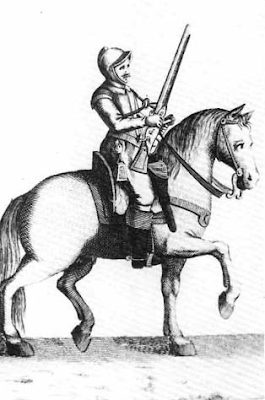
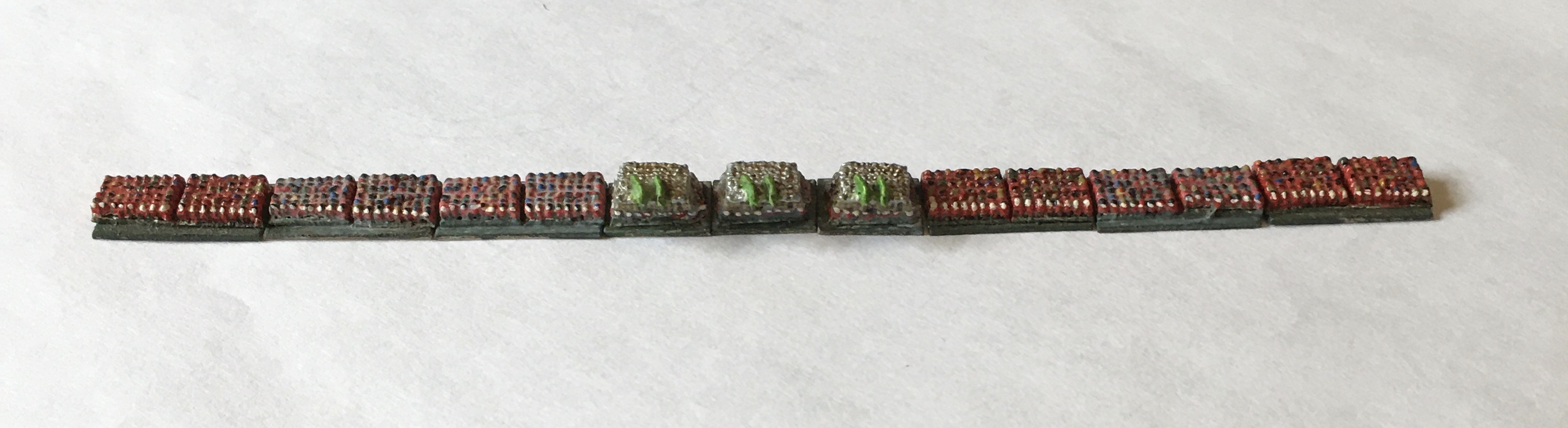
THE INFANTRY
I left the infantry section on the Spanish army until last part as it's the most complicated to explain. The Tercios of Spain, both those of the native Spanish and the other nations, were the best part of the Army. Indeed the best of them were regarded as the best infantry in Europe until after Rocroi (1643). The Infantry consisted of the Spanish Tercios, The Tercios of the Nations (drawn from other Hapsburg possessions in Flanders and Italy and lastly mercenary units tercios of Irish, Scottish and English troops and regiments of Germans and Swiss.
The Tercios
Tercios were infantry formations of Hapsburg subjects (Spainish, Walloons, Italians) and volunteers from other countries primarily Ireland. The formations and tactics of the Tercios were emulated by both the Holy Roman Empire and the allied Catholic League until the 1630's. They fought in Flanders in the 80 Years War (aka the Dutch Revolt), in Italy in the War of the Mantuan Succession, in Switzerland, in France, and in Iberia itself against the Portuguese and Catalan rebels as well as in North Africa and of course saw action in the Thirty Years War. During the period I'm covering they went from being the traditional Tercio with the four corner bastions of shot to something more akin to the pike and shot formations recognised from the BCW.
 |
| 1. Period illustration of a Tercio showing the four corner Mangas of shot |
The long established view was that they were ultra conservative tactically, and struggled to adapt to the changes brought in by Prince Maurice of Nassau (the Dutch tactical style) or Gustav Adolphus (the Swedish tactical style). Yet at Nordlingen in 1634 the Tercios destroyed a Swedish Army and previously they had done the same to the Dutch. In fact many of the tactical changes brought about by Maurice were already used in whole or in part by the Spanish! The basic story of the evolution of Spanish infantry squadrons (the battlefield tactical formation) is that over time they became smaller, less deep but wider and with an increasing proportion of shot. Of that shot a larger proportion of the shot became armed with muskets. At some point the corner formations of shot (the Mangas) became the wings of shot at either side of the pike. What is less easy to tell is when these changes happened so as to be able to say that at a specific battle the squadron looked and fought in a definite way.
A Tercio at the start of the century had an official strength of 3,000 men, although in reality they usually had less men than this, around 1,500 of all ranks in Spanish and Italian tercios and under 800 in Irish and other volunteer Tercios. The Spanish preference for large infantry formations meant a single Tercio could form a squadron on its own or companies from two or more would be merged together. Writing sometime in the early 1630's Gerat Barry (An Irish volunteer who served in the Spanish Army between 1602 and 1632 retiring with the rank of Captain in the Army of Flanders) states that:
"The 4. formes of squadrones moste acustomed and moste in use,is the square of men, the square of grounde, bastarde square and broade square, which the Spaniarde caule quadra de gente, quadra de tereno, prolongado, y gran frente"
(Gerat Barry - A Discourse of military discipline - published 1634)
Based upon Barry we can be fairly sure what the common formations were during the 1620s and possibly until Nordlingen in 1634 as Barry was writing prior to 1633 (when his text was submitted for official approval!). Barry goes into great detail on the arithmetic required to determine the number of ranks and files to form up in (square roots are a bit of an obsession with military writers in the period) but less on the other aspects of deploying a squadron.
The core of those formation was the central pike block, which throughout the period always had two small wings of Arquebusiers permanently attached, known as 'Garrisons'. To that were added four bodies of shot (The Mangas) which were armed with either arquebus or musket. In the mid 16th Century these formations were around 3,000 men strong as shown below (images of the formations are from Pierre Picouet's web site on the evolution of the Tercio via the Internet Archive). The basic formation seems to have continued in use until at least the early 1620's but with a lower head count.
 |
| 2. A 'Field Square' consisting of 2922 men of the mid to late 16th Century |
Other variations on the formation existed as noted by Barry. The extended square sacrificed depth for width to increase frontal firepower while the square of men was deeper than it was wide. Again examples from Pierre Picouet’s now defunct website are below.
 |
| 3. 16th and early 17th Century formations |
By the early 1630's we are starting to see a more easily recognisable German style formation with a pike centre and two wings of shot but still with the garrisons of arquebusiers. This may actually have been the most common formation from sometime in the 1620's (see the section on sources below).
 |
| 4. Deployment of 1,057 men from the mid 1630's with Pike 10 deep and shot wings 9 deep |
The key thing to note is that arquebus armed shot are still in use in the above formation and this continues until at least the Ordinance of 1685 where a third of the squadron still had them, perhaps because an impoverished Spanish Crown had to make do with the firearms they already had!
Pierre Picouet provides some useful statistics in his book 'The Armies of Philip IV of Spain 1621-1665 (Helion 2019) on the size of battlefield squadrons and the weapons mix being used. I also picked up useful stuff from the Osprey on the Spanish Tercios so other authors (other than Mr Picouet) are available!
This is where it starts to get complicated. Tercios in Flanders, Italy and Iberia were organised in slightly different ways and were of different official sizes to each other in any given year. I have no idea why this was. German mercenaries brought a totally different organisation to the party (see below) and there were several reorganisations across the period. It is possible to ignore this though, as the squadron was the fighting unit not the tercio, but the differences in manpower pools and weapon ratios could have had an impact. Still for wargaming purposes a bit of standardisation can be applied.
The average size of the Infantry and Cavalry squadrons varied by army and date but the following table adapted from Mr Picouet's The Armies of Philip IV of Spain 1621 - 1665 gives an idea of the formation sizes we should be using on the wargames table.
 |
| 5. Average squadron sizes at major battles (source Pierre Picouet) |
Bear in mind that these are averages taken from the overall size of the forces involved and divided by the number of squadrons deployed, so some variation would not be unreasonable provided the average unit size stays close to the above.
That's the easy bit, now onto the weapon's ratios within the squadrons, I have had to make some assumptions here the key one being that the ratios within combat formations are the same as the parent tercio, which is by no means certain. Again the data is drawn from Pierre Picouet's Helion book.
 |
| 6. Weapon splits and rough ratios |
The percentages are from Mr Picouet's work the ratios are my (very) rough approximations based upon those splits. Ordinances are the official instructions for how a tercio should be composed and muster rolls are actual head counts at pay musters. Care has to be taken with the later as there was a tendency to claim pay for dead or deserted soldiers. Muster data for the earlier periods tends to be in line with the ordinance requirements.
German Regiments
German infantry were recruited in the same way as was done in Imperial and Catholic League service, by issuing warrants to military contractors. The basic unit for German formations being the Regiment. These seem to have been organised in the same way as infantry formations of the Catholic League. I take that to mean that until the mid to late 1620's they would be using the same formations as the Spanish (Possibly 'el Prolongado' as they were musket heavy formations) and then changed to the mid 1630's formation shown in image 4. However Daniel S on his Kreigsbusch blog considers that German infantry (both Leaguist and Imperial) may have abandoned Spanish formations earlier in the century.
Giorgio Basta's military manuals recommend formations 10 deep as early as 1610 which is different to Spanish doctrine, I would use 12 ranks as that is the best I can do with the 2mm blocks I use. At Lutzen (1632) Wallenstein deployed his German infantry in Battalia of 1,000 men deploying them 10 ranks deep (some sources state 7 ranks) which was probably also the formation used by mercenary formations.. As with the Tercios the actual numbers in field formations slowly reduced and formations became wider and shallower. Between 1630-33 average size was 1,923 men falling to 1,500 men in 1640 and 851 men by 1643. In the 1620's the split between weapon types was 40% pike, 10% Harquebus and 50% muskets giving a ratio of 2:3 pike to shot overall. In general terms I would go with unit sizes and formations similar to Catholic League and Imperial battalia and with the same weapon splits. For training and experience I should start with Trained and Experienced and adjust upwards or downwards depending on the actual performance of the troops in the battle being refought.
CAVALRY PERCENTAGES
The Spanish never deployed the percentages of cavalry seen in other armies, depending on their infantry to win their battles. In 1622 the Army of Flanders had 338 companies of foot but only 56 of horse. By 1659 the numbers were 1,104 infantry companies compared to 219 of horse. That's 14.2% and 16.5% cavalry respectively. This is of course a small sample and takes no account of the number of men per company. To try and get a better view I looked up troop numbers at major battles fought by the Spanish (via Wikipedia so perhaps not as accurate as I would like) which gave me:
 |
| 7. Cavalry as a percentage of the army |
The figure for Nordlingen (marked *) is actually the split at the Spanish rendezvous at Rheinfelden a few days prior to the fight. Again these do not form a big sample but it does show that cavalry was not normally a big proportion of the army. In fact the average of the above table is only 26.5%.
ARTILLERY
The Spanish army standardised the different calibres of artillery at the start of the period and the result fits well to the normal wargaming split between siege artillery (Cannon and half-cannon), field guns (quarter-cannon; 10 or 12 pounders) and light guns (quarter-culverin and sakers of 4 to 7 pounds). The number of guns varied a great deal with 18 at Rocroi to 38 at Lens. The intention was to have 1 to 3 guns per 1,000 men in an army. I would treat artillery as trained and professional throughout the period and as pure firepower tactics.
CREATING A SPANISH WARGAME ARMY
Bear in mind when reading this section that I use Irregular Miniature's 2mm castings which restricts the unit deployment to those possible with the castings. I base infantry in blocks of 50 or 100 shot in 6 ranks and use the single pike block casting to represent 100 pike in 6 ranks. For cavalry I use the three rank Armoured Pistolier casting of 15 horse in three ranks to create blocks of 50 horse (three castings plus five single figures as officers etc). For the Garrisons I will use the horse and musket castings of infantry in three ranks but position them 'sideways on as it were along the flanks of the pike block. If you are using 3D printed figures or Oddizial Osmy 3mm castings you will have to experiment with your basing to get the look of the formations correct.
1. Spanish armies 1618 - 1634
I would use the various versions of the infantry squadron with four corner mangas of shot as shown in Image 3 in this period. Treat the corner mangas of shot as sub-units of the pike block to allow them to deploy without full edge to edge contact and to also allow them to operate at a distance from the pike if required. As early as Nieuport (1600) it seemed to be normal for the shot mangas to operate at a distance from the pike. Both the pike block and shot mangas deploy 12 ranks deep (two bases). To keep things simple for calculating firing I suggest each manga have arquebusiers deployed on the edge of the manga closest to the pike block.
Spanish and Italian infantry squadrons will be a minimum of Trained and Experienced. They may be Elite, Veteran and Professional if drawn from the 'old tercios'. Pike blocks (and attached garrisons) will be classed as shock and Mangas will be mixed fire power fighting style. The standing order should be for mangas to use steady firing rather than volley fire. Tactically Spanish tercios should be aggressive and attempt to close to contact with the enemy. You might also want to reflect the all round defensive capability by counting the Pike block as being equivalent to a mobile pike stand so always without vulnerable flanks or rear. Period engravings seem to show pike formations deployed both deeper than wide and wider than deep and with blocks of shot operating close by but not as corner bastions. I have assumed these are the mangas operating semi-independently.
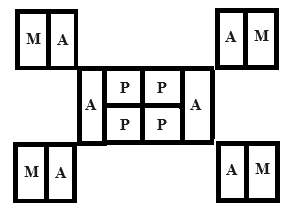 |
| 8. An example of how I might portray a Tercio |
In image 8 I have drawn a rough plan of how I might construct a Squadron in this period. P's are blocks of 100 pike. A's are blocks of arquebusiers and M's are musketeers. The Mangas are made up from castings of 50 shot (48 shot plus a couple of separate officer figures) in 3 ranks giving a frontage of 16 men. Placing two of these behind each other gives 100 Arquebusiers in 12 ranks and 100 Musketeers alongside in the same formation. A total of 800 shot in the four mangas plus two garrisons of 100 Arquebusiers each and 400 pike. This gives a total of 1,300 men split 4 : 10 Pike to Shot or 1:2.5 slightly too many shot but about as close as can be achieved using Irregular's blocks. The shot breaks down to 3:2 in favour of Arquebusiers over Musket and not the 4:1 that actually existed. Making the two rear Mangas entirely Arquebus armed would change the ratio to 4:1. This is entirely conjectural for gaming purposes only though, but it has the feel of an early TYW formation.
Cavalry fight in 6 ranks using mixed fire power for both Cuirassiers (Reiters) and Harquebusiers. Class as Trained and Experienced (if mercenary units) or Trained and Raw if Spanish subjects. Demi-lancers (if used) fight in 3 ranks as shock and class as trained and experienced. Cavalry should not exceed 30% of the army head count. There should be twice the number of Cuirassiers compared to Harquebusiers.
No Croats (light cavalry) are available and native Spanish Jinetes light cavalry seem to have been abandoned in the early 16th century. The first Dragoon units were raised in 1632 but you may only have one unit in an army counting as part trained and raw and firepower tactics. Harquebusiers may dismount to fight if there are no Dragoons available.
2. Spanish Armies 1635 - 1643 ( up to and including Rocroi)
After Nordlingen in 1634 switch to the more traditional pike and shot formation with two wings of shot similar to that shown in image 4. I would remove the sub-unit status for the shot wings so they have to stay with the pike block. Infantry squadrons are of between 1,300 to 1,000 men in 1635, dropping to 800 - 900 by 1643. Keep both German mercenary and Spanish subject infantry formations as 12 ranks deep. A pike to shot Ratio of 1:2 is now pretty standard and the shot is now around 50-50 Arquebus to Musket apart from in Squadrons created from Provincial Tercios in Spain (Army of Extremadura) where there could be slightly more Arquebus armed shot. Status and training stays as shown in the previous period until after Rocroi.
No Demi-Lancers are allowed. Cuirassiers (Reiters) and Harquebusiers still fight in 6 ranks but now both have the option to be classed as mixed shock or mixed fire power. As cuirassiers are shedding armour in this period the distinction between the two types is becoming less clear. As a result there must be two Harquebusiers for each true Cuirassier in the army. Dragoons are available but only one unit in an army and they should count as part trained and raw unless raised in Lombardy or Flanders where they are trained and experienced. Harquebusiers may not dismount to fight where dragoon units are present in the army. Croat Light cavalry appear after 1638 but there may not be more than two units in an army and only in armies fighting in Italy or Germany Cavalry may not exceed 33% of the armies head count.
3. Spanish Armies 1643 (Post Rocroi) - 1660
After Rocroi infantry formations reduce to six ranks deep. It isn't clear exactly when this occurred so it would not be incorrect to continue with deeper formations until the latter part of the 1640s. They also become smaller between 900 and 400 men with a pike to shot ratio of 1:2. There are still arquebusier armed soldiers forming 50% of the total shot in all armies except that in Extremadura where the balance is slightly in favour of Arquebusiers. Class mercenary units as trained and experienced. Troops from Tercios in the Armies of Flanders or Lombardy are trained and experienced and those from the 'Old tercios' may be trained and veteran. Troops fighting in the armies of Extremadura or Catalonia are lower quality if recruited within Spain. Class these as part trained or trained and raw or experienced. There are now no elite formations but troops raised from Spanish Militia serving in the Army of Extremadura or Catalonia may be considered as unwilling. All infantry squadrons of the armies of Flanders may be classed as mixed shock, those of other armies as mixed firepower to represent the lessening willingness to close on the enemy.
For the cavalry, accounts of Rocroi seem to suggest that the Spanish cavalry consisted of a large number of German Reiters. This may be a holdover in terminology from the earlier periods and I would only allow a small proportion of horse to be classed as armoured. Lets call that one in four for Spanish Hapsburg units and one in three for mercenaries. Light cavalry availability remains as before.
The cavalry at Rocroi still appear in Merian's engraving as being in deep formations but others seem to show them as fighting in three ranks. By Lens in1648 they seem to be in three ranks in the engravings of the battle. I consider it to be reasonable to allow 6 rank depth until the late 1640s but with an option to use three ranks. That said this is not a case of start in one formation and change to the other. The army must decide on the depth it intends to use and stick to it.
In terms of training and tactics Mercenaries should be considered better trained and experienced than 'Native' Hapsburg troops be those Spanish, Walloon or Italian. Use the classifications from my previous article with mercenaries using the better classifications. Note that from 1648 the bulk of the cavalry was recruited as mercenaries from Germany.
All of the three versions of a Spanish Army are conjectural and apart from where based on data from quoted sources are simply my attempt to create an army with the 'flavour' of the original. This is especially true of the splits between the various types of cavalry which should be treated as extreme guess work on my part, so feel free to play around with any or all of the above suggestions.
SOURCES
Primary Sources
Giorgio Basta - Il maestro di campo generale...(Venice 1606), and Il governo della cavalleria leggiera (Venice 1612). (OK I will admit my Italian isn't really up to reading the originals so I have relied on translated extracts in secondary sources).
Gerat Barry - A discourse of military discipline - (Brussels 1634). Available through Early English Books Online free version but without illustrations.
Secondary Sources (contemporary)
Period paintings and engravings by contemporary artists (I have counted these as secondary sources as we can't be certain the artists were actually present or how accurate their depiction of fighting formations are. These are all from internet sources. Different artists sometimes portray the same battle with different infantry formations, one must be wrong, but which one?
Pieter Snayers' Paintings. These over a lot of important TYW battles. Although he was not present at them himself, he did use input from those who were and his patrons were military men who may have had an input to the technical details. As a result his paintings are considered to be reasonably accurate. I treat them as giving some indication of army deployments and possible unit formations.
 |
| Battle of The White Mountain 1619 by Pieter Snayers - note the infantry formations |
A number of contemporary engravings ( for example those of Matthias Merian The Elder's) . These do not always provide the detail of Snayer's paintings but they give a different view of the formations used. Many are by unknown artists so the accuracy cannot be vouched for.
Secondary Sources (Modern)
The Armies of Philip IV of Spain 1621-1665 - Phillip Picouet - Helion & Company 2019
In the Service of the Emperor, Wallenstein's Army 1625 - 1634 - Laurence Spring Helion & Company 2019
Imperial Armies of the Thirty Years War (1) Infantry & Artillery - Vladimir Brnardic - Osprey
Imperial Armies of the Thirty Years War (2) Cavalry - Vladimir Brnardic - Osprey 2010
Pike and Shot Tactics 1590 - 1660 Keith Roberts - Osprey 2010
Plus various Wikipedia pages and websites on Battles of the Thirty Years Wars too numerous to list (or remember).