Saturday, 5 March 2022

Coming to grips - The battle of Timerton part 4

Welcome back (assuming you have been here before of course).

In the last post I was dealing with the starting moves of the game.  Both sides having to deal with a poor terrain lay out which resulted in them having to redeploy their cavalry wings.  This started before sunrise and visibility was initially restricted.  The time is now 5.36am and the sun is not yet over the horizon.  Sunrise is at 6.00am after which full visibility should be in place, weather permitting.  Oh and I spotted a typo in my last post.  To correct what I posted:  a support order means the supporting unit maintains its distance from the unit it is supporting and cannot run into it.

So with that out of the way it’s back to the narrative.  

Leonard Deanswood takes up the story:

'As the daylight grew in strength what I had taken to be an early morning mist, a thing most common at that place and time of year, became a shower of rain.  Indeed I began to hold a concern that our muskets should be effected by the dampness in the air.  Still ‘twas clear that should our shotte be so reduced the same would hold true for the rebels.'

Weather is determined at the start of the game using the tables in the play sheets.  These covers all of Great Britain except the Highlands and Islands of Scotland which get a separate table.  Each table has columns for each season.  The player rolls 3D6 and adds or subtracts from the total depending on time of day (as the sun's heat changes the air temperature it may effect the chance of mist or fog.  They then check for temperature and wind speed and direction.  Very low temperatures change rain to snow and high wind speeds can create blizzards.  Rain or snow also impacts on visibility and creates a modifier to musketry.  At present visibility is limited due to pre dawn low light but as the sun rises the maximum visibility will rise unless rain reduces it.

Recently uncovered papers from the Whitlocke Collection give some information from the Parliamentarian left.  From the diary of John Whitlocke who served with Brown's Horse on the Parliamentarian left wing.

'Though it t'wer not yet full day, the sun not yet having shown itself , as the light improved we did see that the Cavaliers were coming down upon us apace. They soon drew so close that it seemed impossible that it should not come to sword strokes and I braced myself to give them a charge ere we came to it. Ours being a troop but newly formed I could see some around me slipping into panic fear in apprehension of what was about to befall us, but our Captain shouted encouragements ‘fear not for the Lord is with us’ and the like which did greatly steady our men.   Those two squadrons of the enemy's horse which opposed our front line came towards us at a good round gallop as if to try their swords upon us but drew rein at but a pistol shot of us where they did draw pistols and give fire upon us.  Yet they did no harm to us, leaving us to marvel at God's Mercy towards our cause.  This continued but for a short while before those who faced us seemed to draw courage and did indeed come to hard sword strokes."

Before entering melee combat the attacker must pass a reaction test.  If that allows them to close then the defender has to take a test to allow them to meet the attack.  In this case the two attacking squadrons failed to press home the attack and halted at 10 yards range.  They had sufficient Action Points (AP) to attempt a round of 'steady fire' combat.  Because the Royalists failed to charge home the Parliamentarians don't need to test in response.  If the initial test had been passed then the target units would have tested to see if they break or retire before contact.  In effect both Royalist units have elected to attempt a caracole rather than immediately follow orders to charge home.  Both had an unspent AP which allowed a single round of shooting.  In the next action phase one again failed the reaction test but the second passed and charged to contact.

"although our men fought like the followers of Gideon they were o'ercome by fear and retired most ignominiously.  Yet what else may be expected from half trained boys and men facing gentlemen raised to horsemanship since they could walk?  T'was a great mercy that despite this we did but retire and not flee"   

Parliament's left wing

The formations which are in a 'zig zag' line are disrupted.  This occurs at the end of a round of melee as officers no longer have full control.  This can be better seen below.

A close up of the melee action

In the above photo you can just see that there is a red dice in the frame of the far cavalry unit.  this shows the number of 'hits' being carried which as they have not been used up to reduce the unit's Combat Efficiency (CE) by a full level.  The unit took five hits in the melee four (one per base) reduced the CE by one step the fifth was carried forward.  It requires one hit per base for a unit's CE to drop a level which gives large units a greater ability to soak up casualties and fatigue but the other side of the coin is that they are less manoeuvrable.  At the end of the melee both sides take a further reaction test and this caused the Parliamentarian Horse to retire even though they had the better combat result.  The Royalists failed to score highly enough to follow up in pursuit and so stand disrupted on the line of engagement.

The centre from Parliament's side of the table

A short Fragment exists describing the opening shots from the Parliamentarian Infantry.  It's author is unknown.

"As we crested the rise we saw the enclosures of the village to our fore and within them a mass of men marching towards us, 'tho through the gloom we could see little detail of them.  Only a faint gleam where pike points could be seen reflecting the early morning light but little else.   I told my men to hold their match within their cupped hands both to hide it's glow  from the enemy and to give a measure of warmth so that cold fingers should not fumble when called into service."

And the Parliamentarian right wing

Turn two ended with just the one clash as most troops are still attempting to manoeuvre around the blocking terrain.  Turn three is going to be messier though. 

The first musketry erupts in the centre

In the picture above the Parliamentarian regiment has fired a volley (cost 3AP) rather than close the range.  Smoke markers show they have shot and add to visibility issues.  They will move in the marker update phase at the end of the turn.  The volley was fired at 75yards range and unsurprisingly had no effect.  To score hits the unit requires an adjusted dice roll of 15 or better.  Three D6 are rolled and adjusted for range, training and tactics.  The 'to hit' score of 14 is deducted  from the adjusted roll and if the result is a positive number that number is the hits scored by each shooting base.  Six bases fired and if (for example) the final score had been plus 2 the volley would have scored 12 hits.

These are 'mixed fire power' troops so they perform slightly better in fire combat but are less keen to close to hand to hand and have a lower bonus in melee than mixed shock or pure shock types.  on the right edge of the image you can just see a triangular marker with a number 1 on it.  This is a defensive fire marker.  It shows that the Royalists have kept back 1AP to use in shooting during the Roundhead turn in case the enemy tried to close on them.

The fragment continues:
'As soon as the enemy drew within long musket shot I ordered a salvee not in any hope of doing great execution upon them but to cause my men some measure of activity both to keep their minds from fear and also to ensure their muskets were cleared.  I also sought early knowledge if their powder be damped before we came to a killing range such that  charges might be drawn and reloaded at necessity.  Such wisdom had my service in the German Warres taught me as .......(the fragment ends here)'

Over on the Roundhead right a serious cavalry melee is under way.

Parliaments right wing in action

John Whitlocke's account continues:
"Once our squadron had passed through our supports we at once drew reign and reformed in good order.  From my place I then clearly saw Ablett's Horse engage with the Cavaliers.  Neither side gave pause but charged straight aways one into the other.  For a few minutes the matter hung in the balance 'til the cavaliers gave some little ground afore they turned away and fled. I saw one of their officers unhorsed and lie without movement upon the ground with non to give him succour.  This I now perceive to have been Colonel Pargetter, whose death did gravely discomfort the enemy."

Passing through lines requires one unit to stay stationary for the entire action phase.  Their 3AP are spent  to allow passage think of it as the cost to open then close files to allow the passage.  They are also showing a defensive fire marker as they failed a reaction test to close to melee on the disordered Cavaliers and had unused AP.

The Royalists took three hits per base in the melee which dropped their CE to Wavering from Nervous.  That is also more than the one hit per base in a single combat round needed to trigger a risk to the general check.  Each hit per base after the first adds 1 to the risk to general dice roll.  In this case adding 2 to the dice roll.  The roll was spectacularly bad (11 on 2D6) which gave an adjusted total of 13.  Any result of  13 or higher is a killed outright result!  It's important to note that only hits inflicted in the current round of combat count for this test, carried forward hits from previous rounds of melee or shooting are ignored.   For comparison the Parliamentarian commander had also led from the front and was subject to a risk check but only suffered a slight wound which has no effect. 

Overview of the field end of turn 3

At the end of turn three the Royalist forces are slowly moving slowly forward on their left (nearest the camera in the overview picture) but things are not going to plan on their right!

You might have noticed that I use a number of markers on the table.  These are not altogether necessary but as I am playing solo and handling around 50 units it helps me keep track of things like compulsory moves.  The only markers that are really needed are the CE indicators and hit counters as these provide limited information to players on unit status.  I add a unit tag as I dislike flipping back and forth through rosters to check factors for reaction tests and combat modifiers.  The main markers I use are retire, pursue and flee along with reserved fire markers showing how many AP are being held back.

I have just about covered the core mechanics of the game in this post.  The last post on this game will be after I have concluded the battle and will be a shorter description of events from the perspective of the two commanding generals.

Thursday, 24 February 2022

Interlude

I'm trying to come to terms that Russia's leader appears to be casually suggesting that WMDs would be used if NATO gets in his way while he de-Nazifies the Ukraine.  Surely the Soviets had plenty of time to do that between 1944 and the fall of the USSR?

Does my pushing toy soldiers around on a table top make me a warmongering neo-facist running dog lackey of outmoded imperialism, I worry that perhaps it does.  Or is that the preserve of the bloke who lied through his teeth about his intentions towards the Ukraine.  How do I feel about risking a short sharp exchange of 'buckets of sunshine' to preserve an independent nation state.  I really don't know.  I grew up in the shadow of the Atom Bomb, I had hoped that was all behind us and my grandchildren could avoid that particular nightmare.  I can see what Putin hopes to gain I simply cannot fathom the depths he is prepared to risk sinking to in pursuit of his ambitions.

As I say this is an interlude normal service will be resumed shortly.


Friday, 18 February 2022

Let Battle commence - The Battle of Timerton part 3

So the table is set up and troops deployed so I shall hand over to the generals to describe events and only break the narrative to explain how the rules have operated.  There will be some stretching of the narrative to make it seem more like an actual battle account but no fiddling with the operation of the rules.  So instead of saying the rules limit visibility to x yards the narrative might say 'a slight mist hung over the field at this early hour limiting my view to no more than x yards'.   For me if the game allows a believable narrative to develop then the rules are working as intended.


From A True Relation of Timerton Fight containing all which it is needful to know of the designs of Prinz Ruprecht towards the Godly folk of Birmingham

"The army being drawn together close upon Northampton it was resolved that it should March to the East to find the forces of the German Prince Ruprecht.   Certain intelligences were provided that he intended to move against Birmingham and we were instructed to interfere with these designs.  Accordingly we went via Daventry intending to March through Rugby towards Coventry.  No sooner had the army left the vicinity of Daventry but we received word that a large force was some distance to the East.  We bent our course accordingly and two days after, the army's forage parties clashed with bodies of horse close upon the village of Timerton.  Scouts being sent forth it was ascertained that the enemy was less than days march from us and marching hither with alacrity.

A council being called it was resolved to meet the enemy on the morrow.  Accordingly an order of march and scheme of deployment was drawn up such that every officer should know his place.  Some time after sunset scouts came into with some intelligence of the numbers of the enemy,  they having espied them upon the road.  Their count was that the enemy seemed close to our numbers but had no artillery.  Five great bodies of foot and numerous bodies of horse were seen to be present."

Neither side's horse have the required numbers to 'out scout' the other so numbers of troops are reported with only a 10% variation.  It is always possible to reduce or increase the reported number of bodies by one hence the no artillery present report.  After scouting results are disclosed both sides draft a general deployment plan before terrain is generated.  Tactical orders are written once terrain is laid out and the initial deployments made.  There is scope to adjust the deployment as sketched but this is limited. In a two player game the Commanders are deployed first then the front lines of each army and then any troops visible to the enemy commanders.  Then tactical orders are drawn up.  If being used, standing orders covering things such as the range at which a unit will start shooting, or foot will form pike stands against cavalry can be drawn up in advance or the generic ones from the rules used (based on experience and training).

From the letters of Sir Robert Snell (Commander of the Royalists)

"The Prince had granted some discretion as to our actions subject only to the proviso that we should seek out any opportunity to bring the Rebels to the field of battle such that by so doing they should have no liberty to interfere with his plans.  In accordance with these commands I ordered the army to advance towards Daventry so as to appear to threaten Northampton and cut the great North Road.  Shortly after we commenced this motion I had word that a very large force of the rebels was ahead of me, which very much suited my purpose.  My officers being well appraised of my intentions there was naught to do except bring the enemy to battle, which we set out to do with great good will.  By some mischance we knew not how close they were until some skirmishes were reported close to our front and all we could ascertain was that the enemy was present in numbers akin to our own.  I therefore gave my orders for the next day as it seemed that we should fight in the morning, whether we willed it or not.

The ground was not such as I should have wished for, indeed it was greatly to our disadvantage.  Should the enemy not have been upon us I should have withdrawn a piece to seek better ground.  I considered what might be done and determined that we should close upon them as quickly as possible to reduce the advantage they held in artillery and also to occupy the enclosures around Timerton village."

The table is divided into 1 foot squares of and terrain is laid out using cards drawn from a standard pack of playing cards, one per square.  Any picture card, ace or joker creates a terrain item in the square, all others cards create clear squares.  Terrain items include the start of a river or stream which, if drawn, will run to a random table edge.  I have decided that the rules need a mechanism to allow players to move terrain to avoid battlefields like this one!  Once scouting reports are exchanged and terrain set out the players write orders.  These consist of an action, a target (location or enemy unit) and a speed of action.  There can also be a delay built in before acting upon the order.  Changes of orders during the game require a reaction test to be passed and the new order to be transmitted down the chain of command.

The Battlefield is split by a river which divides the Royalist deployment area into two roughly equal halves.  Because of the deployment decided on before the terrain was laid out the Royalists will not be able to easily co-ordinate their actions.  The Parliamentarians are not having things all their own way either as a stream is restricting the movement of their right wing.  Also if they advance too far then their left will be separated from the rest of the army by the river.  Lastly there is a low ridge directly to their front which masks one of their guns but would make a decent defensible feature.  Time to amend the deployment and write orders.  Back to the True relation.

"On seeing the lay of the land over which the battle were to be fought it was clear that the intended deployment would ill serve the Parliament men.  My Lord x determined to make a shift in the placing of the guns on the right to allow them to better play upon the enemy's ranks.  Other than this and the small adjustment to the right most Infantry battalia to allow this all else seemed to serve as well as may be...."

Using the change to deployment rules one field piece and an infantry battalia are exchanged no other changes are made by either side.  I'm wondering if there should be a turn one AP penalty for to any units whose location is amended under these rules.

 "...These changes being taken in hand orders were confirmed.  The left hand cavalry wing being over matched should make best speed to deny the enemy use of the bridge over the River Timer and to hold the ground betwixt the eminence on the right and the river.  It was desired that they should not do ought else but hold that place.  The centre was to advance with the greatest of haste and bring the enemy foot to hand strokes with only the minimum of musketry first.  The Horse on the Right were to advance apace to be forward of the foot and to drive the opposing horse from the field.  It was allowed that to achieve this they should extend their lines further unto that flank."

Parliament's adjusted deployment

The Royalist deployment. The wing furthest from the camera is stacked up deep!

In the photo's above the coloured markers behind each unit show the the current CE status which is based on the outcome (before situational adjustments) and assuming an average dice roll of 7 on 2D6 when taking the test.  They are colour coded for a general description but don't show the exact value.

From an account written by an unknown author (possibly Captain Leonard Deanswood)

"We were stood to our arms before sunrise and as the day dawned I saw the enemy before me standing in ranks and files just as were we.  Before we could be disheartened by the sight we were ordered to "Stand right in our ranks and files" and then to 'march on' We set off at a good steady pace towards Timerton Fields.  I discerned that our horse on the left wing commenced their advance by wheeling several bodies to their left hand to over bear upon the Roundheads they faced.  I saw not what transpired on the right.  As our Battalia advanced I saw that we faced difficulties in deploying the brigade as desired due the a river splitting our lines.  Two Battalia were on the far side of this and we unable to effect a juncture with them should need arise.  Though only a few yards away they may had as well been upon the moon.  I saw that we should be forced to fight two battles one upon either side of the river."

The game starts at 05.24 a few minutes before sunrise and with restricted visibility.  This is a random time based on dice rolls for a pick up game.  The two armies are a little over 600 yards apart and visible to each other as visibility is 1,000 yards during "civil twilight".  The Royalists won the initiative by virtue of a higher roll on 3D6 despite a lower command span and will move first.  Parliament were hampered by my adjusting their role for making changes to the planned deployment.  Well I did say I might create a disadvantage for doing that!  This is an IGOUGO game so moving first has advantages for taking advantageous positions but disadvantages as the second player may be able to fire with a closer range advantage, especially with artillery.

The Royalist advance is hampered by the need to extend their line to the flanks.  They have opted to give fast advance and assault orders to the front line which requires at least 50% of their action points to be spent on closing the distance between them and the enemy on contact they can spend a turn shooting before charging home.  The second and third lines have fast support orders which allow them to keep pace with the front line but to run over them.  Support means that they can shoot in support and replace units in the front line that fall back or for horse join in melee instigated by the unit they are supporting after the first turn.

At the end of the Royalist first turn, their troops are struggling to deploy for combat


By the end of the second turn they have some semblance of order! 


Turn 2 ends with Parliament in control of the high ground


And the cavalry on Parliament's left about to clash

The first two turns consisted of both sides frantically rearranging their cavalry wings which takes time as the manoeuvre rules are designed to make this difficult.  Parliament have their left wing in orderly formations as are the opposing horse.  Both sides infantry is struggling to deploy and the bridge is not closed to the Royalists but is going to be heavily contested.  The first clashes are about to occur and that will tell a tale (or perhaps not)! 

Tuesday, 8 February 2022

Are 2mm figures really no better than counters?

It's an accusation that gets levelled at 2mm and 3mm figures by those who normally play using larger scales. What's the point of 2mm figures they are no better than a cardboard counter is the common statement. I can understand where these questions come from if you are used to painting exquisite 28mm soldiers and can identify a unit by it's turn back colour and button patterns, but 2mm isn't intended for those gamers. Those tiny 2mm chaps are for the sweep of large units showing formations and playing out grand tactical problems. The other comment I hear a lot is how can you possibly paint these. Which is a little strange given the level of tiny detail many painters of larger scale figures are capable of showing. It's no harder than the frogging on the chest of a Hussar in 28mm.

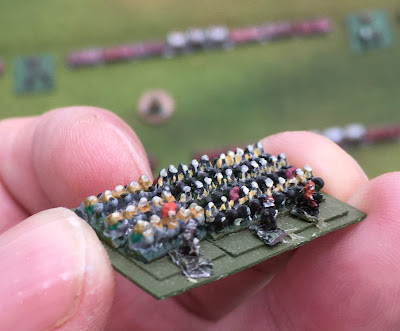
Are the figures really no better than a counter?  Take a look at the picture below and decide for yourself.

Counter v 2mm casting.  The casting wins!

As for detail and the ability to paint them, well again a single picture is worth a thousand words as they say.

Some of those horses have forehead blazes and socks!  Note the Infantry Battalia in the background.

There is detail there and it can be picked out.  Some castings are better than others but careful use of paint helps with the less detailed ones.  The cavalry in the pictures are Armoured Pistoliers in three ranks of five.  These are grouped three castings to a base with separate officers added by splitting open order cavalry bases down.  It gives a look of mass and doesn't require the sacrifice of portraying the rear ranks.  Cavalry are an area where 2mm really does come good.  In larger scales I could never get the correct numbers of horse onto the table.  In 2mm it becomes achievable.

Infantry castings moulded shoulder to shoulder are the basis of most of the rest of my ECW forces although I use some loose order for clubmen and will do the same for highlanders when I start onto the 1645 Montrose campaign figures.  I also use those for ACW dismounted cavalry firing lines.


Six battalia of Foot each of 900 men

Deployed in six ranks, note how long and thin the formation is

The first thing which really struck me when I created these formations is how long the line is compared to it's depth.  Most rule sets for larger scales get the frontage right for the ground scale, but have to exaggerate the formation depth to get the figures to fit the bases.  Not a problem to depict in 2mm.  It also starts to show why battalia were divided into smaller formations of around six files width.  

To explain lets do some math!  A NMA battalia aimed for a 2:1 shot to pike ratio (as seen above) and based upon pay returns I estimate that at Naseby they averaged about 900 men each after deploying supply train guards and the forlorn hope.  So that gives 600 musketeers in two wings of 300 men and 300 Pikemen.  The musketeers formed six ranks deep which means that each rank consists of 50 men.  At the order they would deploy with one man every 3 feet.  So a frontage of 50 yards.  Imagine if using introduction fire (where the front rank fires and then retires to the rear to reload) making a single rank file around the entire 50 yard long block before the next rank can fire.  Firepower would be dramatically reduced instead the single large block was divided into 'divisions' of between 4 - 6 files with a space between the divisions.  Ranks moved from front to rear (or vice versa) using those spaces so they only had to traverse a maximum of 6 yards before moving to the rear.  Allowing a further yard (or so) between divisions I have based each block of 100 musketeers on a 20 yard frontage (100 men in six ranks gives 16 and a bit men per rank plus 3-4 yards for the spaces or close enough to 20 yards).

The formation in the photos above are three blocks of 100 musketeers on each side of the pike blocks.  The pike blocks are at close order so have half the frontage of the shot so overall the battalia has a frontage of 150 yards!  Depth between ranks was almost always at 1.5 yards until pike blocks closed ranks before coming to close combat.  So six ranks at 1.5 yards gives a depth of 9 yards.  (I cheated and used 10 to make measuring bases easier).  2mm allows the use of more realistic unit foot prints than their larger brethren and starts to show up some of the command and control issues a battalia commander would face when all he has to transmit orders are drums and a good shouty sergeant!

Hopefully this post goes some way to showing that these castings are far better than counters and can be painted to a reasonable wargames standard without going blind!


Monday, 7 February 2022

Getting back into the swing of things

It's been a bit slow around here for the last few months. Or more accurately I've been off my game. Partly this was due to the festive season but before that my drive to get things done was , well, a bit lacking. Probably a delayed reaction to retirement and to the heart surgery. However, things are settling down into a new routine now and I have spent a bit of time at the painting station over the last few days.

You may recall that before Christmas I bought some gasket rubber to try as a base for terrain.  So one of the things I decided I should get on with was some additional terrain using this.  I have now completed some river sections and I'm very happy with the results.  The rubber cuts easily with scissors and the final pieces retain some flexibility.  The technique I used is simple as well.  A layer of sand glued to the edges creates a textured river bank and the rest is just a matter of painting which makes them fast to complete.  As a new item  I made a spring area/river source piece for the ECW game I promised before Christmas.  Well I didn't have one and stupidly I have written terrain rules where a river can start on the table!

The new river sections (the ones with the trees)

Having created the terrain I actually also got around to setting out the table for the game and started placing troops.  I quickly realised that I may have overreached myself as I need a lot more cavalry than I actually have.  I mean a LOT more!  Plus the table isn't big enough, the deployment zone isn't large enough for the troop deployments as sketched out, so neither side can fully deploy their lines.  So rather like the New Model Army at Naseby the head of the column of march gets to deploy as intended but the tail is crammed in.  Some redeployment will be allowed under the scouting rules but for Parliament the priority is re-siting the guns so they are not masked by the hill in the centre.  I'm already facing problems that seem all too familiar from reading accounts of 17th Century battles.  I forgot who said it of the planned Royalist deployment at Marston Moor, when shown the sketch "it is all very well, but there is no such thing in the field" or something very similar.  I will put an order into Irregular Miniatures in the next few days and until then I have made up some 2D bases to cover the shortfall.  

The table will stay as it is after all ground is immutable a commander has to deal with the hand geography deals him!  Although I am of the view that no sane commander would have fought on the table the rules came up with.  For testing purposes I am going to leave it as it stands but going forward  I need to add a option for players to move or remove terrain and possibly to add terrain.  At the moment I'm thinking of using the numbered playing cards (2 -10 only as the ace is already being used) for this in some way.  Probably to show how many squares the terrain can be displaced by.

The field of battle using a 6 x 4 foot table.  The tape shows the depth of the deployment area

Details of the forces, deployment map and the table are in earlier posts here....if anyone would like to offer suggestions for a tactical plan for either side please do so.  

It feels good to have some toys back on a table!

Tuesday, 18 January 2022

What I didn't do on my holidays!

Things have started to return to normal at Chez Elenderil after the festive break.   I still haven't put the table out for the ECW game (Christmas dinner seating arrangements got in the way) but as soon as I reorganise the conservatory that will go ahead.  

I have had some feed back on the rules though.  The general feel is that they are for serious ECW tacticians rather than casual gamers.  One play tester suggested single based battalia, which has some merit and was a thought which had crossed my mind.  The only downside is that I would have to create specific units accounting for different deployment depths rather than stacking smaller bases one behind the other as required.  However, sabot style bases might be an option.  The number of reaction test triggers was also mentioned with a suggestion that the current number is to high at 14.  This I have looked at again and by changing definitions I can have less listed triggers but cover the same events.  I don't really want to reduce the need for reaction tests as this is sort of the AI for units because the need to take reaction tests stops a commander having units do exactly as they want all the time.

The unexpected comment was that the turns seem too short for the current number of action points (AP) in each one.  Currently there are three AP available in each of a players two action phases which cover six minutes of game time.  This would allow an infantry unit to cover a maximum of 150 yards across the two phases or 25 yards a minutes which (using a 30 inch pace length) equates to a rate of 30 paces a minute on flat level ground.  Comparing this to Napoleonic battlefield pace, which in turn reflects mid 18th Century march cadences shows this to be a bit slow if anything.  British Army ordinary pace was 75 paces a minute and the Austrians managed 90 paces a minute (although I don't know how long an Austrian pace was).  By comparison modern British Army slow march pace is 65 paces per minute and quick march is 120 paces per minute.  I reduced the theoretical rate to account for uneven ground and poorer drill standards.  So I won't be changing move allowance per AP.  

I based the firing rates on hit rates per volley and worked back.  This was based on some Hanovarian musketry experiments in the latter part of the 18th century, using smooth bore flint locks, and then pretty much halved them.  I then set the 'to hit' figure to achieve the required number of 'hits' per 3 minutes of shooting.  It's a fudge because I'm not just calculating casualties but it gives a result which feels right.  So again those are staying as shown in the rules.

There are a number of sets of rules which I have sent out abut haven't yet had feedback on but I am getting a feel for what people think.  I may have to develop a 'lite' version of the rules!


Sunday, 2 January 2022

So that was 2021 was it?

I can summarise 2021 really simply, it sucked.  I hoped that it would be a better year than 2020 but it really wasn't.  The first clue was Vapnartak (the York Wargames show) being cancelled.   After that my personal wargaming year just got worse.  This wasn't helped by my having surgery in late May which took me out of circulation for a couple of months or more.  As a result I didn't get half of what I had planned for the year done although what I did manage to do I was please with.  

I had opted to make Altar of Freedom my focus rule set for the year but they are a set that really requires a live opponent and lock down and social contact restrictions put pay to that option.  On the plus side I did create two 2mm ACW armies and a bid generator for AoF but face to face gaming just didn't happen.  I also got my 2mm ACW rules to play test standard and with the exception of linking section reference headings to text I'm happy that these are done.  The intended El Cid period armies of Spain and Wars of the Roses 6mm projects were still born.  These stay on the board for 2022 though.  Painting also suffered as I really lost my drive after I came out of hospital and at this point it hasn't resurfaced.  That is partly down to having retired at the end of June.  Now instead of a bit of painting time being a reward to myself for working hard all day (or possibly hardly working) it seems like a luxury as I should really be lifting some of the house hold chores and delayed jobs from Mrs E's shoulders.

Re-enactment wise the year wasn't quite a complete bust there was a major event held at August Bank Holiday which I attended for one day.  The downside was that I couldn't take the field as I hadn't been cleared by the surgeon for strenuous activities at that point!  I did take the chance to take pictures from the crowd lines and although I say it myself I was happy with most of the results.

The thing which was really hard was the toll taken on friends by 2021.  As you will have probably guessed I'm no longer in the first flush of youth!  So what that means is that most of my friends are of a similar vintage, and it's a vintage where grapes start to fall off the vine.  I lost two friends from my circle of re-enacting friends in the first half of the year and in the run up to Christmas my friend the Northampton based historian  Mike Ingham died suddenly and unexpectedly while another friend from the Naseby Battlefield Trust and wargaming had a stroke and was hospitalised.  Then on New Year's day came the last kick in the teeth from 2021 when I got the news that an old friend from the Sealed Knot had died just before Christmas.  Yes 2021 really, really sucked.

So it is with some passion that I end this post by saying here is a hope for a better 2022.  Here is a wish that you all have a happy, prosperous and above all helathy New Year 2022.