Long post warning! But there is a set of wargame rules in what follows.
The Jolly Broom Man (JBM for short) has been running a British Civil War campaign dealing with the first civil war in England. For this he wanted to use a simple set of rules with brigades as the manoeuvre unit. long time readers will know I have been looking into the the Thirty Years War and British Civil Wars period and playing around with the concept of 2mm armies as well as writing a detailed set of rules for the period. What JBM liked in a set of rules was the exact opposite of those rules though, which made me wonder how simple could I make a set of pike and shot rules while keeping a decent feel for early to mid 17th century battles. This couldn't be a stripping back of the detailed set I have been working on over the last few years (years, read that as decades) it needed a fresh approach.
At heart the idea is that a set of rules where a brigade is a single base should remove the micro-management of brigade formations. That works as brigades were not static formations but shifted depending on the situation they were facing. So the rules had to reflect that. You will probably spot ideas 'borrowed' from other rules but hey imitation is the sincerest form of flattery and all that!
This is what I came up with. At the moment they are still liable to change based on any feedback I get. There are a few fudges where I have blurred the lines on ground scale and weapon ranges, I have an excuse all lined up for that in the design notes though.
THE RULES
The full rules consist of a play sheet/QRS (in a second post made at the same time as this one) and the explanations below.
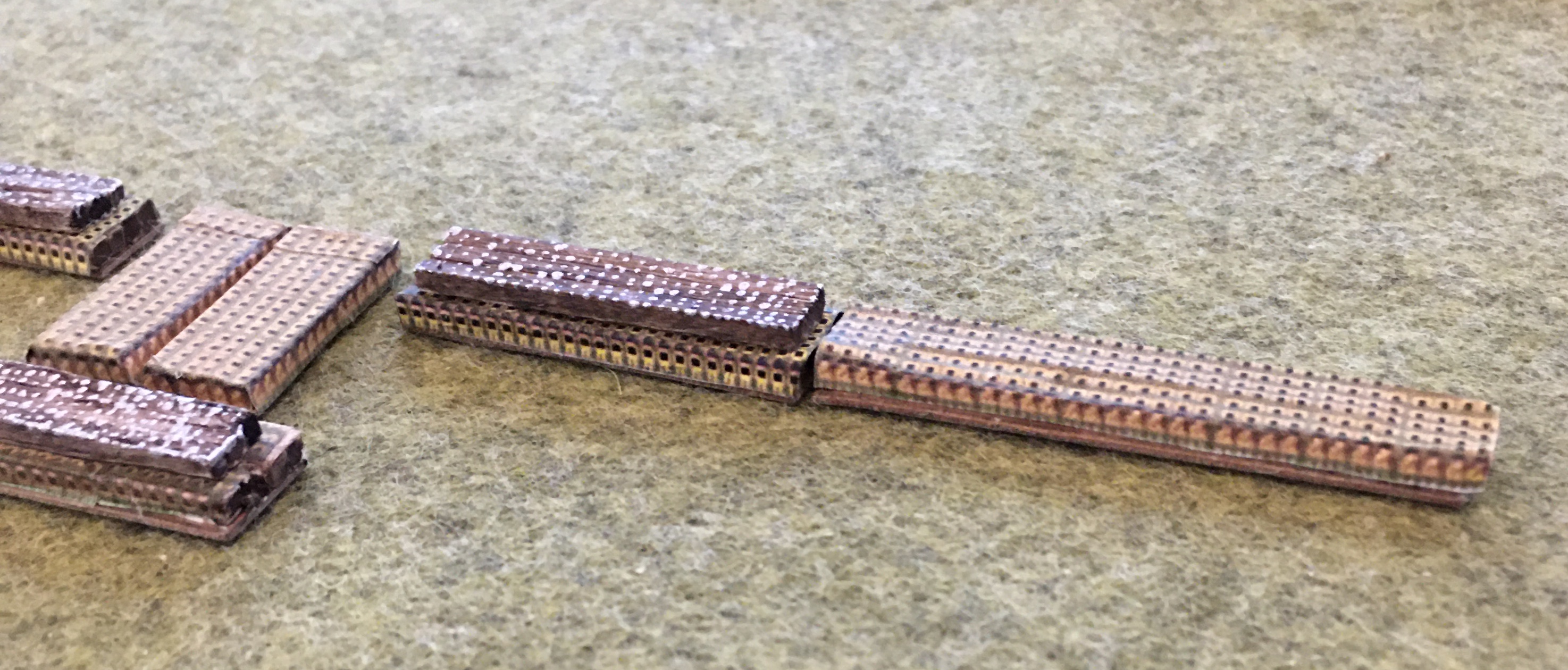
The rules use a brigade as the standard tactical unit. This is a formation of between 500 and 2,000 infantry, 200 and 1,200 cavalry or dragoons and a battery of 2 - 6 guns. The number of figures and base size is up to the players as long as they fit into the grid squares and they can be identified. I went for 10cm squares for 2mm figures on 8.5 cm frontage by 5 cm bases.
1. Table size and troop deployment
Units may deploy up to three squares in from their table edge. Each player takes it in turn to place one brigade. There may only be one brigade in a square. After the first brigade is placed each following brigade must be placed adjacent to a previously deployed brigade. The only exception to this is for Dragoons who may be placed dismounted in a rough terrain square up to five squares from their table edge.
The table must be at least 10 squares deep by 15 squares wide.
2.Turn sequence
This is an “I go - You go” system. Player one runs through the turn sequence and when they have completed their turn play moves over to player two. The turn sequence is as follows
Player one
- Set unit stances
- Movement
- Defensive fire
- Shooting and close combat (close combat is an attack and defence by both players)
Player two
- Set unit stances
- Movement
- Defensive
- Shooting and close combat (close combat is an attack and defence by both players)
Lastly both players attempt to rally off confidence reductions from combat.
2. Set unit stances
Each brigade must be in a ‘stance’ which determines how it will fight and move. These stances are:
- Marching
- Shooting
- Close Combat
- Defensive
A brigade chooses a stance at the start of it’s turn and stays in that formation until the start of its next turn. Only Infantry or dismounted dragoons units may take up a defensive stance.
3. Movement
A unit will have a number of movement points determined by it’s stance. These are shown on the QRS
Field artillery - cannot move once deployed
Brigades may only move directly ahead, or change facing to face another side of the current square by 90 or 180 degrees or to mount or dismount. The movement point cost to enter a square is determined by the terrain type within it as shown on the QRS. Changing facing costs one movement point.
4. Terrain
Types of terrain
Terrain is defined as clear, rough, buildings and impassable. in addition any terrain type may also be classed as blocking. Blocking blocks line of sight in addition to any other terrain effects. Common types of terrain are treated as follow:
Woods - rough and blocking
Orchards/scrubland/warrens/boggy ground etc - rough
Grazing land or Champion land - clear
Fields with crops ready for harvest - rough. (things like corn, beans or wheat in full growth).
Rivers and Lakes - Impassable. Rivers lie along the edge of squares and prevent movement between the squares they divide but do not otherwise change the terrain in those squares
Hills - clear and blocking or rough and blocking
Roads, fords and bridges are a special case. These convert any rough or impassable terrain to clear but ONLY for a unit in marching stance which is following the line of the road or crossing the bridge or ford.
The entire square is counted as a single terrain type not just the area covered by the terrain piece laid out in it. With the exception of roads and rivers.
Terrain effects
Clear terrain has no effect on movement or combat.
Rough terrain has no effect on infantry or dismounted dragoon movement. Cavalry cannot use their charge bonus movement point if they have to enter rough ground and need two movement points to cross a square of rough ground (so can only cross in marching stance). Attackers deduct one from close combat dice if attacking into rough terrain.
Buildings are treated as rough terrain except that cavalry suffer no movement penalties. Attackers deduct one from all dice when shooting into or in close combat against troops in buildings. Cavalry cannot count the charge bonus for making a double move ending in contact or for attacking flanks or rear of foot
Impassable terrain cannot be entered by any troop type other than as noted for roads etc.
In addition blocking terrain blocks line of sight.
5. Combat
Each brigade has a shooting and close combat factor which is the number of dice rolled in those types of combat. This is based upon the number of men in the real formation and not the number of figures on the base. Once the combat factor is calculated players don’t need to worry about the number of men depicted or figures on the base. An explanation of how to calculate these factors is in the design notes.
For example an average New Model Army brigade would be 900 men with a 1:2 pike to shot ratio deployed in six ranks. It would class as
- Confidence: Steady
- Shooting factor: 2
- Close combat Factor: 3
The score required to create hits on the enemy is determined by the units stance and adjusted by terrain as shown on the QRS .
Combat target areas
Infantry, dragoons and cavalry may only shoot or engage in close combat straight ahead. Field Artillery may fire into the square directly to their front then into the square directly ahead of that or one square either side of that. They can then shoot into any square directly ahead of those three squares provided they are in range and the artillery has line of sight. Light artillery may be attached to an infantry brigade by adding a model gun to the brigade base or may be stand alone pieces. In both cases they may only shoot into the two squares to their front.
Close combat attacks may only be made into the square directly ahead of the attacking unit.
Light Artillery
Light artillery fire is rolled separately to musket fire even when attached to a brigade. They have a range of two squares each gun will roll one dice at a range of 1 square and two dice at a range of two squares. It will hit on a six in the first square or a double six in the second one in all stances other than marching. In marching stance it may not fire at all. If attached to a brigade it's stance is the same as the brigade it is attached to.
Defensive fire
The non active player may attempt defensive fire if they have not fired or fought in close combat in their previous turn and are in shooting or defensive stance. Defensive fire uses the shooting factor but only scores hits on di rolls of 6
Defence rolls
Units roll the same number of dice as it would in melee (if in shooting, melee or defensive stance and half that if in movement stance) and every six rolled negates a hit taken in that combat.
Push backs and follow ups from close combat
After calculating the reduction in confidence for the units involved in close combat the unit which has taken the largest number of step reductions in confidence is pushed back one square. Any units in that square are also pushed back to make space.
In the case of ties the attacking brigade will decide whether:
- both brigades retire one square, or
- they stay in contact
Where only one brigade is pushed back or destroyed the other may follow up or stand it's ground unless the winner is a cavalry brigade where it must always follow up or artillery which may never move.
Taking hits to confidence
Units have five possible levels of confidence
Keen - Steady- Nervous - Wavering - Breaking.
The majority of troops will start as Steady. Some elite troops will start as Keen while some less enthusiastic units may start as Nervous.
Each hit which is not negated reduces the level of confidence by one step. Confidence may be returned by rallying (see below).
6. Rally
At the end of each turn a player may attempt to rally a number of units. If successful this will restore one step of confidence. Each army has a number of commanders available. Each commander may only attempt to rally one unit per turn. It must be within their allocated command.
Most armies will have three or four commanders. One commander in chief, one commander for each wing of cavalry, one for the infantry centre. In some cases there may also be a commander for a reserve or for re enforcements.
To attempt a rally roll 2D6 to return:
a breaking unit to wavering requires a score of 11 or higher
a wavering unit to nervous - 10 or higher
a nervous unit to steady - 9 or higher
A steady unit to keen - 8 or higher
A unit may only recover one step of confidence in a turn and may never recover beyond the level of confidence that unit held at the start of the game.
7. Winning and loosing
Unless different conditions are listed in a scenario the first side to loose 1/3rd of it's units or more has lost the game.
DESIGN NOTES
You have probably noticed that I haven't defined things like ground scale or turn length or included a morale rule in the above. I didn't forget, I deliberately left them out to make things move faster. Morale is sort of dealt with by the different levels of confidence and the rally rules. If it helps I sort of considered each square to be somewhere between around a hundred and two hundred yards across. Figure scale doesn't really matter its the factors for the brigade that count, and yes I know that is very board gamey, but that was one of the underlying design decisions to speed things up. I did consider the number of men in the historical brigades being depicted just not how many figures that converted to. That decision I leave to your sense of aesthetics!
Combat factors are calculated as
follows.
Close combat factors – Infantry
and dismounted Dragoons
1.
Decide how many men are in the
historical unit, what the ratio of pike to shot was and how many ranks they
deployed in.
2.
If the historical unit deployed
in more than 6 ranks deduct the men in the ranks after the first six. For
example: if there are eight ranks divide by eight then multiply by six.
3.
Next using the pike to shot
ratio determine how many pikemen and musketeers are in the first six
ranks. To do that add the numbers in the
ratio and divide the answer at step three by that then multiply that number by
the individual parts of the ratio. So if
there are 900 men with a ratio of 1:2 divide 900 by 3 (1 +2) this gives an
answer of 300. 1 x 300 means that there
are 300 pikemen 2 x 300 gives 600 musketeers.
4.
Now it’s time to allocate
factors. For close combat all infantry
and dragoon units have a base factor of one, add two for each full 500 pike
armed soldiers or one for a pike division of between 250 and 499 men in the
first six ranks (ignore pikemen of between 1 – 249 for the moment). Add one for
each full 500 musket or arquebus armed infantry in the front six ranks. If any soldiers have not counted towards the
close combat factor yet (so those pikemen we ignored earlier or any after the
first 500, plus any others not already counted in giving a factor) count these
up as a single total if that number is 250 or more add an additional 1. If it is below 250 ignore them.
Close combat factors – Cavalry
and mounted dragoons
1.
Cavalry units have a base value
of two, mounted dragoons have a base value of one. For cavalry and
mounted dragoons we look at the first 3 ranks only not the six used for
infantry to determine how many men to use in calculating factors. Add an additional one for each 250 cavalry
and mounted dragoons in the first three ranks. If cavalry (not dragoons) are
armed with pistols or carbines add an extra factor of one for each full 250
men. Ignore any balance of less than 250 troopers. Add an additional one for
cuirassiers deployed in six to eleven ranks and a further one if they are in
twelve or more ranks.
Shooting Factors -Infantry and
dismounted dragoons
1.
As with close combat factors we need
to determine how many men are in the first six ranks and how many are armed
with muskets. This is done as in steps 1
to 3 in infantry close combat calculations
2.
Any unit with musket armed
troops will have a base factor of one. To that add one for each full 500
musket armed soldiers in the first six ranks and a further one for any reminder
of between 250 and 499. Ignore arquebus armed soldiers these are included
in close combat factors due to their shorter range.
Note cavalry do not have a
shooting factor as their firearms are used at close combat ranges
For example a New Model Army
infantry battalia of 900 men with 600 musketeers and 300 pikemen deployed as 6
ranks.
Confidence - steady
Shooting – 2. Base of 1 plus 1 for 500 musketeers. The balance of the musketeers has no effect
as in total they only come to 100 unallocated men.
Close combat – 3. Base of 1 plus 1 for pike division of between
250 and 499 men and 1 for the first 500 musketeers. The balance of the of the pikemen and musketeers has no
effect as the 300 pikemen are already used to gain the plus one and there
are only 100 unallocated musketeers.
I will provide some army lists with unit statistics in further posts post
Although the default name for a combat unit is a Brigade this does not always mean that there are several battalia in the formation. For infantry the Swedes and Dutch will have three or four battalia (or squadrons if you prefer) on a base. Imperials, Spanish and Catholic League forces will have one large body on a base made up of troops from one or more regiments. Early British Civil War brigades will have two or three battalions on a base (Royalists will be using that structure for longer than Parliament). The New Model Army will normally have one large 'battalia' per base depending on the battle being fought. Cavalry brigades will represent several squadrons in almost all cases.
When I'm designing, or amending a set, of rules I almost always start by considering the relationship between weapon ranges, ground scale and movement ranges. That is because I try to focus on the risks that arise in combat for the period. Understanding that almost automatically informs me about the turn length and after that the rest is just deciding on some mechanisms. I then pretty much move onto the quick reference sheet with the detailed rules being to explain things that I took for granted on the QRS.
As mentioned earlier there are some fudges to make the game playable. The main one is shooting ranges. Muskets could cause harm at 300 yards but mostly didn't. Effective range was around 50 yards so part way into the adjacent square, but I have given a range of two squares, why? well I wanted to create a danger zone units had to cross to come to close combat. Plus Brigades may be at the front of a square or at the back of a square so the actual range they are firing at could be anywhere from point blank to 400 yards.
The other big fudge is unit frontages. Big brigades could have a frontage of over 200 yards, so more than one square, but I have stated all brigades fit into a single square. That is because I wanted to keep the rules simple no more and no less. You can pretend the intervals between shot corporalships, shot and pike divisions and different battalia in the brigade have been compressed if it helps you to suspend disbelief.
The boring legal bit
These rules and the associated QRS are copyright to Dave Geldard. You are free to print copies for your own use or to provide spare copies for use by your gaming friends. You may not copy print or distribute for commercial gain without the permission of the author. Printing copies or otherwise transcribing the rules and QRS will considered acceptance of these conditions.
Last of all I will answer any queries as a separate blog post so any clarifications or amendments are easy to find. I hope you enjoy these rules.
Edited 14 June 2024 to clarify combat factor calculations. Amended defensive dice allocations when attacked in flank or rear and added light artillery rules.