Monday, 21 December 2020

Unexpected gifts and In Deo Veritas

I don't think I have ever really mentioned anything to do with my working life.  I work in the world of tax, no not H.M. Revenue and Customs.  I did once work for them, well the Inland Revenue as it was back then, but not since 1999!  I now work for a niche tax consultancy which in turn is part of a larger US based corporation.  Usually at this time of year there are the usual corporate events to thank the staff for their efforts and this would normally include a nice bottle of something and a box of choccies.  Of course this year isn't normal, the Coronavirus has put paid to any staff get togethers and as we are all working remotely issuing physical gifts was going to be a nightmare.  So image my surprise, and pleasure to receive an email giving me the choice of a £100 Amazon voucher or a donation to a charity in the same amount in place of this years' Christmas get together and gift.

So there was I with an unexpected £100 burning a hole in my pocket and the whole of Amazon to go at!  I bought some additional Christmas gifts for the ever lovely Mrs E and the rest I spent on goodies.  A few painting materials and then military history/wargaming books.  In no particular order I splurged on:

  • In Deo Veritas wargames rules for the 17th Century (Helion & Co)
  • Twilight of Divine Right also 17th century rules (Pike and Shot Society)
  • A rabble of gentility - The Northern Horse (Helion & Co)
  • In the Emperor's Service - Wallenstein's Army 1625 - 34 (Helion & Co)
All books I wouldn't have thought of purchasing apart from my unexpected windfall.  The Helion & Co books are all from their 'Century of the Soldier' range which covers the pike and shot period with the current focus being on European conflicts in that period.  I'm very impressed with what I have seen so far.  Good production values, excellent content and coverage of stuff that hasn't previously been easily available in English language material.

I also downloaded a copy of the 'Tilly's very bad day' free rules for the Thirty Years War.  These are by Steve Thomas who co authored the first edition of Twilight of the Sun King, the predecessor to Twilight of Divine Right.  'In Deo Veritas' arrived on Friday so I have had chance to skim read both sets and I also read a few reviews of Twilight (as my set hasn't arrived yet).


The good production values start with the cover 

All three sets claim to be fast play and in each case they do this, at least partly, by using manoeuvre units which are brigade or tercio sized.  Less units means less things to move so faster play, seems to be the idea.  

One common criticism I keep seeing in reviews of all three sets is that the definition being used of these brigades or tercio sized units is imprecise both in terminology and unit size.  To be fair to the authors, I had the same issue with my rules mainly because there is no standardisation between armies as to what to call military units, especially of foot.  This leads to a need for rules to use a catch all title for all armies, at all places and times in the period which didn't really exist.  The complaint being that it makes it hard to convert orders of battle for use under these rules if you don't know what a brigade actually is.  I would have thought that this would have been easily dealt with by explaining the problem upfront.  IDV especially seems to play fairly fast and loose with the concept.  The rules include about a half-dozen sample battle scenarios and one of these is Marston Moor 1644.  This is a battle I know fairly well having lived close to the battlefield for a number of years and having based my 6mm army on the forces deployed at that battle.  The scenario order of battle reduces the number of actual units by between a half and a third.  Some of the amalgamations make sense as they match known composite formations but others don't.  Some description of the process would have been helpful.  As it is it presumes either no interest in the actual battle or an in depth knowledge good enough to allow the player to work things out from scratch! 

I can't help but think that this will loose some of the period flavour. The 17th Century was a period of military evolution and part of this showed as different formations and tactical styles at brigade level.  Now I may be wrong here and those differences may well shine through in play.  Reading has made me decide that as I have a fair few 17th Century figures in 6mm that I will give 'In Deo Veritas' a try out.  I will then be able to compare the feel with the rules I have written which are more flexible on formations and tactics as the manoeuvre units are less restricted.  I'm hoping for some inspiration on unit basing and victory conditions as a minimum out come and perhaps even a 'Road to Damascus' moment producing a conversion to this approach to fast play. 

Thursday, 17 December 2020

My first painted 6mm ECW figures figures for a very long time


I have been trying to meet one of 2020's New Year's resolutions for the last few weeks; having less unpainted figures by midnight on December 31st then I had at January 1st!  So a personal challenge to reduce the lead pile by painting more than I bought over 2020.  It should have been easy, mainly because Baccus 6mm's shopping cart has had to close for a large part of the year to manage demand and I prefer to buy from Peter's range where he has the figures available, or something close enough to be a viable proxy.  As a result chances to splurge have been restricted.  On the other hand lockdown and the need to be strict in observing the social distancing that came with it dealt my painting mojo a blow and there were three months without any figures getting finished!

Additional Late Imperial Romans.  Legionaries, Auxilia and Equites Sagittarii

All of which meant that I entered November needing to pull my finger out.  At this point please imagine the sound of a finger making that popping noise as it flicks out of the side of your mouth.  You know the one, the cork out of a bottle sound, better yet...do it, go on... you know you want to!  Well I have extracted said digit (more popping sounds here) to the extent that I have run out of unpainted Late Imperial Roman infantry and proxy Byzantine infantry figures!  


Baccus Sassanid Infantry as Byzantine Skoutatoi.  Those shields need some work.

In desperation I turned to the deeper reaches of the lead pile and found unpainted Irregular Miniatures 6mm ECW figures lurking in the shadows.  ECW in 6mm was my earliest foray into sub 25mm gaming.  The bulk of the figures were purchased in the late 1980's from a wargaming store a few hundred yards from Kings Cross station at the end of Pentonville Road if memory serves.  Looking over the tray of unpainted lead made me realise how far 6mm sculpting has come in the intervening years.  The majority of the infantry look like clothes peg dollies scaled down to 6mm!  But in the middle of those were a handful of better sculpted casts.  These were the newer irregular miniature casts.  I have no idea when they were introduced or where I got them from.  I suspect some now long forgotten benefactor gifted them to me.  So onto the painting table they went.  Partly I wanted to reduce the numbers in the 'to paint' pile but also I wanted to see how my painting style had changed in the intervening thirty some years.  So here they are.


Older casts with older paint jobs in the centre.  At this range they all look reasonable

As you can tell the older casts are prone to snapping at the ankles.  A trip to the surgeon and a dose of superglue should fix that.  The new casts need separating so as to have a firing and a ported rank so they are more work than the old ones, but the animation of the figures is far better.  My painting was simpler back then but my eyes were better so I picked out more detail, or at least what detail there was to be picked out.  I'm more ambitious but probably less able now, well my eyes are 35 years older then when I painted the first figures

At the time of writing this I am 53 figures short of target with half of December still to go and with 98 figures on the painting table at various stages of completion.  Fingers crossed I may actually achieve a New Year's resolution for the first time ever this year!


Sunday, 6 December 2020

The Dark Ages campaign - some musings

 The original campaign rules included some detail that I can't use in a solo game.  The main one was a system to provide some ability to create alliances and exert influence over other players.  Each ruler would have had points of influence allocated based upon the battles won or lost, and their personal ability to rule.  These were to have been used to maintain loyalty in their populations and sub commanders, or to create unrest in other player's home provinces and to influence other players policies through agreements.  

The idea was that a strong successful leader would be able to 'lean' on neighbouring players and if he managed to 'outbid' them with influence points to force through treaties and agreements.  The effect would be cumulative so a long reigning king with a high influence rating should leave a relatively stable country to his successor.  I say 'should' as a proportion of spent influence points would be lost on the death of a leader to represent the personal nature of kingship.  This would have been useful in the current situation in south west Wales as the attack on Devet would probably been replaced or offset by player negotiations and agreements.  In the original campaign the Welsh Princedoms were threatened by Mercian aggression and would have had an option to set up non aggression and support agreements which would have possibly left a small princedom like Devet less exposed.

Historically Devet (or Dyfed or Ceridigan depending on the source) had a tough time of it, Formed in the mid to late 8th century it was ultimately swallowed up by Seisslywch in the 840's to form a larger political entity under Hywel Dda.  Before that it may have been a client state of Seisslywch as there is an interregnum possibly due to Viking or Mercian attacks after which a new royal line appears which may have had links to their northern neighbour through marriage.  it seems to have been a thing with the Celtic kingdoms as the Scots and the Picts eventually merged through intermarriages rather than military conquest.  

In my mind, in this solo variant the conquest of a province doesn't automatically mean occupation and boots on the ground.  Instead it represents an extension of influence as much as conquest, although I haven't really thought it through in any great detail.  This gives me an option for these one sided battles. The threat of unresistable force exerts a lot of influence (well war is the extension of politics by other means as Clauswitz told us) so I could simply surrender control to Seisslywch.

In the far North I realised that I have missed an option and a playing faction.  So lets all say hello to the Norse the Norwegian Viking faction.  They have a toe hold off map in the Shetlands and historically raided and settled the North and Western Isles, Parts of Ireland, the Isle of Man and the North west of England.  At the start of the campaign, some areas are not under any player control which was originally intended to provide the Norse with options beyond ripping straight into Pictia.  Their first game action will be to attempt to occupy and settle the Orkney's.

Monday, 30 November 2020

Dark Ages Campaign - 799AD Shattered shields in Seissllwch?

Well actually it's going to be in Devet down in the south west of Wales, but that doesn't have the same ring.  The Prince of Seissllwch has decided that Devet would make a nice country estate for his son and heir.  Late in the summer he assembles his fighting men for a strike to the South West.  

Now this is a unbalanced affair as Devet can only put 4 elements into the field to face 10 from Seissllwch.  Its not really the kind of tabletop action wargamers would normally fight out, but that's the joy of a campaign.  They throw these unbalanced scenario's up from time to time and they need to be fought out.  It creates a different mindset to the line 'em up and let 'er rip type of game where both sides have some chance of a win.  Instead in these games different objectives come to the fore.  Can the men of Devet do any damage to the invaders or do they decide discretion is the better part and all that and hide in the mountains.  If they hide in the mountains how do the invaders winkle them out?  Does Joe peasant farmer really care who the local bigwig is?  If he does, does he care enough to fight for a loosing cause or does he just get on with working the land?  After all the land is always there, while Princes come and go, tithes and taxes will still be due no matter who sits on the throne.  It will still be a Welshman won't it  which probably counts for something.

So the issue is would this result in a battle, Guerrilla warfare or an acceptance that there is a new ruler?

What does the hive mind think?  I may even take it into account! 

Thursday, 26 November 2020

Random thoughts #11 - when funerals outnumber weddings

 That's when you know age is catching up with you, or so said my old Grandad.  Like much of his received wisdom this turns out to be truer then I should like.  No weddings this year but three funerals all of which I had to attend virtually via video feed.  I'd like to say technology is defeating lockdown but it really isn't.  There is no chance to get together after the funeral and have a wry smile over the long gone antics of the dear departed, you know those 'do you remember when [insert name here] did [insert weird shit [insert name here] did 40 plus years ago] moments.

Which led me to wonder what would the random weird thing be that comes up at my post funeral get together.  It's not like there isn't a good selection to choose from!

Wednesday, 25 November 2020

Its been a funny old year


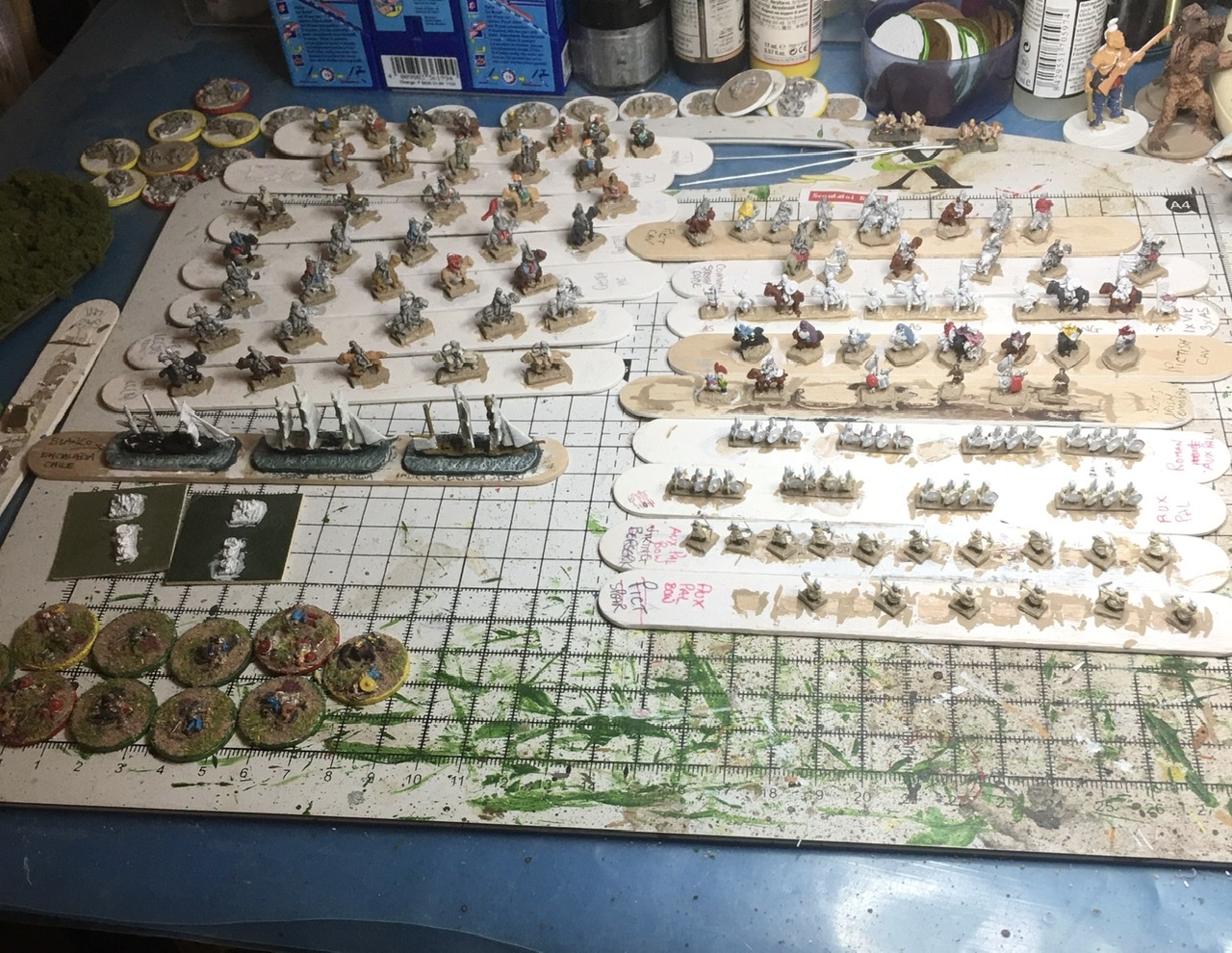
 I think it's due to the self-isolating but my painting mojo had deserted me for the best part of three months.  I simply couldn't summon up the enthusiasm to put paint to figures.  Even the frequency of my blog posts slowed down. Happily I can report a slight return to form and I have managed to finish painting  over seventy 6mm figures so far this month, mostly Late Imperial Romans and Maurikian Byzantine proxies.  

The bad news is that while I'm not out of figures to paint, I am running low on the stuff I need for the projects I'm working on, and I missed the Baccus ordering window to top off stocks!  I will have to peruse the Irregular Miniatures catalogue instead.  I'm also running low on some DBA/ADLG bases but I have an order on its way to cover that so that shouldn't be a problem and I have included 60 x 30mm ones for Alter of Freedom units as well.


Lots still to paint, mostly mounted troops.

As you can see there is still plenty to go at on the painting table at the moment and I might just end the year without increasing the size of the lead pile!  Currently the lead pile is ahead by something like 230 6mm figures for the year.


Wednesday, 18 November 2020

Dal Raitia 799AD - Pictia attacks Comgail (Dal Raitia)

The Pictish Forces are advancing from the North East and near an insignificant settlement called An Cladach they clash with the Dal Raitian royal army.  The Dal Raitian Scots are defending and the invading Picts are being run by the AI rules.  I am again using De Bellis Solitarius which are available as a free download from the Fanaticus and other, websites.  Versions are available for DBA 2.0 and 3.0 and I find that they give an interesting game by virtue of setting constraints on what the AI side is allowed to do while allowing player input within those constraints.  Before the game started I decided on the Scots deployment.  I then rolled up the Picts overall tactical stance for the encounter and then their deployment.  Think of that as the commanders pre-battle briefing from the CinC something like:

"Right settle down and listen up,  here is the plan.  We outnumber them almost two to one so they either have to hit us hard and fast before we have the line properly set up or they will want to defend and use the ground to their advantage.  If they attack their initial charge is a problem but if we stack the spearmen deep we should be able to absorb the impact.    

Moravin, you have the larger command so act aggressively, I'm putting you out on the right flank with Mar.  You have the majority of the mounted lads so if you get a chance to get around their flank, take it. Especially if you see a chance to attack their camp.  Nothing like having your women attacked to take a man's mind off the fighting eh?  

I will be in the centre with the rest of the Army, so that's you three, Strath Erin, Athfotla and Monath.  Your boys will hold the centre and cover our camp.  Nothing too clever required there, I think we can hold back in a defensive posture and see how things develop on the right.  If they attack us then all the more space on the flank for the mounted lads to use.  I'm pretty sure their entire strength is in the field against us but I'm not ignoring the risk of them trying to land behind our flank from boats.  Moravin the beach is on your flank so have a think about about what you might do to cover that eventuality will you. 

Everyone happy?  Excellent well grab what sleep you can and we shall see what the morning brings."

Or as the dice rather more prosaically gave me; place the camp as near the centre line as possible and behind any available bad going.  Command 1 (The King with  8 elements) deploy in the centre with a defensive stance.  Command 2 (11 elements) deploys on the right flank and takes an aggressive stance.  Pike form up two deep if facing warbands.  Fastest troops deploy on the end of the line.  

The Scots have 11 elements to deploy including the King.  There is nothing to loose and a defensive strategy just will not cut it.  The Scots will probably never have more men in the field than they have today, so they have to take the fight to their Pictish cousins.  Accordingly I have decided to go with a littoral landing.  That will be on the Pictish Right which it turns out are under orders to be aggressive and so with any luck it will land behind their flank.

The Scots briefing is an altogether more downbeat affair.

'Alright then sit down and take a drink it may be the last one you get from me.  You all know the Picts outnumber us and have a point to prove having had a beating from the Strathclyders of late.  They have crossed the mountains to get at our heartlands so I doubt they just want to talk.  Tomorrow is going to be bloody, the only question is whose blood will be on the heather?

We don't have the luxury of giving up this ground and there are no reinforcements coming. What we do, win or loose, we do with the men we have, here, at this place.  They will come on fast and that is our one advantage as it will give us the option of turning their flanks.  I will have the main body but  you Comgail,  you will lead a small group to land on the beach behind them.  Hit them in the flank or rear and hit them hard.  Make them rue the day they came to Dal Raitia.  You will be the hammer, we will be the anvil and between us I intend to crush them.  Now go see to your men, tell them of certain victory on the morrow and, remind them that they are fighting for their homes and families.

The Day of Battle

'The day of battle  dawned and looked set fair so the fight commenced almost immediately. Our landing party sprang into action as soon as the Picts were in reach and charged up the beach into the end of their line.  Two units of Pictish light horse turned to meet the threat.  Meanwhile our main line advanced as quickly as they could but it was clear that the landing party would be on their own for a wee while.  We could tell that the attack from the beach had the Picts rattled as their advanced stopped dead on that flank.'  

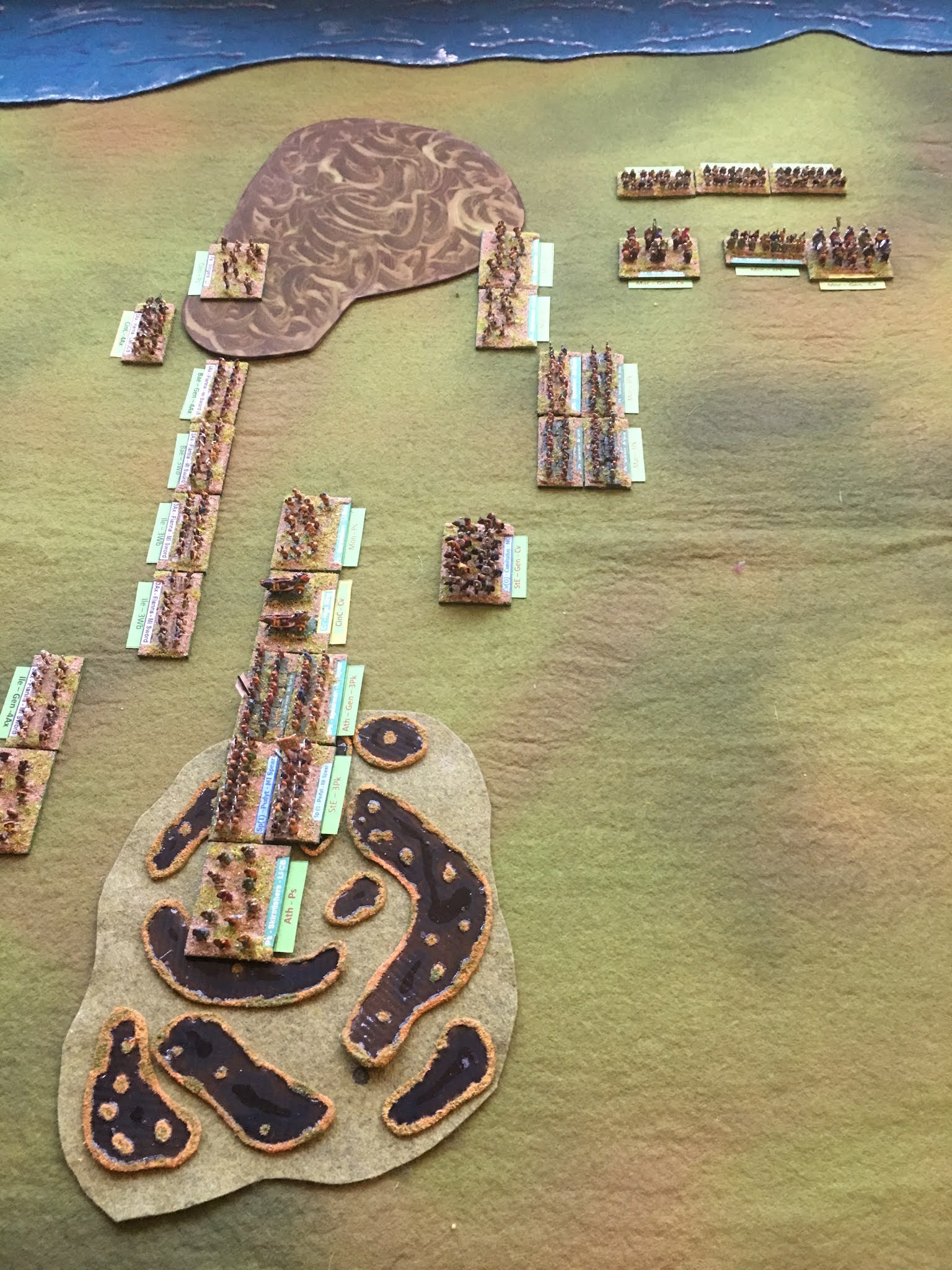
1. The armies deployed -landing party ready to storm up the beach!

A good opening pip score allows the out of command littoral landing to get into contact with the end of the Pictish line.  In their turn both Pictish commands get abysmal pip scores and low aggression scores meaning that the right hand command who are meant to be moving up stall as their flank units have to deal with the Scottish attack. The left hand command does manage to advance to occupy the boggy ground to their front.  This was repeated for the next two turns where the Picts consistently rolled single pips for both commands.

'We couldn't believe that the beach attack had thrown the enemy into such confusion, we could see that the fighting was muckle fierce on that flank and one group of Pictish light horse was soon destroyed.  The rest of that wing seemed incapable of reacting to the attack.  Our main body continued to push forward towards the enemy with our wilder tribesmen leading the advance.'

2. Picts in a pickle - down one LH already

I roll two dice for each Pictish command the large dice is the aggression for this turn the smaller the Pip score.  The aggression roll is adjusted based on the starting aggression and the pip score.  The photo below shows just how bad the Pictish rolls were!

3. On the defensive. Awful dice mean the Picts cannot put attacks together!

As the day rolls on the landing party takes out a second light horse unit it had pinned back against the end of the Pictish line. The poor Pictish command rolls are really hurting them and the right wing is only one unit away from becoming demoralised.

4. It looks better than it really is for the Picts (on the left here)

The terrain is helping the Scots.  The aggressive Pictish right wing has to overcome the flanking attack and get through the woods to to turn the Scot's left.  The other flank, which is wide open, is facing the defensive Pictish wing who are less likely to take advantage.  The boggy ground is doing nothing to slow either side but it is preventing the Pictish spearmen gaining the rear support bonus  Fast Pike would gain in clear terrain.

5. The Scots have a decent defensive line at least

It isn't until turn five that the Picts get a decent pip and aggression roll and with the Scots racing forwards to the attack with their main force it isn't a moment too soon.  They bring more troops up to the fight on the right wing and push forwards in the centre where the two lines come to close combat.  There the fighting leads to a first casualty for the Scots and the usual confusion as the neat lines dissolve.  At this point you would have thought that things are about to improve for the Picts, they are in contact all along the line and should be able to bring the advantage of numbers to bear.  You might have thought that but, the dice gods really have it in for the painted people and in the first combat they loose another unit.  Even worse this is from their right wing command which pushes them over the edge into demoralisation.  There is a single ray of hope now as a second scots unit was destroyed in the combat round, so the Scots are edging closer to their break point. 

6. A turn later and the battle is slipping away from the Picts

The next couple of turns have the Picts attempting to keep their right wing on the table by using pips to force unit's hold their ground.  Because they are demoralised that wing can't do anything but hold or retreat and it takes a pip to have a unit hold in place, they can't initiate combat although they can defend.  Their biggest problem is that if they hold the units closest to the edge of the table in place then those who are pinning the Scot's beach landing in place have to retreat and that opens the way for a camp run.  On the other wing I successfully override the standing orders for a turn and send a Pictish light infantry unit sprinting for the Scot's camp but with my Scot's cap (should that be bonnet?) on I counter that with a Scots light infantry unit in the following turn by bringing close enough to pin the Picts in their threat zone.

7. Although the Picts' left is holding men a streaming to the rear on the right wing

Things are looking bleak for the Picts now as the only command that can act has defensive standing orders so is going to struggle to advance to combat.   Poor dice rolls on the other wing are allowing units to head to the rear there.  Although the Pict's have managed to get into a good position for an attack the defensive stance stops them from capitalising on it and I failed the override dice roll for them.  A poor pip roll for the demoralised command sees four elements leave the table and that is game over.

Although not particularly heavy, the losses will have an impact on both sides the Picts have lost three elements and the Scots two.  At least the King of Picts was able to escape the disaster.

The Pictish chronicles simply recounts 

'The fury of the Scotsmen knew no bounds'

This game taught me a few things about these troops.  Fast pike are capable troops but only if well deployed the +3 rear support bonus would have made a huge difference had I been able to use it.  It was only the poor initial deployment that worked against them and I should have redeployed the line to get them into good going.  The terrain made no difference to movement for the infantry as both sides have fast foot or solid auxilia who are not slowed in bad going.  Still the Picts are not going to let a little thing like two defeats in one turn change their ambition and they will be be back.