They tell me that some people like really hot weather. They must be the ones who don't spend bank holidays running up and down fields in woolen clothes and armour and carrying an assortment of out of date military equipment. For those of us who indulge in military reenactment as a hobby bank holidays are usually wet. Either from the outside in or the inside out, there doesn't seem to be any happy medium. This last one was no exception it was a getting wet from the inside out variant which is getting more common of late. The display on our car claimed it was 29 centigrade, in the shade maybe. Where I was it was difficult to find shade, not even in the lee of the average re-enactor ( who is probably best described as large economy sized)*.
Still it did help build up a thirst which our Bavarian guests were keen to help us deal with. Forty plus Bavarian Pikemen from the Memmingen Pikeniere. Who says the EU doesn't do anything useful for British culture. I didn't go on the field the second day. I'd like to claim it was due to drinking prodigious quantities of Bavarian beer. I'd like too but I can't because I was asleep by 8.00pm the heat had done for me.
Some may like it hot, but not apparently I don't.
* which reminds me that the BBC apparently turned down an offer from the Sealed Knot to provide extras for a Civil War drama with the killer put down of "Too old, Too fat". Harsh, but sadly really rather fair.
Friday, 30 August 2019

Thursday, 22 August 2019
Fields of Fire
Well it's actually flock in this case not fire. A chance conversation with Phil Steele from the Northamptonshire Battlefields Society brought me back to a project which has been on hold for a while. That project being the making of some Ridge and Furrow fields for the Medieval to 17th Century period. Phil needs some for the 1469 Edgecote Battlefield model the Society is currently displaying at events. I had what I thought might be just the thing, courtesy of Hobbycraft. Its a brown corrugated rubber/plastic sheet, A4 size. The ridges are about 3 to the centimetre and stand a couple of millimeters high so ready made ridge and furrow for smaller scales.
All that is really needed is to cut the sheet to the required size and then glue some flock to the top of the ridges. Of course as with a lot of my projects I needed to go back an additional step and make my own static grass applicator before I could do the flock application! It was a really easy job using an electric fly swatter and a small seive as the main components. The trickiest part is the soldering of the wires coming out of the circuit board of the fly swatter to the sieve on one side and a length of additional wire on the other. Mind you if I can do it anyone can so not exactly rocket science. I'm not going to provide any detailed instructions as there are any number of good tutorials only a Google search away.
I was a bit concerned about getting the flock to stick to the corrugated sheet. I needn't have worried it stuck fine. Simply place a thin strip of PVA on the top of the raised ridges and sprinkle the flock and Bob's your mother's brother! Well not quite, the thin school style PVA does tend to flow down into the grooves rather than stay where it was meant to be, but the strands do stand on end! Still its part of a learning curve and a second test with woodworking PVA was more successful. I will take some photos of the finished article when its, well, finished!
Its off to the wars for me this weekend. The Sealed Knot has its largest event of the year just outside Scarborough this coming bank holiday weekend so I will be shooting at the ever romantic but commonly wrong supporters of that man of blood Charles Stuart for a couple of days.
 |
| Sorry about the sideways image. This is the Hobbycraft sheet. |
All that is really needed is to cut the sheet to the required size and then glue some flock to the top of the ridges. Of course as with a lot of my projects I needed to go back an additional step and make my own static grass applicator before I could do the flock application! It was a really easy job using an electric fly swatter and a small seive as the main components. The trickiest part is the soldering of the wires coming out of the circuit board of the fly swatter to the sieve on one side and a length of additional wire on the other. Mind you if I can do it anyone can so not exactly rocket science. I'm not going to provide any detailed instructions as there are any number of good tutorials only a Google search away.
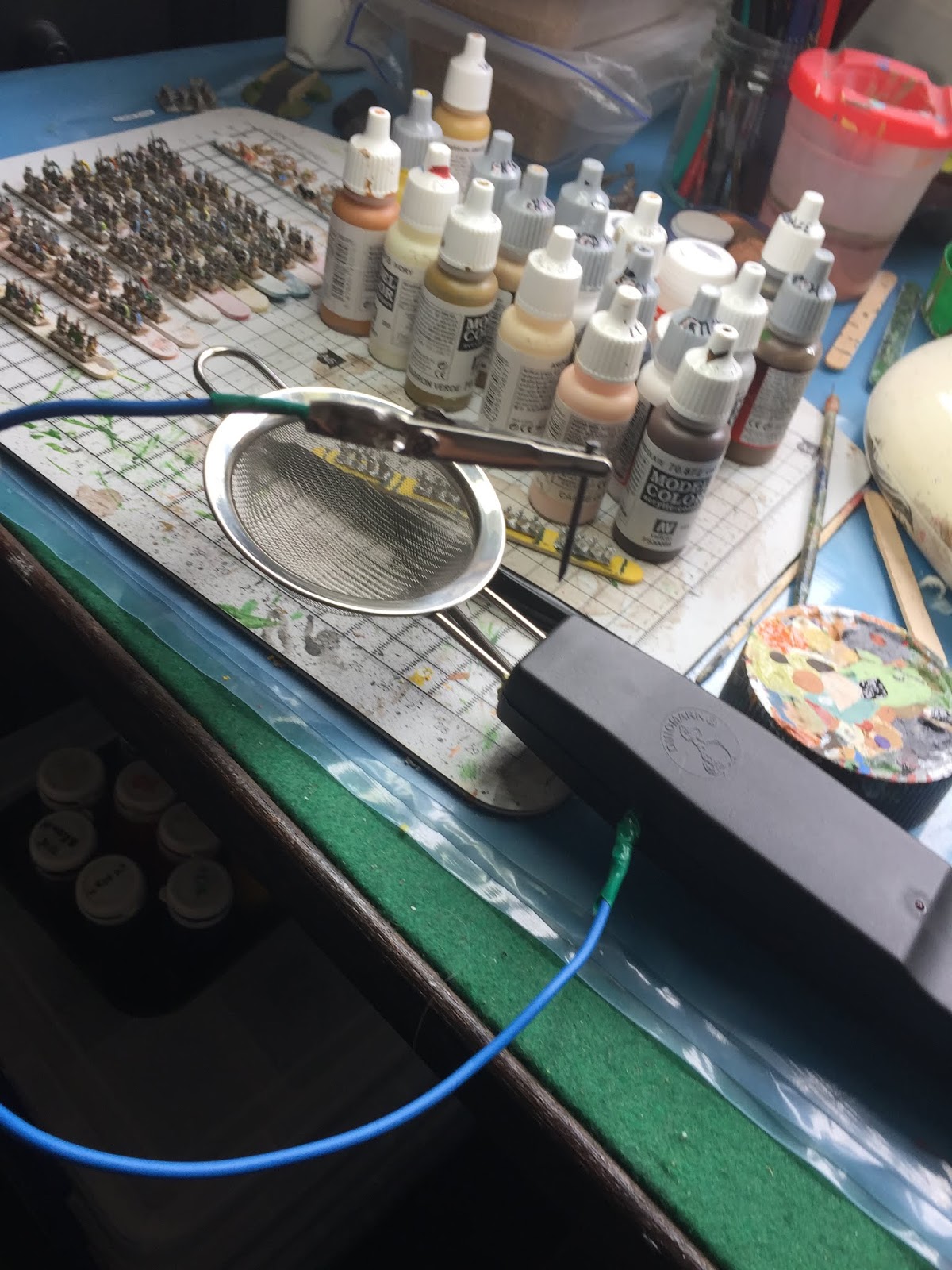 |
| The completed applicator. Its a bit Heath Robinson but it does the job. |
Its off to the wars for me this weekend. The Sealed Knot has its largest event of the year just outside Scarborough this coming bank holiday weekend so I will be shooting at the ever romantic but commonly wrong supporters of that man of blood Charles Stuart for a couple of days.
Tuesday, 6 August 2019
Ambush Markers
ADLG uses some hidden deployment rules which need markers for the rough location of the unit in ambush, or blinds where they could be (but aren’t). As I had some H&R figures that were not being used for anything I thought I could use them on the markers. I wanted something a little better than a simple square with a ID number on it so I started to think about what might stop the other side being certain of what was in the potential ambush location.
What I came up with was the element of doubt, the 'are those troops or just bushes in the shadows/mist/gloom' factor. To recreate that I decided that a simple paint job of Vallejo sky gray, with a black ink wash was enough for the troops it gives some detailing but overall keeps the idea of not quite being able to see what it is you are looking at idea going. I based then with my usual fine sand textured base but painted some random gray patches rather than adding flock.and then added something to represent mist.
As luck would have it (not saying what kind of luck) George our Brittany had decided to disembowel a dog bed and I had tufts of stuffing material all over the place. Clearly no one was going to miss a bit of that when it came to restuffing the bed so I grabbed some and added it to my bits box.
With a bit of teasing out it became thin enough to look vaguely like mist and a drop of glue was enough to hold it in place. I wrote a code letter on the underside of the base and done. I'm not claiming them as great works of art but they are good enough for a game marker.
What I came up with was the element of doubt, the 'are those troops or just bushes in the shadows/mist/gloom' factor. To recreate that I decided that a simple paint job of Vallejo sky gray, with a black ink wash was enough for the troops it gives some detailing but overall keeps the idea of not quite being able to see what it is you are looking at idea going. I based then with my usual fine sand textured base but painted some random gray patches rather than adding flock.and then added something to represent mist.
As luck would have it (not saying what kind of luck) George our Brittany had decided to disembowel a dog bed and I had tufts of stuffing material all over the place. Clearly no one was going to miss a bit of that when it came to restuffing the bed so I grabbed some and added it to my bits box.
 |
| George, my able assistant and destroyer of dog beds |
 |
| What's that coming over the hill, is it a dog bed, is it a dog bed? |
Monday, 5 August 2019
The lights are going out
Those who have read my earlier ramblings will know how much I use a magnifier lamp to assist in painting as I do tend to concentrate on 6mm stuff!. Well a few days ago I noticed the light was flickering and next day it had failed completely. Now I have had this lamp for the best part of ten years and my first thought was on the lines of 'oh bugger I'm going to have to buy a new one!'. However in a fit of eco friendliness I checked the make and model and tried to get a replacement for the failed circular fluorescent tube.
Another 'oh bugger' moment now occurred as the website listed on the label no longer existed. But wait there was a limited company named as the maker on that same label so perhaps my google fu would find that. A couple of minutes later and I found myself looking at the web pages of the manufacturer - Shesto Ltd. Not, as the name might lead you to suppose, a Chinese business but a long established British brand. A quick search of their product lines resulted in yet another 'oh bugger' moment as they no longer make the model of magnifier lamp I own. Still there were replacement light tubes with similar model numbers so nothing ventured, nothing gained and I rang the sales line. To be fair I was expecting that there would be no direct replacement, or a minimum order, or trade only sales, but what I actually received was some of the best customer service you could ever hope to get.
The lady on the sales line went off and checked the model number and the bulb details from my burnt out tube and compared the spec to the current items they stocked and confirmed that although the part number was different the one they now stocked should fit and...get this...'if it doesn't work send it back and we will refund you' ! All for an order of one bulb costing under £15 including postage. I tried to order from the website but got an error so called them back, and was again met with the same excellent customer service. So order made I settled down to await the delivery.
The replacement lamp* arrived within 48 hours and was the one I needed. It went into place easily, only seven screws to deal with and that included the cable retainer gadget. The whole process took under 15 minutes from start to finish. Its really nice to have a bit of kit which is designed to allow a home handy man to replace pretty much all the electrical parts.
I can heartily recommend Shesto Ltd, they stock a range of lamps and tools for hobbyists, the price isn't exorbitant and the quality of the products is great. All in all worth checking out. Now that I can see what I'm doing again it's back to painting!
* For those who like the technical details it's a 12w 6400K bulb, 6400K is the kelvin colour temperature and for what it is worth is on the top end of daylight bulbs. If you need to know more about the temperature colour I found this useful explanation on line https://www.energystore-usa.com/index2.php?option=com_content&do_pdf=1&id=23.
Another 'oh bugger' moment now occurred as the website listed on the label no longer existed. But wait there was a limited company named as the maker on that same label so perhaps my google fu would find that. A couple of minutes later and I found myself looking at the web pages of the manufacturer - Shesto Ltd. Not, as the name might lead you to suppose, a Chinese business but a long established British brand. A quick search of their product lines resulted in yet another 'oh bugger' moment as they no longer make the model of magnifier lamp I own. Still there were replacement light tubes with similar model numbers so nothing ventured, nothing gained and I rang the sales line. To be fair I was expecting that there would be no direct replacement, or a minimum order, or trade only sales, but what I actually received was some of the best customer service you could ever hope to get.
The lady on the sales line went off and checked the model number and the bulb details from my burnt out tube and compared the spec to the current items they stocked and confirmed that although the part number was different the one they now stocked should fit and...get this...'if it doesn't work send it back and we will refund you' ! All for an order of one bulb costing under £15 including postage. I tried to order from the website but got an error so called them back, and was again met with the same excellent customer service. So order made I settled down to await the delivery.
The replacement lamp* arrived within 48 hours and was the one I needed. It went into place easily, only seven screws to deal with and that included the cable retainer gadget. The whole process took under 15 minutes from start to finish. Its really nice to have a bit of kit which is designed to allow a home handy man to replace pretty much all the electrical parts.
I can heartily recommend Shesto Ltd, they stock a range of lamps and tools for hobbyists, the price isn't exorbitant and the quality of the products is great. All in all worth checking out. Now that I can see what I'm doing again it's back to painting!
* For those who like the technical details it's a 12w 6400K bulb, 6400K is the kelvin colour temperature and for what it is worth is on the top end of daylight bulbs. If you need to know more about the temperature colour I found this useful explanation on line https://www.energystore-usa.com/index2.php?option=com_content&do_pdf=1&id=23.
Friday, 2 August 2019
Excuses time!
I've been a bit lax with blog posts of late. In my defence real life has intervened in the shape of work and home improvements. On the plus side I have had the chance to play some games with Trebian's 'Monday Night Gamers' who confusingly get together on Tuesdays (see some of my earlier posts). I have also found time and space to set up my painting table.
I have been painting some of the 6mm figures from Baccus which I have had since last year. These are mainly figures for Viking age games for the period 795 - 1066 AD. I'm not just working on the obvious Anglo-Saxon and Viking forces but also on the nations around the fringes. These consist of the british remnant states of Dumnonia (in the South West of England covering modern Cornwall and parts of Devon in the 790's), the Welsh princedoms and Strathclyde. Along with these are the two other Scottish factions of the Picts and Dal Raitian Scots, who may or may not have been one kingdom in all but name by this stage.
The range from Baccus covers almost everything I need except for Picts and Scots. I can proxy Gothic horse and foot for generic Early Medieval types Which covers off the limited cavalry options, only the Strathclyde Welsh seem to have had any significant heavy cavalry in this period. The welsh have some lighter horse which I can cover using the Gothic Medium Cavalry figures from Baccus. Their Gothic Infantry also work well as Strathclyde Welsh Pedyts (Spearmen) and Anglo Saxon General Fyrd. Moorish Foot from the Roman range provide some nicely animated figures for the various LMI javelinmen and welsh medium Infantry types. The Picts are provided by Irregular miniatures as are Scots - Irish swordsmen. I'm only really left scratching around for proxy figures for the Pictish light infantry and Scots-Irish Kerns.
I'm very happy with the quality of the baccus figures and would really like to use then for everything. If only Peter would do a Pictish range! Irregular Miniatures are a mixed bunch some castings are as good as anyone might wish others could do with a re-sculpt. I bought a couple of their pack mule figures which are lovely little figures with crisp clear details, although noticeably smaller than Baccus, I'm going to claim they are boys with pack ponies rather than mules!
On the terrain front I do a lot of scratch building for fields and woodland (watch this space for details of how I make these). Buildings are from Leven Miniatures and Timecast and are sat in the paining queue. So I have been busy just not with blogging.
I have been painting some of the 6mm figures from Baccus which I have had since last year. These are mainly figures for Viking age games for the period 795 - 1066 AD. I'm not just working on the obvious Anglo-Saxon and Viking forces but also on the nations around the fringes. These consist of the british remnant states of Dumnonia (in the South West of England covering modern Cornwall and parts of Devon in the 790's), the Welsh princedoms and Strathclyde. Along with these are the two other Scottish factions of the Picts and Dal Raitian Scots, who may or may not have been one kingdom in all but name by this stage.
The range from Baccus covers almost everything I need except for Picts and Scots. I can proxy Gothic horse and foot for generic Early Medieval types Which covers off the limited cavalry options, only the Strathclyde Welsh seem to have had any significant heavy cavalry in this period. The welsh have some lighter horse which I can cover using the Gothic Medium Cavalry figures from Baccus. Their Gothic Infantry also work well as Strathclyde Welsh Pedyts (Spearmen) and Anglo Saxon General Fyrd. Moorish Foot from the Roman range provide some nicely animated figures for the various LMI javelinmen and welsh medium Infantry types. The Picts are provided by Irregular miniatures as are Scots - Irish swordsmen. I'm only really left scratching around for proxy figures for the Pictish light infantry and Scots-Irish Kerns.
I'm very happy with the quality of the baccus figures and would really like to use then for everything. If only Peter would do a Pictish range! Irregular Miniatures are a mixed bunch some castings are as good as anyone might wish others could do with a re-sculpt. I bought a couple of their pack mule figures which are lovely little figures with crisp clear details, although noticeably smaller than Baccus, I'm going to claim they are boys with pack ponies rather than mules!
On the terrain front I do a lot of scratch building for fields and woodland (watch this space for details of how I make these). Buildings are from Leven Miniatures and Timecast and are sat in the paining queue. So I have been busy just not with blogging.
 |
| Baccus Gothic Medium Horse as Welsh Cavalry |
Thursday, 6 June 2019
More Ancients in action - This time with Armati II
I have never played Armati or any of it's variants in this case Armati II. I have now played two games. Trajanic Romans v German Tribesmen and the classic match up of Greeks v Persians. After the game of ADLG a couple of weeks ago (see xxx) we discussed the pros and cons of ADLG and Trebian said he could see where some of the game mechanics had come from. This turned out to partially be from Armati. One difference he pointed out was that units were much less maneuverable than in ADLG which to him it felt more like an ancient period battle. After all command and control wasn't a huge feature in most ancients battles especially in the barbarian armies!
Armati does indeed restrict maneuver or to be accurate there are limits to what can be achieved while maintaining a unit's order. Like ADLG it has 'hit points' for each type of unit and when these are gone so is that unit. Unlike ADLG light troops don't count towards an armies break point and lights are quick killed by contact with certain heavy troop types, representing light troops being dispersed beyond recall rather than wiped out. Movement is not directly linked to base widths although like ADLG and other games it does use the standard WRG base sizes. There are restrictions on how many maneuver groups an army can have and different armies have different initiative modifiers. In the game the Romans get to add 7 to a D6 roll us Germans only get to add 4. The difference between the Greeks and Persians was less marked being 5 and 6 respectively.
On to the Games
The Roman game was played in 15mm using Peter Pig figures, which are really rather nice, its a shame they only produce a limited range of armies for the ancient world. Trebian and Phil umpired and provided tactical advice and the remaining four us commanded the troops. As I had been on the winning side last time out I elected to try out the German side as they are very much the under dogs when facing the cream of Rome's army.
Another interesting point in Armati is that after terrain is deployed a screen is used to allow table top deployment without either player seeing what the other is doing. That actually works really well and it means deployments are never guaranteed to be optimal.
The terrain provided two areas of woodland on the front edge of the German deployment area and a small hill on the Roman right. When the screen went into place we decided to deploy the heavy german foot with the ends of the line anchored within the woods, a cavalry heavy right flank and a lightly defended left as we expected a lot of Roman light troops in that area. When the screen was removed we saw the Romans had deployed an infantry box in their centre with horse in reserve behind that and light infantry out on their right.
The Romans won the initiative roll (they never lost this roll all game) and the game was afoot. Long story short the germans moved forward to occupy the woods (Roman legionaries are at a hefty disadvantage in them) and pushed forward on the flanks. The Romans elected to advance as well. Once we had our Infantry lines set they stood to wait the oncoming storm. We pushed our flank units of light infantry and cavalry forwards. The Romans just kept on coming. On the left we swept aside most of the Roman Light Infantry and sent our own Light Infantry up the low hill hill to pin down the single unit of Roman cavalry. It worked for one round of shooting! On the other wing the Roman Horse was pushed right back and they were forced to break a cohort of legionaries off the main assault line to protect the now open flank. These were supported by auxilia.
The two centres clashed and the legionaries started to chew up the warbands. However the flanks of their line were not doing so well and because Germans are cheaper than Romans there were more of us than them and we elected to turn our flanks inward to envelop the Roman Infantry. This cost us initiative points as everytime you split a command your initiative bonus is reduced by one.
Long story short....the Romans broke our centre but we rolled up their flanks and won. By one breakpoint! The consensus was that if the Romans had coordinated their flanks and centre more efficiently the Germans would have been badly beaten.
In the second game it was obvious from the start that the Persians had a huge advantage in cavalry numbers while the Greeks had better infantry although in even numbers to the Persians. The Persians flowed round the Greek left in jig time and swept away the horse and peltasts who were defending their then hit the hoplites in the flank once they were locked into combat with the Persian foot. The line simple dissolved with rear and flank attacks providing quick kills on the otherwise powerful Hoplite line. The Greeks lost 7 - 1!
Armati does give a good game and in these games at least it was clear that the game was lost by poor deployment and decisions as much as from the enemy making good decisions. Deployment really matters as the ability to reset the line of combat troops (especially the close combat formations) is really restricted. It is vital to try to guess at the potential deployment you will be facing when the screen is removed and deploy to counter those threats. Oh and it helps to have an ex-world champion player on your team!
Armati does indeed restrict maneuver or to be accurate there are limits to what can be achieved while maintaining a unit's order. Like ADLG it has 'hit points' for each type of unit and when these are gone so is that unit. Unlike ADLG light troops don't count towards an armies break point and lights are quick killed by contact with certain heavy troop types, representing light troops being dispersed beyond recall rather than wiped out. Movement is not directly linked to base widths although like ADLG and other games it does use the standard WRG base sizes. There are restrictions on how many maneuver groups an army can have and different armies have different initiative modifiers. In the game the Romans get to add 7 to a D6 roll us Germans only get to add 4. The difference between the Greeks and Persians was less marked being 5 and 6 respectively.
On to the Games
The Roman game was played in 15mm using Peter Pig figures, which are really rather nice, its a shame they only produce a limited range of armies for the ancient world. Trebian and Phil umpired and provided tactical advice and the remaining four us commanded the troops. As I had been on the winning side last time out I elected to try out the German side as they are very much the under dogs when facing the cream of Rome's army.
Another interesting point in Armati is that after terrain is deployed a screen is used to allow table top deployment without either player seeing what the other is doing. That actually works really well and it means deployments are never guaranteed to be optimal.
The terrain provided two areas of woodland on the front edge of the German deployment area and a small hill on the Roman right. When the screen went into place we decided to deploy the heavy german foot with the ends of the line anchored within the woods, a cavalry heavy right flank and a lightly defended left as we expected a lot of Roman light troops in that area. When the screen was removed we saw the Romans had deployed an infantry box in their centre with horse in reserve behind that and light infantry out on their right.
The Romans won the initiative roll (they never lost this roll all game) and the game was afoot. Long story short the germans moved forward to occupy the woods (Roman legionaries are at a hefty disadvantage in them) and pushed forward on the flanks. The Romans elected to advance as well. Once we had our Infantry lines set they stood to wait the oncoming storm. We pushed our flank units of light infantry and cavalry forwards. The Romans just kept on coming. On the left we swept aside most of the Roman Light Infantry and sent our own Light Infantry up the low hill hill to pin down the single unit of Roman cavalry. It worked for one round of shooting! On the other wing the Roman Horse was pushed right back and they were forced to break a cohort of legionaries off the main assault line to protect the now open flank. These were supported by auxilia.
The two centres clashed and the legionaries started to chew up the warbands. However the flanks of their line were not doing so well and because Germans are cheaper than Romans there were more of us than them and we elected to turn our flanks inward to envelop the Roman Infantry. This cost us initiative points as everytime you split a command your initiative bonus is reduced by one.
Long story short....the Romans broke our centre but we rolled up their flanks and won. By one breakpoint! The consensus was that if the Romans had coordinated their flanks and centre more efficiently the Germans would have been badly beaten.
In the second game it was obvious from the start that the Persians had a huge advantage in cavalry numbers while the Greeks had better infantry although in even numbers to the Persians. The Persians flowed round the Greek left in jig time and swept away the horse and peltasts who were defending their then hit the hoplites in the flank once they were locked into combat with the Persian foot. The line simple dissolved with rear and flank attacks providing quick kills on the otherwise powerful Hoplite line. The Greeks lost 7 - 1!
Armati does give a good game and in these games at least it was clear that the game was lost by poor deployment and decisions as much as from the enemy making good decisions. Deployment really matters as the ability to reset the line of combat troops (especially the close combat formations) is really restricted. It is vital to try to guess at the potential deployment you will be facing when the screen is removed and deploy to counter those threats. Oh and it helps to have an ex-world champion player on your team!
Wednesday, 15 May 2019
Another week another game
Apologies for another post without pictures. I was so involved in the game that I forgot to take any photos.
In a personal best for consecutive games this century, Tuesday of last week saw me back at the gaming table. this week for a game of Arte de la Guerre. Now these are a set of rules I own and really wanted to like. For those who haven't seen them (have you been off planet or something?) these are an extremely popular set on the competition circuit and get a lot of blog coverage. Trebian hosted the game and has already posted a battle report over on Wargaming for Grown ups (Link to Wargaming for Grown Ups) so I'm going to stick to a quick personal view.
As I say I wanted to like these rules and I did. Like all rule sets there are niggles but overall these are because of the basing conventions and are similar to those experienced in any game with DBx style element basing. What I did like was the use of cohesion points to give a bit of resilience to the units. Heavy Infantry need to take four cohesion hits before being destroyed, most other units take three, with light troops taking two. Units with a single cohesion hit fight with a disadvantage which means that you have to think about screening melee troops and withdrawing the screening units before they are destroyed. I'm less keen on the army lists which feel very competition focused and don't have the detail of the lists from DBM or DBMM.
The rules are translated from the French and the translation is very good but some of the concepts do need a moment or two before they click. For example heavy troops are not better armoured than medium troops. Instead its a measure of how close packed and how resilient they are. I have settled for thinking of light troops as open order, medium as at deploying at order and heavy as being at close order. Instead there is an option to give some troops the 'armour' capability giving them the chance to offset loosing combats effects. To make things even more confusing Cataphracts and Knights are already 'armoured'.
All of that aside the game played well and allowed a battle to be played to a conclusion in under three hours. It was tight and winning didn't harm my view of the rules either!
In a personal best for consecutive games this century, Tuesday of last week saw me back at the gaming table. this week for a game of Arte de la Guerre. Now these are a set of rules I own and really wanted to like. For those who haven't seen them (have you been off planet or something?) these are an extremely popular set on the competition circuit and get a lot of blog coverage. Trebian hosted the game and has already posted a battle report over on Wargaming for Grown ups (Link to Wargaming for Grown Ups) so I'm going to stick to a quick personal view.
As I say I wanted to like these rules and I did. Like all rule sets there are niggles but overall these are because of the basing conventions and are similar to those experienced in any game with DBx style element basing. What I did like was the use of cohesion points to give a bit of resilience to the units. Heavy Infantry need to take four cohesion hits before being destroyed, most other units take three, with light troops taking two. Units with a single cohesion hit fight with a disadvantage which means that you have to think about screening melee troops and withdrawing the screening units before they are destroyed. I'm less keen on the army lists which feel very competition focused and don't have the detail of the lists from DBM or DBMM.
The rules are translated from the French and the translation is very good but some of the concepts do need a moment or two before they click. For example heavy troops are not better armoured than medium troops. Instead its a measure of how close packed and how resilient they are. I have settled for thinking of light troops as open order, medium as at deploying at order and heavy as being at close order. Instead there is an option to give some troops the 'armour' capability giving them the chance to offset loosing combats effects. To make things even more confusing Cataphracts and Knights are already 'armoured'.
All of that aside the game played well and allowed a battle to be played to a conclusion in under three hours. It was tight and winning didn't harm my view of the rules either!
Subscribe to:
Posts (Atom)