Saturday, 11 December 2021

15mm Napoleonic photos

 No not photos from 1815, these are some pictures of the new toys I was bequeathed.


The figures came in two display cases intended for wall mounting.

The smaller display case - cavalry and artillery
  

I need to replace the glass which was in the door of the larger display case as it was broken.  I will try to find some Perspex rather than go with more glass.
This is the larger case - infantry and cavalry

The eagle eyed may have spotted that the figures are not standing on the shelves as they should be.  I needed to sort them out into units as they were jumbled up so I used the cases flat on their backs as sorting boxes.

Now for some close ups of individual units to show the paintwork off.


French line infantry


There are also some Grenadiers of the Guard Infantry, Carabiniers in bearskins  and Light Infantry plus separate skirmishing LI.

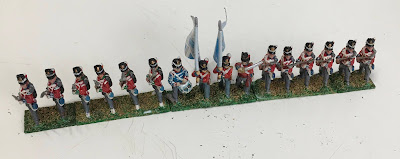
British Line Infantry - Just spotted that I have mixed two poses together

The British also have Highlanders and Fusiliers in bearskins (I know they didn't campaign in those but I'm not changing them) and allied Portuguese infantry, but no Light Infantry or Cascadores.  Some of the flags will need replacing as they have faded while waiting for me to be able to collect them but no other touching up is required

I'm less clear about the identity of the Hussar units but a bit of research should sort that out!

Might not even be hussars, although they do have Pelmans


More unidentified Hussar types

The next horsemen I do know.

French Dragoons - There are two units of these

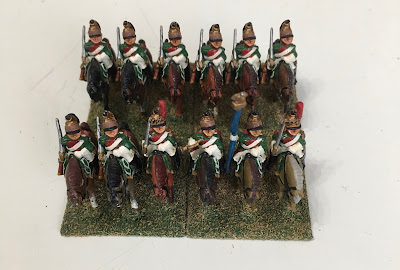
The next up are French Gendarmes of the Guard (I think)

Gendarmes 

Last but not least French artillery.  The cannon is loose so it can be attached to the limber as required.


Just a part of the artillery!  

If you look back on the display case shots you will see that these are only a sample of the figures.  They are all painted and based to the same standard.  All I need to do is decide on a set of rules.  I have had more recommendations for Paddy Griffith's Napoleonic Wargaming for fun than any other set so they will be my first set to try out.  If I like them they will also be the last.  Not God's own scale but they do have a charm all of their own, even if there is an element of a few chaps taking a flag for a walk at this scale!


Thursday, 9 December 2021

Napoleonic's in 15mm - surely not!

Yes I know I'm generally a 6mm or smaller guy and I have very limited experience with horse and musket gaming, but.   A friend from the re-enacting world passed away a pre-covid and left me a bequest.  Because of the covid restrictions and my own health situation I only picked them up from his executor last weekend.  Almost 600 Anglo-Portuguese and French  infantry, and 150 plus cavalry with artillery and a couple of supply wagons.  All painted to a decent standard and with a pair of display cases to boot.  So I should really do something with them I suppose.

Having the figures led me down that rabbit hole which is Napoleonic uniforms as I tried to identify what I had.  The Anglo-Portuguese are reasonably straight forward but the French, oh dear.  I have figures with Plumes, others with Pom Poms and Carabinier companies for Light Infantry battalions in Bearskins as well as shakoes.  Let's just say it's been a steep learning curve working out which figures belong with which formations.  I think I have my head around it now.  Cavalry is just as bad plus I have rogue unit of Spanish Dragoons that don't seem to fit anywhere in the rest of the Orbat!  I'm sure I will get the hang of it the question is whether a future of slow and steady decline into button counting now awaits me. 

Monday, 6 December 2021

The battle of Timerton - a 2mm ECW play test

 I have been telling you about the rules for what seems like ages,  certainly my researching and writing has been going on for at least the last decade!  But, at long last I have a finished draft so that's another thing off the objectives for 2021.  Shame about all the others.

The Jolly Broom Man of the Mud, Blood, and Iron blog has kindly run a number of independent play tests and tells me that he was able to follow the rules as written and couldn’t break them.  Better yet he didn’t find any outcomes which he felt were wrong.  that is particularly important to me as JBM knows his stuff when it comes to pike and shot warfare.

So with that first play test results under my belt, I tidied up a couple of turns of phrase I found clunky and moved a couple of rules to different locations in the text so concepts which belonged together were actually together in in the rules.  Like a light turning on suddenly they were done (unless further independent play tests throw a spanner into the works).  JBM suggested running a solo game to create an after action report to see what interest it generated so here goes.

The rules split into two separate areas; pre battle and the actual tabletop fight.  That first area is very much my attempt to force players to consider the decisions a 17th century general had to make before fighting started (along with stuff that we have to do to allow a wargame to happen like selecting forces)  as these had a knock on effect on the fight that would follow.  This part of the play test covers that initial pre battle part of the game.  I’m doing this solo so the description of the pre battle stage is a bit one sided as I am trying to keep my self in the dark as to what I will be facing.

First I created an army and drew up a standard deployment plan.  This was fairly generic with a cavalry brigade on each wing and two foot brigades in the centre.  The army is using German doctrine.

The deployment map - different colours denote the separate commands

The army is a generic 1643 force with relatively low levels of training and experience.   It totals 2,050 horse, 4,300 foot and 4 guns divided into 4 brigades.  It has 4 brigade commanders plus an army commander (who isn't shown on the deployment map).

17th century armies drew up a proposed deployment which was intended to be used if a battle was imminent.  This allowed an order of march to be determined which allowed a quick deployment into battle formation.  The rules require the players to do the same.  It is a kind of bluff and counter bluff as neither side knows how the other is going to deploy in advance.  Scouting results provide some advance information on the number of battalia/squadrons the enemy has, as well as a rough idea of numbers.   With that information in hand players can amend the deployment plan within limits.  In reality it was hard to do this in the face of the enemy so the options under the rules are restricted.  Late arrivals may not be able to take their proper place in the deployment (as was the case with Newcastle's Tercio at Marston Moor) and unexpected re-enforcements are similarly restricted to where they will be deployed.

Every unit has a Combat Effectiveness value which is a measure of the units ability to continue fighting.  To calculate the unit Combat Effectiveness (CE) levels Troop training and experience levels have been allocated and  calculated. It is a key value for reaction tests and the traits which influence the CE value also have other effects during the battle part of the rules.

As 2mm figures are cast as blocks there is no scope for figure removal so the unit’s continuing ability to fight must be measured in a different way.  This is by using a “Combat effectiveness” rating (CE).  The starting CE derives from a small number of factors including the units training and experience and is calculated pre battle.  Each unit starts with a CE value of 5 which is adjusted upwards or downwards by selecting a level of training and experience and in some cases status, using the factors below to calculate the initial CE rating: 

Training

Untrained

 -1

Trained

  0

Well Trained

+1

Professionals

+2

Experience

Raw

  0

Experienced

+1

Veteran

+2

Status

Elite

+1

Unwilling

-1

 The initial rating will range between 3 (Nervous) and 10 (Keen) and will be shown by a colour coded marker.  Tihe top of the marker shows the description and the underside the actual CE value.  Each description will cover a number of actual CE scores to add to the fog of war.

If players want a balanced game the overall value of the army needs to be known so that the two sides can have broadly the same points total.  This is calculated by taking the initial CE of each unit in the army and multiplying it by the number of bases in that unit.  Adding all those scores up is the value of the army which is actually the number of hits required to reduce every unit in the army to a CE of zero.  On top of that there is a budget for the armies command structure.  This is set at 10%  of the army value as calculated above.  Different armies have a different base cost for a general with the median cost being five.  Armies with a poorer command and control capability have a higher base cost which comes from the 10% command budget leaving less to spend on command traits.

Each separate field command must have a general.  This starts with the Army commander and then goes down to wing, centre, reserve level ( those formations above brigade and tercio level) down to brigade & squadron level.  A chain of command must be defined when the army is being selected.  

Generals are the source of reaction test adjustments and command and control influences.  They have traits covering ability to issue orders, situational awareness and reaction test adjustments and can adjust combat di rolls if fighting with a unit.  Changes of orders must flow down the chain of command, although formation commanders and even individual regiments can attempt to react to events unfolding around them by taking a reaction test to change their current orders.

This army has a total value of 561 points so my budget for generals is 10% of that which is 56.1 so lets call that 56 I have assigned a command cost of 5 for generals.

Then I created standing orders using the generic examples in the rules.  These determine things like how long may a unit hold defensive fire for or when will it pursue and how long for.   These are determined by the unit's experience rating.

Terrain came next with random selection and placement being used for this battle.  This has created an …er, ‘interesting’ battlefield.  Definitely not what I would have come up with left to my own devices.  The deployment rules allow for troops to be placed behind a line half way from the relevant table edge and the centre line and covering half the length of the table measured as being an equal distance either side of the centre line.  In this case that is one square (30cm) into the table from the long edge and three squares along that edge centred on it's half way point (also known as I forgot to mark the deployment areas on the map).

The battlefield.  
Parliament deploys at the upper edge Royalists at the lower.  In the top right is an area of scrubland a road runs from upper to lower edges with a track connecting the village to the road.  That village has enclosed fields around it.  A river runs from the central area to the lower edge and a narrower stream runs up to the top left corner.  Two hills complete the layout.

To select random terrain the table is divided up into 15 - 30 cm (call it 6 to 12 inch) squares and a playing card is drawn for each square.  Number cards of any suite are open ground.  Any picture card or joker shows a terrain feature exists in that square.  if that is a river or stream it starts in that square and runs to a random table edge.  Lastly a road will run between random points on the two long edges.

In a two player game scouting totals and force details (adjusted for scouting results) would have been exchanged at this point.  This would provide an indication of the strength of each army to the enemy giving rough totals for horse, foot and guns and the numbers of bodies of each.  Those totals would be adjusted upwards or downwards according to the scouting results.  As I am going to play solo I am not doing this instead I’m going to assume neither side is gaining an advantage as that keeps me in the dark for longer.

Last comes the deployment of forces to the table and writing orders.  The rules aim to keep the fog of war in place for as long as possible.  Both sides must first deploy their army commander base.  All other units are positioned as shown in the deployment map around him.  The distances between units should match that on the deployment map.  If a side is classed as out scouted, they must deploy their front-line units first along with any pike bases that could be seen from the enemy commander’s position.  At this point some adjustment of unit placement is allowed.  

Orders are now written for all units these consist of three components:

  • A target unit or location they are to move towards
  • Speed of action - how fast they will close on the target or a hold position order
  • Action on arrival
Plus a fourth option may be included a delay to commencement either to a set time or until a specified event occurs.  Players have 15 minutes to do this but may extend this period by mutual consent.  Once orders are written they are binding until new orders are issued or a reaction test is taken to allow a change of orders on a unit's own initiative.

That's the pre-battle stage it looks cumbersome and time consuming but I'd note two things.  Firstly it took me longer to write this post then it did to create an army, it's deployment plan and CE value.  Drafting Standing orders can be done in advance and will be standardised based on the arm of service (horse foot etc) and their experience.  The battlefield orders take a little longer but not a great deal.  Secondly all the army values and orders can be dropped as long as you know the CE of each unit, it's training style, experience and if relevant if it's status (if it is elite or unwilling).

Lastly I created an opposition for the parliamentarians to fight.  This worked out at as 11 Squadrons of horse, 5 battalia of regiment and a single gun.  it has a value of 571 and a command value of 6 (for no other reason than I wanted to see what effect a difference in command traits will create in game play.

In the next post I will detail the standing orders, and battlefield orders and start the after action report.  I'm off to set up the table now. 


Tuesday, 23 November 2021

Making Chilli Jam (again) and some terrain builds

As it is now officially the run up to Christmas I made a batch of Sweet Chilli Jam over the weekend using the recipe I posted here  https://elenderilsblog.blogspot.com/2018/10/chilli-jam.html.  It has come out nicely and one pot has already been eaten!  

In other news Mrs E and I have had our annual flu jabs and the booster Covid jab this week.  I felt a bit under the weather the following day but nothing too extreme and no unexpected side effects such as a constant need to tell Amazon what I'm thinking of buying next!.  Sadly the expected wi-fi boost from the first two jabs never materialised either.  I blame the quality of conspiracy theorists we get now a days!

Its a new product to me but I like it so far

I have started on making some extra river sections using the gasket rubber I purchased a couple of months ago.  I'm glad to report that some of the smell has worn off that so my painting table no longer smells like a tyre fitting shop (I was actually starting to like it which is a bit worrying).  The stuff is really easy to work with.  It cuts using scissors, takes glue well and still flexes after the first coat of spray paint.  I used good old UHU clear glue along the edges and then sprinkled fine sand over it to show where the banks are.  I then primed it with a new spray paint I bought at Hobbycraft - Montana cans Gold NC acrylic in 'sand'.  It sprays well and seems to work at least as well as Humbrol rattle cans but is in a bigger can, although more expensive so it evens out.  It seems easier to obtain the shades I need than the Humbrol range which always seem to be out of stock.  Oddly they don't come with a snap on top though.  All the cans are this gold colour with the actual shade being shown on the domed bit below the nozzle.  

First stage completed now to paint in the wet stuff

I need to sit down and paint in the water and then give it a coat of high gloss varnish, dry brush the banks in a grass green and brown mix and add a few clumps of foliage to finish them, but like everything else post retirement I never seem to have enough time!  I really need to knuckle down and stop wasting time on important jobs around the house!  I also found a supply of high density foam in 5mm thick sheets which is perfect for making hills for 2mm gaming, so once those pesky important jobs are done I will be testing the spray paint on that prior to hill raising.

Thursday, 4 November 2021

More on the 2mm ECW project

I am making progress on this, again!  My handwritten amendments on the last printed version are being added to the MS Word version and I have learned how dynamic cross links are meant to work in Word.  I say supposed to work as I haven't actually tried that out yet but will be doing so in the next few days once all the amendments are done.

The exciting part is that an initial version has gone out for playtesting with the Jolly Broom Man doing the initial honours.  So far he hasn't said he never wants to see them ever again which is a positive and he has been able to play a game just from the written rules, so what I have written must be partially intelligible!  JBM has asked a couple or ten questions to clarify some points which is, of course, the whole point of play testing.

The last technical issue I am wrestling with in the game mechanics is calculating the extent of dead ground behind hills when observers and observed are at different heights and distances to an intervening hill.  I hate trigonometry and consider that it has no place in a set of rules so I'm working out a fudge to give some kind of approximation to the real answer.  I could suggest the use of laser pointers, periscopes or mobile phone cameras but I suspect it would create arguments about the accurate placement of whatever tool is used.  I may go for the low tech solution of a piece of string as a testing device yet!

Other than that, unless JBM spots any mayor issues, the rules are about there which will allow me to reduce the deficit in the 2021 to do list.  On that topic I really need to start painting again before I forget which end of the paint brush to use!


Wednesday, 20 October 2021

2mm ECW rules update

 I really don't recall when I first started work on these, other than to say I'm pretty sure it was this century sometime!  Probably around 2004 if I'm honest.  The original idea was to create a set of rules to allow a refight of Naseby using 2mm figures, with a 1:1 relationship between figures, unit foot prints and terrain.  The initial ideas were based on the use of Irregular Miniatures blocks so figure removal was never an option and I turned to a reducing willingness to fight as a measure of a unit's degrading combat effectiveness.  Some of the terrain effects were intended to replicate the impact of the terrain at Naseby and I only really looked at the weapons in use in the major field armies, at least to start with.  As these things do a hint of madness crept in, the pursuit of the one ruleset to rule them all kind of thing, and I started to expand the scope of the basic design.

There have been a couple of lengthy hiatuses in the development of the rules and a lot of new sets have come and gone in the mean time.  I have since retiring actually been working on bringing the loose collection of concepts and mechanisms into a coherent system, or at least what I think is a coherent system.   I have simplified aspects, notably the combat mechanisms and simplified terminology in places but the core systems and concepts have stood up remarkably well to a couple of decades of visiting and revisiting.

As a result I'm going through a final  editing process before passing copies out for play testing.  It will be a while yet as I'm not the fastest typist and I struggle with the section numbering system in Word, but what I am doing now is tidying up not redesigning.  So if anyone would like to assist with play testing please let me know via my google email account as shown at the top of the page.

Thursday, 30 September 2021

Sorry about the blogging slow down

You may have noticed a reduction in the frequency of blog posts recently.  This has been because I have found that rather than having more time after I retired, I seem to have less, quite a lot less.  Uncompleted hobby projects are stacking up and I will definitely fail to meet some of this years hobby targets partly due to loosing a couple of months either side of my heart surgery and partly because the back log of "things I will eventually get around to after I retire" (TM pending) is being addressed.  On top of which having more time has allowed me to contemplate restarting hobbies which took a back seat before retirement, which of course restricts the time available to those hobbies which were prioritised while I was still working.

I have picked up some of my musical hobbies; playing Bodhran, Mandolin and Guitar (note I said playing, not playing well) and photography.  We have even started to attend some of the acoustic music sessions in the local pubs which is a torture when I'm not allowed alcoholic beverages!  Plus we have finally gotten around to taming the contents of the garage (or in some cases simply locating them).  Trips to the local recycling centre seem to be a regular occurrence as we pare down the garage contents. Other stuff is going on Facebook market place or to the family, I mean really how many pressure washers does a man need?  On the plus side I can actually see the garage floor again, on the down side it needs painting.

Even the dogs seem to recognise that I'm not sat working from 9.00 to 5.30 and expect more and longer walks!

Hopefully things will pick up again once the back log is cleared.